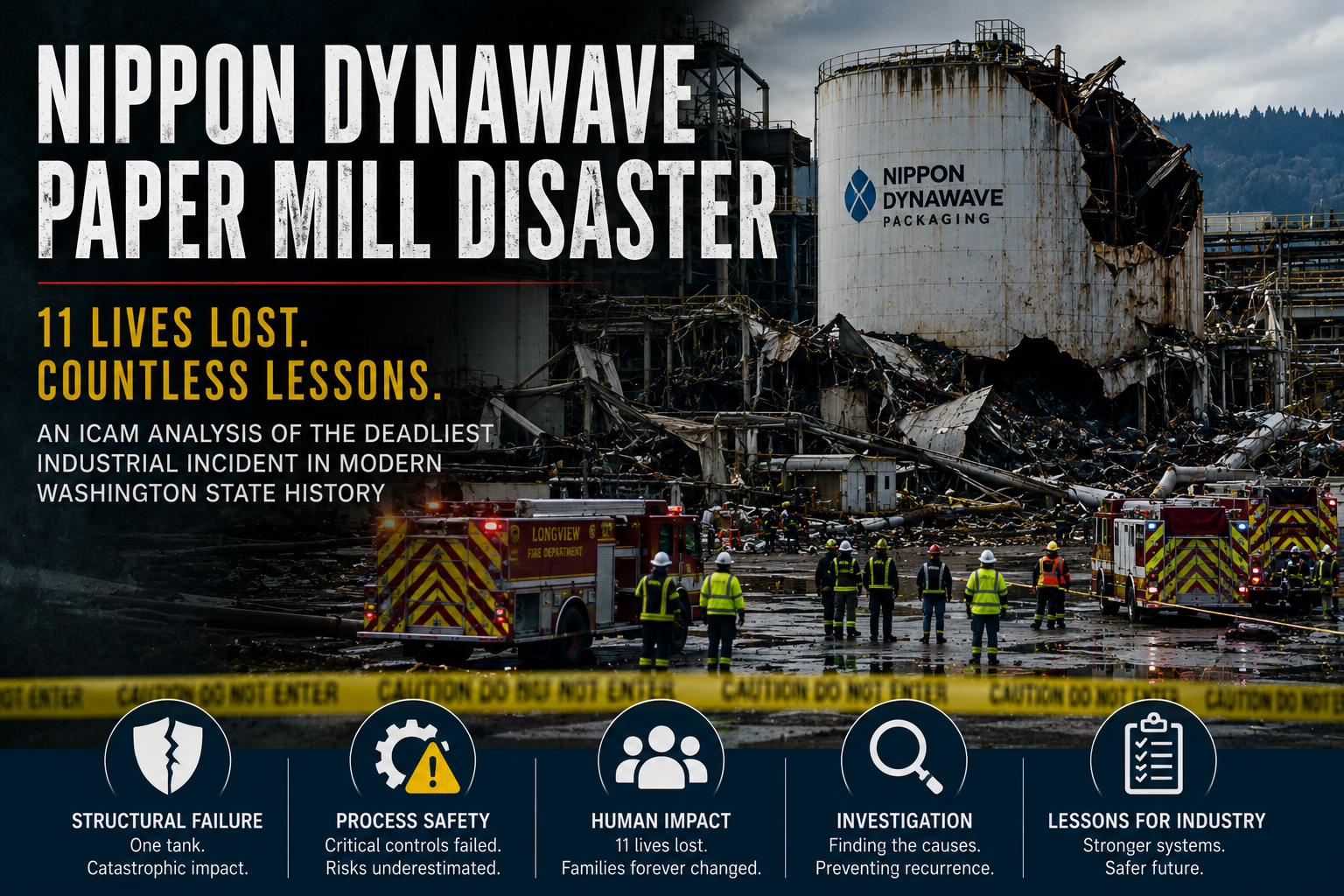
On 26 May 2026, a catastrophic industrial incident occurred at the Nippon Dynawave Packaging paper mill in Longview, Washington. A large storage tank containing approximately 900,000 gallons (3.4 million litres) of white liquor—a highly caustic chemical used in paper manufacturing—failed catastrophically, resulting in the deaths of 11 workers and injuries to several others. The incident is believed to be one of the deadliest workplace disasters in modern Washington State history.
The scale of the event shocked the manufacturing sector and has prompted widespread discussion about process safety, asset integrity, and the management of major industrial hazards.
While the official investigation remains ongoing, the incident already provides important lessons for organisations operating facilities that store or process hazardous substances.
What Happened?
According to publicly available reports, the incident occurred during the early morning hours around a shift change period. A large process tank containing white liquor suffered a catastrophic failure, releasing a significant volume of hazardous chemical solution and causing extensive structural damage throughout the surrounding area.
White liquor is a corrosive chemical mixture commonly used in the kraft pulping process. In addition to causing severe chemical burns, large-scale releases can create challenging emergency response conditions due to contamination, visibility issues, and ongoing structural hazards.
Recovery operations continued for several days as emergency crews worked to locate missing workers and stabilise the damaged facility.
Understanding the Incident Through an ICAM Lens
The Incident Cause Analysis Method (ICAM) focuses on understanding how organisational, technical, and operational factors combine to create pathways to failure.
Rather than looking for a single mistake, ICAM examines why multiple layers of defence failed simultaneously.
Failure of Primary Containment
The most obvious failure was the storage tank itself.
Industrial chemical tanks are designed to safely contain hazardous materials under a wide range of operating conditions. The fact that the vessel catastrophically failed suggests a significant breakdown in one or more areas, including:
- Structural integrity
- Corrosion management
- Engineering design
- Maintenance activities
- Inspection programs
- Operational conditions
While investigators have not yet identified the exact failure mechanism, the tank’s inability to contain its contents represents the first critical defence that failed.
Asset Integrity Management
One of the key areas likely to be examined is asset integrity management.
Large industrial vessels require regular inspection, maintenance, and condition monitoring throughout their service life. Effective asset integrity programs typically include:
- Corrosion monitoring
- Thickness testing
- Structural inspections
- Risk-based maintenance planning
- Fitness-for-service assessments
A common theme in major industrial disasters is the presence of latent defects that remain undetected until a catastrophic event occurs.
Investigators will likely examine whether warning signs existed and whether those signs were recognised and addressed appropriately.
Process Safety Controls
Facilities handling hazardous chemicals rely on multiple layers of protection.
These controls may include:
- Monitoring systems
- Pressure and level controls
- Alarm systems
- Emergency shutdown systems
- Engineering safeguards
The severity of the incident suggests that either the initiating event occurred too quickly for these controls to prevent escalation or the controls themselves were ineffective.
This will likely be a major focus of the investigation.
Potential Contributing Factors
Although definitive conclusions cannot yet be drawn, several factors commonly associated with major process safety incidents may be relevant.
Ageing Infrastructure
Many pulp and paper facilities operate equipment that has been in service for decades.
As assets age, organisations face increasing challenges associated with:
- Corrosion
- Material degradation
- Historical modifications
- Increased maintenance requirements
Without effective ageing asset management strategies, the likelihood of significant failures can increase over time.
Organisational Oversight
Major hazard facilities require strong governance systems that ensure critical risks are identified, monitored, and controlled.
Questions investigators may explore include:
- Were inspections completed as required?
- Were identified defects appropriately managed?
- Were maintenance activities prioritised effectively?
- Were critical risks regularly reviewed by leadership?
Major incidents often reveal weaknesses not only in equipment but also in decision-making and organisational oversight.
Shift Change Exposure
Reports indicate the incident occurred during a shift transition.
While shift change is unlikely to have caused the event, these periods often involve increased worker movement and occupancy levels. As a result, more workers may have been exposed when the tank failed.
Key Lessons for Industry
Regardless of the final investigation findings, several lessons are already emerging.
1. Strengthen Asset Integrity Programs
Organisations should ensure storage tanks, vessels, and critical infrastructure are subject to robust inspection and maintenance programs.
Critical assets should be monitored based on risk, not simply age or inspection schedules.
2. Verify Critical Controls
Businesses should routinely verify that safety-critical controls are functioning as intended.
The presence of a control on paper does not guarantee it will prevent an incident.
3. Manage Ageing Assets Proactively
Ageing equipment requires ongoing assessment and investment.
Businesses should have formal strategies for:
- Condition monitoring
- Life-extension assessments
- Equipment replacement planning
4. Improve Process Hazard Analysis
Facilities handling hazardous substances should regularly review major hazard scenarios using recognised methodologies such as:
- HAZOP studies
- Bowtie analysis
- Layer of Protection Analysis (LOPA)
These reviews help identify emerging risks before incidents occur.
5. Strengthen Emergency Preparedness
Major chemical releases can quickly overwhelm conventional emergency arrangements.
Businesses should regularly test:
- Emergency response plans
- Evacuation procedures
- Communication systems
- Incident management capabilities
Final Thoughts
The Nippon Dynawave disaster serves as a tragic reminder that catastrophic industrial incidents remain possible even within mature industries.
Although the paper manufacturing sector has a long history of managing hazardous processes, large inventories of chemicals, ageing infrastructure, and complex operations continue to present significant risks.
As investigators work to determine exactly what happened, the broader lesson for industry is already clear.
Major workplace disasters rarely result from a single failure. They occur when multiple safeguards, systems, and organisational defences break down simultaneously.
The challenge for every organisation is ensuring those weaknesses are identified before they align.
Disclaimer
This article is provided for educational and informational purposes only. It is based on publicly available information and general process safety principles. Official investigations into the Nippon Dynawave incident remain ongoing, and the causes and contributing factors discussed in this article are preliminary assessments rather than confirmed findings.
Nothing in this article should be interpreted as a legal determination of fault, liability, negligence, or regulatory non-compliance. Readers should consult official investigation findings and seek advice from appropriately qualified professionals when assessing similar risks within their own organisations.
Leave a Reply