Category: Uncategorized

  • Legislative Updates

    Legislative Updates

    Seven Health & Safety Legislative and Regulatory Developments Employers Should Be Watching

    Health and safety legislation continues to evolve as governments respond to emerging risks, regulatory pressures and changing expectations around workplace protection. Over recent weeks, a number of significant developments have emerged across several jurisdictions, ranging from major reforms of occupational safety legislation to new approaches to heat exposure, electrical safety, building safety and chemical regulation.

    Not all of the developments covered below represent legislation that has already come into force. Some are enacted reforms awaiting implementation, proposed regulatory changes, or government programmes that indicate where occupational health and safety regulation is heading. For employers operating internationally, these developments are worth monitoring because regulatory approaches adopted in one jurisdiction can often influence wider industry expectations.

    1. New Zealand – Major Overhaul of Health & Safety Legislation

    Health and Safety at Work Amendment Act 2026
    Royal Assent: 9 July 2026
    Main provisions take effect: 1 April 2027

    New Zealand has enacted a significant reform of its health and safety legislation through the Health and Safety at Work Amendment Act 2026. The legislation introduces a stronger focus on “critical risks” – risks capable of causing death, serious injury, serious illness, occupational disease or other serious harm. The stated intention is to encourage businesses to prioritise the risks with the greatest potential consequences rather than treating every workplace risk as requiring the same level of regulatory attention.

    The reforms also seek to provide clearer expectations for businesses and strengthen the role of Approved Codes of Practice. The changes are particularly relevant to smaller businesses, with the legislation introducing a framework that gives greater emphasis to critical risks and proportionality. Most of the substantive changes are scheduled to come into force on 1 April 2027, giving businesses time to understand the new requirements and adjust their systems.

    Why this matters

    The New Zealand reforms are particularly interesting because they reflect an increasingly common debate in health and safety: should organisations concentrate their greatest resources on the risks capable of causing catastrophic harm, rather than attempting to manage every conceivable risk to the same degree?

    This is also an important development in the context of work at height. World Safety News has previously examined concerns surrounding proposals to introduce a three-metre threshold for certain work-at-height requirements. The final reforms therefore warrant continued monitoring to understand how the critical-risk approach will operate in practice.

    2. Queensland, Australia – New Electrical Safety Regulation

    Electrical Safety Regulation 2026
    Commencement: 1 September 2026

    Queensland is replacing its existing Electrical Safety Regulation 2013 with a new Electrical Safety Regulation 2026, which comes into effect on 1 September 2026. WorkSafe Queensland states that the new regulation does not introduce new policy or regulatory obligations, but instead restructures and clarifies the existing requirements to make them easier to navigate, understand and apply alongside the Electrical Safety Act 2002.

    The change follows the statutory review of the existing regulation. Although employers should not expect a fundamental change to Queensland’s electrical-safety framework, the replacement regulation provides an opportunity for businesses to review their existing procedures and ensure that internal references, systems and compliance documentation remain aligned with the new legislation.

    Why this matters

    Regulatory changes do not always mean new obligations. Rewriting and restructuring legislation can nevertheless be important because employers, supervisors and safety professionals need to understand where existing requirements have moved and how they are expressed in the replacement regulation.

    3. California, United States – Proposed Changes to Heat Illness Regulations

    Cal/OSHA Heat Illness Prevention Standards
    Latest draft: 14 August 2026
    Consultation deadline: 21 September 2026

    California is continuing work on revisions to its workplace heat-illness regulations. On 14 August, Cal/OSHA published a further revised draft standard covering both outdoor and indoor heat-illness prevention requirements and invited interested parties to submit comments by 21 September 2026.

    The proposed changes are being developed under California’s Assembly Bill 2243 and seek to revise and align the state’s existing heat-illness requirements. They do not represent legislation that has already come into force; rather, they are part of an ongoing regulatory process. California already has extensive heat protections, including requirements relating to water, shade, cool-down areas, rest breaks, training and heat-illness prevention planning.

    Why this matters

    Heat exposure is becoming an increasingly important occupational safety issue internationally. California’s approach is therefore worth watching beyond the state’s borders, particularly as governments consider how workplace regulation should respond to increasingly frequent periods of extreme heat.

    The development also demonstrates how regulators are increasingly considering indoor as well as outdoor heat exposure, recognising that warehouses, manufacturing facilities and other enclosed workplaces can present significant thermal risks.

    4. United States – OSHA Continues Major Regulatory Programme

    Key areas: Heat, emergency response, tree care and hazard communication

    The US Occupational Safety and Health Administration (OSHA) continues to progress several major areas of regulatory activity. Its current regulatory programme includes proposed rules concerning heat injury and illness prevention, emergency response and tree-care operations, alongside ongoing work concerning hazard communication.

    At the same time, OSHA is pursuing a number of deregulatory initiatives, including proposed amendments affecting requirements within the respiratory protection standard. Public hearings are taking place during August on some of these proposals.

    This creates an interesting regulatory picture. The US is simultaneously considering stronger or more specific requirements for emerging and high-risk hazards while reviewing other requirements with the intention of reducing regulatory burden.

    Why this matters

    The direction of US OSHA regulation is particularly important for multinational organisations because OSHA standards frequently influence corporate safety expectations well beyond the United States.

    The development also raises a broader question for safety professionals: how can regulators reduce unnecessary administrative requirements without weakening controls around genuinely critical risks?

    That question is increasingly relevant internationally and mirrors some of the themes emerging from the New Zealand reforms.

    5. United Kingdom – Building Safety Levy to Take Effect

    Building Safety Levy
    Commencement: 1 October 2026
    Jurisdiction: England

    The UK’s Building Safety Levy is scheduled to come into effect on 1 October 2026. The levy will apply to relevant residential developments in England, subject to specified exemptions, with funds being used to support the remediation of building-safety defects.

    The levy represents another component of the UK’s continuing response to the building-safety failures exposed by the Grenfell Tower fire. It will apply to relevant building-control applications submitted from 1 October and is intended to ensure that the development industry contributes towards addressing building-safety defects.

    The introduction remains contentious within the construction sector. Housebuilders have recently called for a further delay, arguing that the additional cost could affect the viability of some developments. The Government continues to support implementation of the levy.

    Why this matters

    Although the levy is not a conventional workplace health and safety regulation, it forms part of one of the UK’s most significant building-safety reforms in decades.

    For developers, contractors and other organisations involved in residential construction, it represents another financial and regulatory consideration arising from the UK’s post-Grenfell building-safety framework.

    6. United Kingdom – Government Pushes for a More Agile Chemicals Regulatory System

    Government programme: HSE Regulation Action Plan 2026–27

    The UK Government has identified the development of a more agile chemicals regulatory system as one of its priorities for the Health and Safety Executive during 2026–27. Under the Government’s Regulation Action Plan, HSE is expected to develop changes to the regulatory framework through a statutory instrument during the current financial year.

    The programme forms part of a wider government objective to make regulation more responsive while maintaining appropriate protections. The HSE’s work includes areas of chemicals regulation and is intended to provide a framework that can respond more effectively to developments in industry and technology.

    This should not be interpreted as a completed change to UK chemical-safety law. Rather, it represents a government policy direction and planned regulatory reform that businesses involved in chemical manufacture, import, storage or use should monitor.

    Why this matters

    Chemical regulation can be complex, particularly for businesses operating across multiple jurisdictions. Any move towards a more agile regulatory framework could have implications for how chemical hazards are assessed, controlled and communicated.

    Given the number of significant chemical and gas-related workplace incidents being reported internationally, this is an area where regulatory effectiveness remains particularly important.

    7. India – Occupational Safety Framework Continues to Develop

    Occupational Safety, Health and Working Conditions Code 2020

    India’s major reform of occupational safety legislation continues to develop through the implementation of the Occupational Safety, Health and Working Conditions Code 2020 and associated Central Rules.

    The Code represents a major consolidation of India’s previous occupational safety legislation, bringing multiple laws into a single framework intended to simplify compliance and provide greater consistency across industries and jurisdictions. The Central Rules were notified in May 2026, forming part of the continuing implementation of India’s wider labour-code reforms.

    The reforms cover a broad range of issues including occupational safety and health, working conditions, welfare arrangements, contract labour and other employment-related requirements. State-level rules and implementation remain important because responsibilities can differ depending on which government is the appropriate authority for a particular establishment.

    Why this matters

    India’s labour-code reforms are among the most significant changes to the country’s employment and occupational-safety framework in decades. For companies operating across India, the transition from multiple historic laws towards a consolidated framework could have substantial compliance implications.

    The reforms are also particularly relevant to international businesses because India has one of the world’s largest and most diverse industrial workforces.

    What Do These Changes Tell Us About the Direction of Health & Safety Regulation?

    Although these seven developments come from very different jurisdictions, several common themes emerge.

    1. Greater focus on critical risk

    New Zealand’s reforms are perhaps the clearest example of governments attempting to concentrate regulatory effort on hazards capable of producing catastrophic outcomes. The same concept can be seen indirectly in regulatory discussions elsewhere.

    2. Heat is becoming a mainstream occupational safety issue

    California’s continuing work on heat regulations, combined with OSHA’s federal heat rulemaking, demonstrates that heat exposure is moving increasingly towards the centre of occupational safety policy in the United States.

    3. Regulators are trying to balance protection with regulatory burden

    Both New Zealand and the United States are wrestling with the same fundamental question: how can regulation remain effective without creating unnecessary administrative requirements?

    That is potentially one of the defining occupational-safety policy debates of the coming decade.

    4. Building safety remains a major government priority

    The UK’s Building Safety Levy demonstrates that the regulatory consequences of major disasters can continue for many years. The focus has shifted from the immediate causes of Grenfell towards funding remediation, strengthening accountability and changing how buildings are designed, constructed and maintained.

    5. Chemical and industrial hazards remain firmly on the regulatory agenda

    The UK’s planned chemicals reforms demonstrate that governments continue to view chemical regulation as an area requiring both strong protection and greater regulatory flexibility.

    What Should Employers Be Doing?

    For employers operating in these jurisdictions, the most important point is that not every announcement represents an immediate new legal requirement.

    Businesses should distinguish between:

    • legislation already in force;
    • legislation that has been enacted but has a future commencement date;
    • proposed regulations;
    • consultations;
    • government policy announcements; and
    • longer-term regulatory programmes.

    The appropriate response will therefore depend on the jurisdiction and the specific development.

    However, organisations with international operations should consider maintaining a regulatory horizon-scanning process so that forthcoming changes can be identified early rather than discovered when a new requirement has already taken effect.

    World Safety News – Legislative Update

    Health and safety legislation is rarely static. Governments are continually adjusting regulatory frameworks in response to changing technology, emerging hazards, major incidents and concerns about the effectiveness or proportionality of existing requirements.

    For safety professionals, the challenge is not simply knowing what the law says today. It is understanding where regulation is heading and what that may mean for the way organisations manage risk tomorrow.

    World Safety News will continue to monitor significant legislative and regulatory developments internationally, including new laws, consultations, enforcement priorities and changes to established safety requirements.

    This article is provided for general information and does not constitute legal, regulatory or professional advice. Legislative and regulatory requirements vary between jurisdictions and may change. Organisations should consult the relevant government agency, regulator or qualified professional to determine the requirements applicable to their specific circumstances.
  • Incident Deep Dive Report

    Incident Deep Dive Report

    Liuyang Fireworks Factory Explosion — Hunan Province, China

    4 May 2026

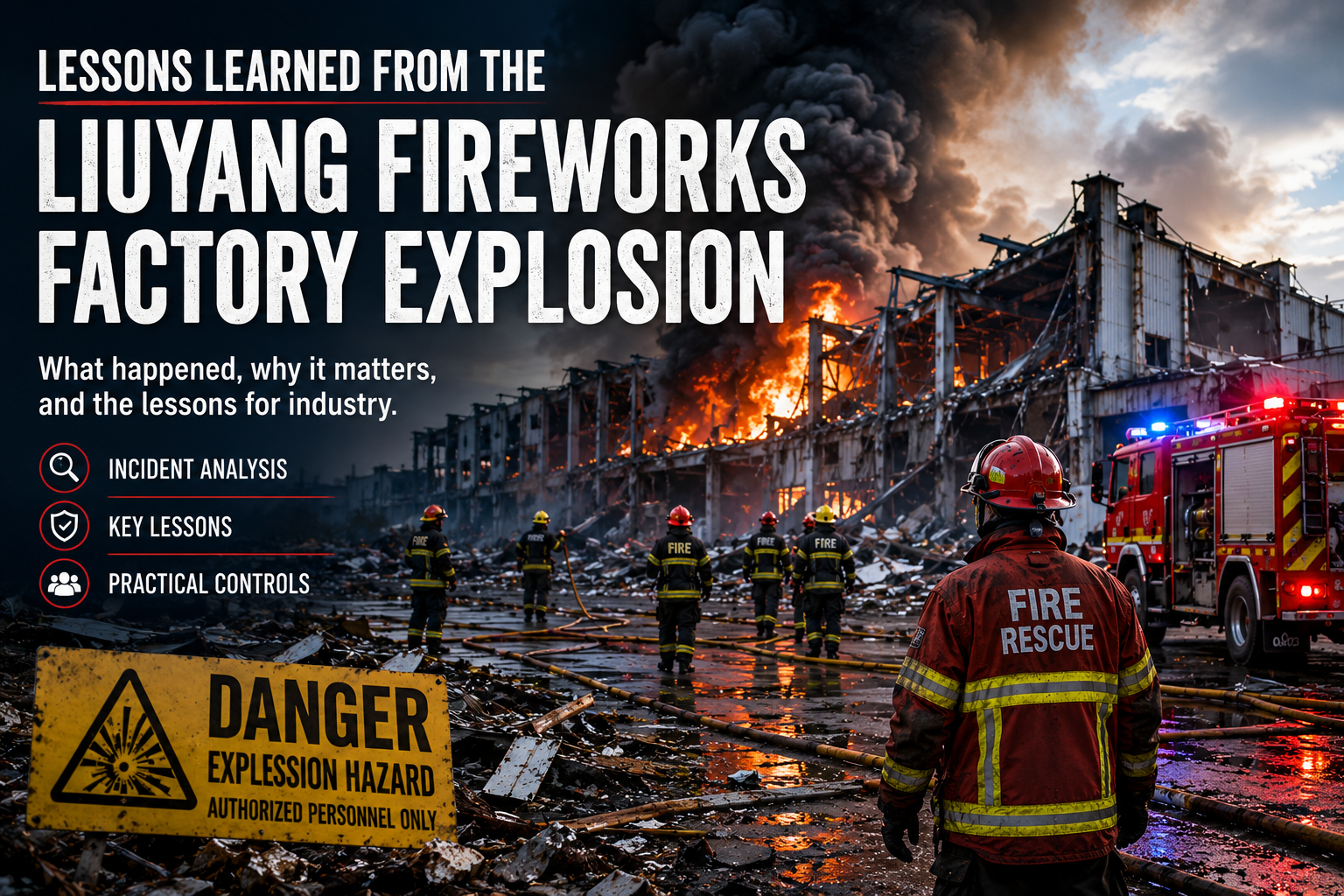
    On 4 May 2026, a catastrophic explosion occurred at the Huasheng Fireworks Manufacturing and Display Company facility in Liuyang, Hunan Province, China — an area widely regarded as the country’s “fireworks capital.” Initial reports confirmed at least 26 fatalities and 61 injuries, with the final death toll later rising to 37 people, making it one of China’s deadliest industrial explosions in recent years.

    The explosion reportedly occurred at approximately 4:40 pm local time inside a workshop area of the facility. Multiple secondary explosions followed after fireworks products and semi-finished pyrotechnic materials ignited across the site. The blast flattened buildings, uprooted trees, shattered windows in nearby villages, and scattered debris over a wide area.

    Rescue operations were significantly complicated by the presence of highly combustible black powder stored in warehouse areas near the explosion site. Authorities deployed more than 1,500 emergency responders, including firefighters, rescue personnel, drones, robots, and specialist response teams. Nearby residents were evacuated due to concerns about further explosions and environmental hazards.

    Although the official cause remains under investigation, several contributing risk factors have already emerged from media and regulatory reporting. Investigators confirmed the company had previously been cited for safety violations, including the dangerous mixing of reducing agents and oxidisers within workshop areas — a practice known to significantly increase ignition and explosion risk in pyrotechnic manufacturing. Reports also identified substantial quantities of explosive materials and semi-finished products stored throughout the facility, which likely intensified the scale and duration of the blast.

    The incident has again highlighted longstanding concerns regarding process safety management within high-hazard manufacturing sectors. Fireworks production presents unique operational risks due to the sensitivity of explosive compounds to friction, impact, heat, static electricity, contamination, and poor segregation controls. The repeated occurrence of similar incidents in China and elsewhere suggests that failures involving hazardous material storage, supervision, housekeeping, and operational discipline remain significant industry-wide concerns.

    The Chinese government responded rapidly following the incident. President Xi Jinping ordered a full investigation and called for strict accountability for those responsible. Authorities suspended operations at all fireworks manufacturing facilities within Liuyang while emergency inspections and wider safety reviews were undertaken. The company’s management was detained by police, and China’s State Council established a formal investigation team to examine both the immediate causes and potential regulatory failures associated with the disaster.

    Beyond the tragic loss of life, the explosion has had broader operational and economic implications. Liuyang produces approximately 60% of China’s domestic fireworks supply and around 70% of exports globally, meaning the temporary shutdown of regional factories may significantly disrupt international supply chains. The incident has also increased scrutiny on hazardous manufacturing industries across China, particularly regarding emergency preparedness, regulatory oversight, and process safety compliance.


    Key Lessons & Recommendations for Other Businesses

    Businesses involved in hazardous manufacturing, chemical handling, explosive materials, or combustible dust processes should consider the following risk reduction measures:

    1. Hazardous Material Segregation

    • Separate incompatible substances.
    • Maintain strict storage zoning.
    • Minimize quantities held within production areas.

    2. Process Safety Management (PSM)

    • Implement formal PSM systems for high-risk operations.
    • Conduct regular hazard and operability (HAZOP) reviews.
    • Establish management-of-change procedures.

    3. Housekeeping & Combustible Material Control

    • Prevent accumulation of combustible dusts and residues.
    • Maintain strict cleaning and waste removal routines.

    4. Explosion Protection & Engineering Controls

    • Install blast-resistant barriers where appropriate.
    • Introduce automated handling systems to reduce worker exposure.
    • Implement explosion venting and suppression systems.

    5. Emergency Preparedness

    • Develop realistic evacuation and emergency response plans.
    • Conduct drills regularly.
    • Establish exclusion zones around hazardous storage areas.

    6. Safety Culture & Supervision

    • Strengthen frontline supervision.
    • Encourage hazard reporting and intervention.
    • Prevent normalization of unsafe shortcuts or deviations.

    7. Regulatory Compliance & Auditing

    • Conduct independent safety audits.
    • Immediately address previous violations and near misses.
    • Ensure corrective actions are tracked and verified.

    8. Training & Competency

    • Provide specialized training for hazardous material handling.
    • Reinforce ignition source awareness and static control measures.
    • Verify competency before authorizing workers in high-risk areas.

    Conclusion

    The Liuyang explosion serves as a stark reminder that catastrophic industrial incidents are rarely the result of a single failure. Instead, they often emerge from a combination of unsafe storage practices, inadequate process controls, regulatory weaknesses, and operational complacency. For organisations operating high-risk processes, this incident reinforces the importance of robust process safety management, disciplined operational controls, and proactive hazard prevention systems designed to prevent small failures escalating into mass-casualty events.

  • A Triumphant Return

    After nearly a decade away, World Safety News is returning.

    Originally launched to share workplace safety stories, lessons learned, and industry developments from around the globe, the platform is being relaunched with a renewed focus on real-world incidents, operational insights, safety leadership, and practical learning for safety professionals everywhere.

    In an industry that never stands still, the need for clear, credible, and globally relevant safety information has never been greater. From major industrial incidents and emerging workplace risks to investigation deep-dives and lessons learned, World Safety News aims to become a trusted source of professional safety intelligence once again.

    The world of work has changed dramatically over the last 10 years — and so has the world of safety. We’re excited to begin this next chapter.

    SpaceX Starbase Construction Fatality — Texas, USA

    Incident Date: May 2026

    A worker was killed during construction activities at SpaceX’s Starbase facility near Brownsville, Texas in May 2026. The incident reportedly occurred during work associated with the company’s Gigabay expansion project. OSHA launched an investigation into the circumstances surrounding the fatality, including scaffold safety, work-at-height controls, and contractor management practices. Construction activities in the immediate area were temporarily suspended while investigators assessed site conditions and operational controls.


    Front-End Loader Collision Fatality — Victoria, Australia

    Incident Date: Early May 2026

    A 21-year-old worker died after being struck by a reversing front-end loader at a warehouse and fertilizer handling facility in Lara, Victoria, Australia. Reports indicate the worker had been cleaning fertilizer residue from a trailer when the mobile plant collision occurred. WorkSafe Victoria commenced investigations into traffic management systems, plant segregation, reversing controls, and visibility arrangements within operational areas.


    Staten Island Shipyard Explosion — New York, USA

    Incident Date: May 2026

    One worker was killed and more than 30 emergency responders were injured following an explosion and fire at a shipyard facility in Staten Island, New York. Emergency crews had initially responded to reports of workers trapped inside the facility before a secondary explosion occurred during firefighting operations. Authorities continue to investigate the source of the explosion and the potential involvement of hazardous materials or confined-space conditions.


    Manufacturing Die-Setter Fatality — Michigan, USA

    Incident Date: May 2026

    A die setter working at a manufacturing plant in Howell, Michigan died after becoming trapped between industrial dies during setup operations. Investigators are examining lifting arrangements, energy isolation procedures, suspended-load controls, and safe positioning practices during equipment adjustments. MIOSHA confirmed the case as one of Michigan’s latest workplace fatalities for 2026.


    Liuyang Fireworks Factory Explosion — Hunan Province, China

    Incident Date: 4 May 2026

    A catastrophic explosion occurred at the Huasheng Fireworks Manufacturing facility in Liuyang, Hunan Province, China on 4 May 2026. The blast triggered multiple secondary explosions involving black powder and pyrotechnic materials, resulting in at least 37 fatalities and more than 50 injuries. Chinese authorities suspended fireworks production operations across the region while investigators examined hazardous material storage, process safety management, and previous safety violations associated with the facility.


    Chemical Release Disaster — West Virginia, USA

    Incident Date: 22 April 2026

    Two workers were killed and approximately 30 others injured after a hydrogen sulfide release occurred during decommissioning work at a chemical facility in Institute, West Virginia. Preliminary reports indicate incompatible chemical reactions inside a tank generated toxic gas during maintenance activities. OSHA and emergency agencies initiated investigations into permit-to-work systems, isolation controls, and chemical handling procedures.


    Coal Mine Gas Explosion — Shanxi Province, China

    Incident Date: 22 May 2026

    At least 82 miners were killed following a major gas explosion at the Liushenyu coal mine in Shanxi Province, China. The blast occurred while 247 workers were underground and is considered China’s deadliest mining disaster in nearly two decades. Investigators identified alleged serious safety violations by the operating company, while authorities launched nationwide safety reviews across coal mining operations.


    Daejeon Factory Fire — South Korea

    Incident Date: 20 March 2026

    A major fire at a car-parts manufacturing facility in Daejeon, South Korea resulted in 14 fatalities and approximately 60 injuries. Fire rapidly spread through the facility, trapping workers on upper floors and creating structural instability during rescue efforts. Authorities initiated national reviews of industrial fire protection systems and hazardous-material management practices following the incident.


    Chairlift Maintenance Basket Fatality — Oregon, USA

    Incident Date: 30 April 2026

    A maintenance worker was killed and another seriously injured after a chairlift maintenance basket fell into rugged terrain at a ski resort in Oregon, USA. Emergency responders attended the scene following reports that the suspended maintenance platform had failed during routine servicing activities. OSHA and state investigators are reviewing work-at-height systems, maintenance controls, and equipment integrity.


    Coal Mine Vehicle Rollover Fatality — Western Australia

    Incident Date: 8 April 2026

    A 38-year-old mine worker died following a vehicle rollover incident at the King of the Hills Gold Mine in Western Australia. Reports indicate the worker was a passenger in a vehicle travelling on an access road when the rollover occurred. Mining safety authorities commenced investigations into vehicle stability, road conditions, fatigue management, and operational driving controls at the site.

  • 8th May, 2017

    8th May, 2017

    Three killed and three injured in molten steel spill

    West Bengal, India

    Three workers were killed and three others injured after the molten contents of an industrial crucible were accidentally tipped on them during works at a steel mill in Asansol early on Saturday morning. A 29-year-old worker and a 30-year-old worker were killed instantly in the incident when the molten metal poured onto them from 18m (60ft) above. Four others in the area were also injured with a third man, aged 30, succumbing to his injuries in hospital on Saturday night after receiving burns to over 90% of his body. Two other workers remain in critical condition.

    Investigators are trying to determine how safety mechanisms to prevent such occurrences seem to have failed in this instance.


    35 Killed following mining blast

    Golestan Province, Iran

    Local media are reporting the death of 35 coal miners who died following an explosion in an underground coal mine near the town of Azadshahr in the northern region of Iran last Wednesday. Officials have determined that a large methane explosion was responsible for the entrapment of 32 miners more than 1,800m (6,000ft) underground, in what has been labelled the worst mining disaster the country has encountered. Rescue efforts slowly turned to recovery work as the mining tunnels gradually filled with asphyxiant gases.


    Worker struck and run over by truck

    Virginia, USA

    A 52-year-old man was killed last Wednesday morning at a lumber mill in Christiansburg after being struck and run over by a truck. Emergency services were called to the site shortly after 6am after reports that a man had been struck and run over by the vehicle. The man had reportedly been working on the truck and had climbed up into the cabin to start the vehicle when the incident occurred. The vehicle was reportedly in reverse when the man started it. He was knocked to the ground as the vehicle proceeded in reverse and then run over by the front wheel.


    Worker electrocuted

    Sharjah, United Arab Emirates

    A 31-year-old immigrant worker was killed last Tuesday after being electrocuted at a construction site in Sharjah. An investigation by local police claims that the man received the fatal electric shock whilst attempting to connect wires at the site. It is alleged that the man was not wearing safety equipment mandated by law for the type of work he was performing.


    Interesting Article:

    UK: Construction boss jailed following death of worker

    https://www.theguardian.com/uk-news/2017/may/05/kelvin-adsett-jailed-amanda-telfer-death


  • 4th May, 2017

    4th May, 2017

    Utilities worker killed in fall from height

    Mississippi, USA

    Authorities are investigating the death of a 39-year-old man who died on Tuesday night after falling from a cell tower east of Meridian, approximately 145km (90 miles) east of Jackson. According to preliminary investigation findings, the deceased victim was wearing appropriate fall protection equipment when he fell more than 45m (150ft) to his death. A co-worker of the man claims that he had turned away to look at something and when he turned back, he saw the victim falling.


    Utilities worker killed in bucket lift incident

    Pennsylvania, USA

    A 54-year-old utilities worker died on Sunday afternoon after the buck lift truck he was working from tipped over at a residential site near the township of New Castle, approximately 65 km (40 miles) north of Pittsburgh. The man had been working at height from the bucket of the vehicle when the vehicle began to roll backwards. The vehicle tipped on its side, causing the man to fall from the bucket and strike the roadway. He was declared dead at the scene.


    Worker crushed between two vehicles

    British Columbia, Canada

    A 36-year-old mechanic died last Friday morning following an incident at a workshop in the township of Penticon, east of Vancouver. The man had been working on vehicles in the workshop when he became trapped between cars. He suffered a cardiac arrest before co-workers managed to free him. They performed CPR on the man until emergency services arrived. He was taken to a nearby hospital but was declared dead shortly after arrival.


    Interesting Article:

    Ireland: One in four skin cancer deaths are from the construction and farming sector

    http://www.farminglife.com/farming-news/one-in-four-skin-cancer-deaths-are-from-the-construction-and-farming-sector-1-7940636

    Bangladesh: 699 Workers killed in 2016

    http://en.prothom-alo.com/bangladesh/news/146819/699-workers-died-in-workplace-accidents-in-2016


  • 6th April, 2017

    6th April, 2017

    Worker killed in fall from height

    Georgia, USA

    Local authorities have confirmed the death of a 41-year-old contractor who was killed on Tuesday morning at a movie studio facility outside of Fayetteville, south of Atlanta. The man had been working on the construction of a new warehouse at the site when he fell out of a boom lift.

    Authorities have confirmed that the man was not wearing a safety harness at the time of the incident. The man is believed to have been killed in the incident.


    Worker crushed under concrete wall collapse

    California, USA

    A 51-year-old worker has been confirmed dead and another worker remains in hospital following the collapse of a concrete wall at a construction site in El Cajon on Monday. The men were part of a crew of workers excavating a trench near the wall when it suddenly collapsed on them shortly after midday.

    One worker was struck by the 1.8m (6ft) wall and was taken to a nearby hospital with injuries to his back and legs. Emergency crews worked for over an hour to free the second worker but discovered that he had died.


    Stone mason killed in fall

    Uttar Pradesh, India

    A 19-year-old stone mason died on Sunday afternoon after falling from a building under construction in the area of Mankapur near the Nepalese border in far north India. The man was working on the second floor of the construction when he slipped and fell. He was rushed to a nearby hospital but succumbed to his injuries only a few hours later.


    Worker crushed by falling poles

    Maryland, USA

    A 54-year-old worker was killed last Friday morning after being crushed by falling aluminium poles at a commercial property in Jessup, south west of Baltimore. The man had been delivering the large poles to a business when they shifted weight and collapsed on top of him. Emergency crews responding to the incident declared the man dead at the scene.


    Construction worker killed by falling steel beam

    Ohio, USA

    A 34-year-old construction worker was killed last Thursday after being crushed by a falling steel beam at a residential construction site in Galena, approximately 40km (25 miles) north of Columbus. Local authorities report that the man was part of a group of workers assisting a crane to manoeuvre a 1,100kg (2,500lb) steel beam into place when it broke free from its restraints. The victim was struck by the falling beam and killed instantly.


    Miner killed in rock fall

    Kentucky, USA

    A 33-year-old miner was killed last Thursday morning at an open cut coal mine in the state’s south after being crushed under a rock fall. The man had been performing maintenance work on an auger adjacent to the 4.5m (15ft) high rock face when it unexpectedly fell. According to a release from government agencies, an inspection of the mine that was conducted in December last year found no unsafe conditions.

  • 30th March, 2017

    30th March, 2017

    One worker dead and another missing following fall from bridge

    Hong Kong – Macau

    One construction worker has been confirmed dead and another remains missing, feared dead, following an incident at the construction site of the Hong Kong-Zhuhai-Macao Bridge on Wednesday.

    A group of workers were dismantling a temporary work platform underneath a section of the bridge, about 3m (10ft) from the water’s surface, when the incident occurred. Three workers on the deck of the bridge were also injured in the incident, two of whom remain in hospital in a critical but stable condition.

    The three workers on the temporary platform at the time of the collapse all fell into the water. One worker managed to swim ashore and was treated in hospital for minor injuries. The body of the worker confirmed dead was found by search and rescue crews a few hours following the incident.

    Construction of the bridge commenced in 2011. In this time, there have been 7 reported fatalities and more than 170 reported injuries directly related to works on the project.


    Worker killed in trench collapse

    Odessa, Ukraine

    A 48-year-old water utilities worker died on Tuesday at a civil construction site near the city of Odessa after a trench collapse. The man was reportedly working near the edge of a pipeline trench when the ground gave way beneath him. He fell into the pit and became engulfed in rubble. The man was declared dead at the scene.


    Forklift operator crushed under overturned forklift

    Pennsylvania, USA

    Paramedics have declared dead at the scene a 35-year-old forklift operator following an incident at an industrial facility adjacent to the Philadelphia International Airport on Tuesday afternoon. The man became trapped under the forklift when it toppled over during operations, sustaining fatal crush injuries.


    Worker killed in fall from height

    Zacatecas, Mexico

    A 25-year-old construction worker has died in hospital after falling from an under-construction wind turbine in central Mexico on Monday afternoon. The man was reportedly working from a height of approximately 60m (200ft) when he fell. The man was transported to a nearby hospital in an unconscious state, but was declared dead shortly after arrival. Local officials are as yet unsure if the man was wearing suitable fall protection equipment.


    Worker crushed by safe deposit box

    Pennsylvania, USA

    A 35-year-old construction worker was killed on Monday after being crushed under a safe deposit box at a construction site in Cheltenham Township, north of Philadelphia. The man and a co-worker, who were involved with the refurbishment of an old Wells Fargo bank building, were removing the large steel safe deposit box from a bank vault with the use of a forklift when the box toppled and crushed him.

    According to local authorities, the incident occurred as the men were attempting to lift the box with the forklift. Emergency crews attended the scene but found the man deceased.


    Construction worker crushed by concrete slab

    Ontario, Canada

    Government officials are currently investigating the death of a 35-year-old construction worker who was killed on Monday at a construction site near the waterfront in downtown Toronto. The man had been working as a pre-cast concrete installer at the site when he was crushed by a concrete slab that allegedly fell from the back of a truck whilst it was being unloaded by a mobile crane.

    The man became pinned under the slab, sustaining critical crush injuries. Emergency service crews were able to extract the man and rush him to a nearby hospital, where he died shortly after arrival.


    Roofing worker killed in fall from height

    Voronezh, Russia

    Government officials are investigating the death of a 55-year-old worker who died on Monday at a factory near the city of Voronezh in Russia’s west. According to local reports, the man fell through an opening in the roof of the factory that his colleagues had made the previous day in order to gain internal access to the roof. The man fell a significant distance to the floor of the factory below, killing him instantly.


    Council worker killed in vehicle roll-over

    Hawke’s Bay, New Zealand

    A 44-year-old council staff member was killed last Friday evening whilst inspecting a rural property near the township of Ashley Clinton, approximately 90km (55 miles) south west of Napier. The man, a senior resource technician with the regional council, had visited the property in a council owned four wheel drive and had called the office to advise them of his departure.

    The alarm was raised when the man failed to return to work and his vehicle tracker was not moving. Emergency services attended the scene and found the vehicle overturned after reportedly leaving a track on the property.


    Worker in critical condition after being struck by equipment

    Sydney, Australia

    A 27-year-old construction worker remains in hospital in a critical condition following an incident at a construction site in Sydney on Monday morning. Emergency services were called to the site west of Sydney shortly after 8am after receiving reports of a worker being struck in the head with a concrete pumping boom.

    The man was working on the fifth floor of an under-construction apartment complex when the incident occurred. Fire services assisted paramedics in bringing the man down from the building with the use of an elevated work platform. The man sustained traumatic head injuries in the incident and was transported to a nearby hospital where he remains in a critical condition.


    Worker dies following crush incident

    Northwestern Province, Zambia

    A 42-year-old Indonesian man has died following an incident last Thursday morning at a copper mine near the town of Solwezi near the border with the Democratic Republic of the Congo in Zambia’s north west. The expatriate worker, a pipe fitter by trade, was performing routine duties in the mine’s processing plant when he was struck in the chest and upper body by a large section of a steel launder pipe that fell from the roof.

    The man sustained traumatic chest and upper body injuries including several broken ribs and punctured lungs. He was transported to a nearby hospital where doctors advised that he be airlifted to a more suitable facility in South Africa. The man succumbed to his injuries last Friday at the Kenneth Kaunda International Airport as he was being prepared for evacuation. Despite the incident occurring last Thursday, it was not reported to government officials until Saturday.


  • 28th March, 2017

    28th March, 2017

    9 Workers killed in platform collapse

    Guangdong Province, China

    The collapse of a work platform on Saturday morning at an under-construction thermal power plant in Guangzhou has claimed the lives of nine workers and injured two others. Local police have reported that the group of men were working on the 40m (130ft) high platform when it suddenly collapsed, sending them plummeting to the ground below. Initial investigations suggest that the platform was of a poor design and inadequately supported.


    11 Workers killed in 2 separate mining incidents

    Henan Province, China

    Government officials have confirmed the death of 11 miners following incidents at neighbouring gold mines in Henan Province on Friday. In almost identical incidents, thick smoke engulfed the pits of the neighbouring mines trapping a number of workers. Despite the efforts of rescue crews, a number of workers remained trapped. Up to a dozen workers still remain in hospital in varying conditions of health.


    Worker killed in fall from height

    Putrajaya, Malaysia

    A 31-year-old construction worker from Nepal has died following a fall last Friday at a construction site south of Kuala Lumpur. The man reportedly fell through an open space on the 23rd floor and landed on the ground floor. A 45-year-old construction worker was also injured in the incident when the deceased victim struck a sunshade he was installing, breaking his right hand.


    Worker crushed under truck

    Queensland, Australia

    A 55-year-old mechanic was killed last Thursday morning after being crushed at a workshop in Coolum, approximately 120km (75 miles) north of Brisbane. The man had allegedly been working on the engine of a cab-over style truck when the cabin of the truck tipped back and crushed him in the engine bay. Emergency service crews attended the scene but were unable to revive the man. He was declared dead at the scene.


    Worker killed in fall from excavator

    Connecticut, USA

    A 60-year-old excavator operator was killed last Wednesday morning after he fell from the cabin of his excavator whist conducting demolition work along a motorway in East Hartford. According to local reports, the machine tipped over the shoulder of the road, ejecting the operator. The man fell 6m (20ft) to the ground below. He was transported to a nearby hospital but later succumbed to his injuries.

  • 21st March, 2017

    21st March, 2017

    Mine worker killed in fall

    Tasmania, Australia

    Government officials have confirmed the death of a 32-year-old mine worker who was killed last Friday afternoon after falling a significant height at an open cut iron ore mine near Savage River, approximately 100km (60 miles) south west of Burnie in the state’s north west.

    Union officials have reported that the man, a specialist contractor from interstate, was performing scaling operations near the edge of a pit when he slipped and fell a considerable distance to the pit floor below.


    Worker killed in explosion

    London, England

    A massive gas explosion at a commercial construction site in north London has claimed the life of a man in his fifties. Local residents reported hearing the blast shortly after 2pm last Thursday as works were underway at the site in the residential suburb of Highgate.

    The site, reportedly a former petrol station, was being prepared for the construction of a strip mall and residential complex. According to one witness, there had been a strong smell of fuel for a number of days leading up to the incident. Another witness confirmed that a large underground fuel tank had been removed from the site prior to the incident as the first stages of construction began.

    The victim was airlifted to a nearby hospital but died later from his injuries.


    Worker electrocuted

    Texas, USA

    A 30-year-old utilities worker was killed last Thursday in an electrical incident in Laredo on the border of Mexico, approximately 240km (150 miles) south west of San Antonio. The man had been working on live overhead wires from an aerial lift bucket when he contacted the wires.

    The victim’s co-worker was spotting from the ground when he saw a bright sparking flash. The man collapsed inside the lift bucket and was unresponsive when emergency services arrived at the scene. The man was rushed to a nearby medical facility but was pronounced dead shortly after arrival.


    Worker killed in fall from height

    Galloway, Scotland

    A 37-year-old contractor was pronounced dead at the scene following a fall inside a wind turbine at a site in south west Scotland Last Wednesday afternoon. The man had been involved in the construction of the turbine at the site, approximately 120km (75 Miles) south west of Glasgow, when he fell whilst working inside the structure. Local officials are currently investigating the cause of the fall but are as yet unable to provide further specific details.


  • 17th March, 2017

    17th March, 2017

    Worker dies from injuries 5 years after workplace incident

    York, England

    A jury at a formal inquest into the death of a 26-year-old man concluded on Monday that the man’s death was as a result of injuries sustained in a workplace incident in October of 2010. The victim had been working at the construction site of a retail store when he was crushed against a metal gate by a dump truck he had been operating. The man sustained critical upper body injuries, leaving him without the use of his limbs or torso. He remained in hospital for more than five years until his death in March last year from respiratory failure.


    Oil worker killed by falling block

    Texas, USA

    A 43-year-old worker was killed on Tuesday when an item of equipment fell from an oil rig in Brazoria County, south of Houston. Investigators are currently trying to determine how the 1,150kg (2,500lb) snatch block detached from the oil rig, striking the man and killing him instantly. Officials have focussed their attention on the well mast where it is believed that an item initially failed, striking the snatch block and causing it to fall to the rig floor.


    Worker killed by falling panel

    Perth, Western Australia

    A 19-year-old man has died at a construction site in Yarloop, approximately 130km (80 miles) south of Perth, after he was crushed by a falling panel wall on Monday morning. The man was working as a rigger on a crane crew for the construction of a pre-fabricated home when a section of the structure fell. Investigators currently believe that an unexpected gust of wind caused the 800kg (1,750lb) section of wall to slip from its lifting devices and fall, crushing the man.

    The incident is the second fatality of a young worker in Western Australia this year following the death of a 17-year-old construction worker who fell more than 12m (40ft) whilst helping to install a glass ceiling in a building in Perth’s central business district in early January.


    2 Female construction workers killed in wall collapse

    Telangana, India

    Two female construction workers have died, and two other workers have been injured, following the collapse of a wall at a construction site near Kondapur, north west of Hyderabad, last Sunday. The two deceased workers were believed to have died instantly when the wall collapsed during its construction. The two injured workers, the husbands of the deceased women, were transported to a nearby hospital from the treatment of minor injuries.


    Worker crushed by falling load

    New York State, USA

    A 54-year-old construction worker was killed last Friday afternoon at an asphalt production facility on Staten Island after being struck by a falling load. The man sustained traumatic upper body injuries when an unspecified load fell from a crane at the facility. The man was initially conscious after the incident but quickly began experiencing breathing difficulties and significant pain. He was transported to a nearby medical facility but was pronounced dead shortly after his arrival.