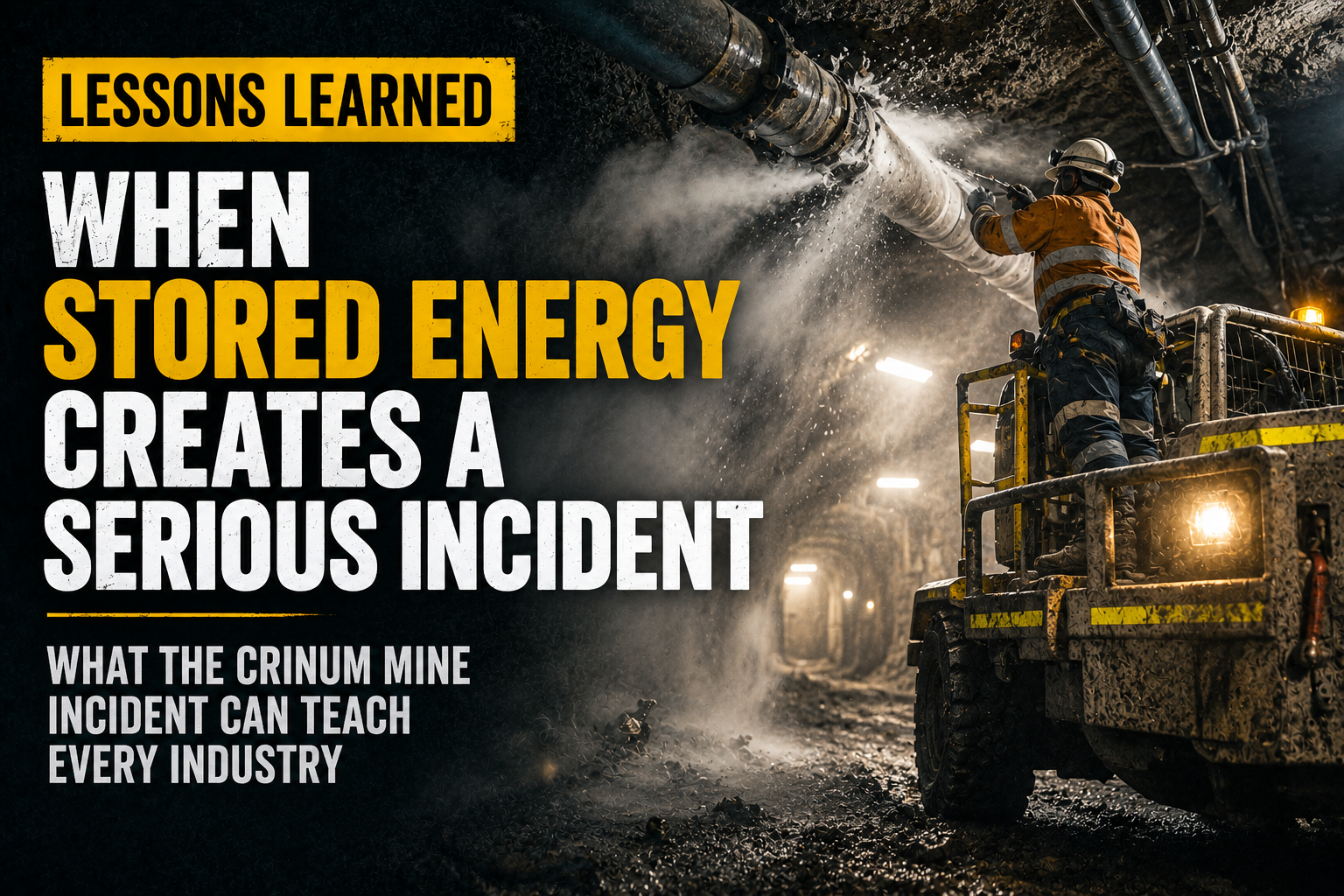
What the Crinum Mine incident can teach every industry about isolation, line of fire and changing conditions
On 12 September 2026, a worker at the Crinum underground coal mine in Queensland sustained life-threatening injuries during maintenance work involving a pressurised compressed-air pipeline. What began as maintenance on a pipe assembly developed into a sequence involving stored energy, a sudden release of compressed air, reduced visibility, a fall from a mobile vehicle and subsequent contact between the worker and that vehicle.
The worker, a 71-year-old man, suffered significant injuries to his chest, face, arms and abdomen. He was initially taken to Emerald Hospital before being transferred to Rockhampton Hospital and then flown to the Royal Brisbane and Women’s Hospital in Brisbane in a critical condition. A subsequent report said he required surgery to his jaw and that his condition was improving. Further details about the full extent of his injuries and his recovery have not been publicly released.
Resources Safety and Health Queensland (RSHQ) issued a Safety Alert following the incident, stating that the precise sequence of events and circumstances remained subject to investigation and verification. The regulator’s preliminary information provides enough detail, however, to examine a set of hazards that exists in almost every industry: stored energy, isolation, line-of-fire exposure, work positioning and interaction with mobile equipment.
That is what makes the Crinum incident particularly valuable as a safety case study. The lesson is not simply about compressed air or underground mining. It is about what can happen when one unexpected release of energy changes the conditions around a worker and allows several hazards to interact.
What happened?
According to RSHQ’s preliminary account, the worker was undertaking maintenance on a pressurised compressed-air pipeline system. He was standing on the front bumper bar of a drift runner — a heavy-duty utility vehicle used to transport workers and materials — to access the pipework.
While the worker was tightening a clamp, the pressurised clamp and pipe assembly reportedly failed. The failure released compressed air, creating significant dust and reducing visibility. The worker subsequently fell from the front of the drift runner.
RSHQ says that, for reasons yet to be determined, the operator of the drift runner then moved the vehicle and it made contact with the fallen worker. The worker suffered serious injuries. The investigation into the precise sequence and circumstances remains ongoing.
The important point is that the eventual injury was not the result of one isolated hazard. There was pressure energy within the compressed-air system. There was the physical exposure created by the worker’s position on the vehicle. There was gravitational energy associated with the elevated position. There was the sudden release of compressed air and the resulting loss of visibility. And there was mechanical energy associated with the movement of the drift runner.
The incident became serious because those hazards interacted.
The first question: Why was the system capable of releasing energy?
Compressed air is one of the most familiar utilities in industry. It is used for tools, instrumentation, cleaning, conveying, control systems and countless other applications. Its familiarity can make it easy to underestimate.
Compressed air is stored energy. Until that energy has been positively isolated and released or otherwise controlled, the system can remain capable of causing serious harm.
RSHQ’s guidance following the incident specifically tells mine operators to verify that effective controls are in place for work involving pressurised systems and stored energy. Its broader guidance also emphasises the need to isolate and depressurise pressurised systems before maintenance and to verify that the energy has been removed.
The principle is universal. A hydraulic accumulator can contain stored pressure. A steam line can contain heat and pressure. A pneumatic cylinder can move unexpectedly. A suspended load contains gravitational potential energy. An electrical capacitor can remain energised after equipment has been switched off. A rotating flywheel can continue to store kinetic energy after its drive has stopped.
The critical question is therefore not simply:
“Has the equipment been switched off?”
It is:
“What energy could still be present, and how do we know that it has been made safe?”
Isolation is not the same as switching off
One of the recurring weaknesses in maintenance work across many industries is the assumption that stopping equipment means the equipment has been made safe.
A valve may be closed while pressure remains downstream. A circuit breaker may be open while another energy source remains connected. A hydraulic system may have stopped moving while pressure remains trapped within the system. A machine may be stationary while gravity, stored tension or another mechanical force remains capable of producing movement.
Effective isolation therefore needs to address the complete energy pathway. The source needs to be identified and isolated. Stored energy needs to be dissipated, restrained or otherwise controlled. And, critically, the absence of hazardous energy needs to be verified.
Verification is the step that turns an assumption into evidence.
The second question: Where was the worker positioned?
RSHQ’s preliminary information indicates that the worker was standing on the front bumper bar of the drift runner to access the pipework. The regulator subsequently advised mine operators to ensure that suitable work platforms are used and that mobile equipment is not used for that purpose.
This is an important part of the story because work positioning can determine how a person is exposed when something goes wrong. The worker was not simply beside a pressurised pipe. He was positioned on a mobile vehicle, close to the component being worked on.
When the pipe assembly reportedly failed, the consequences extended beyond the pressure release itself. Dust was generated, visibility was reduced, the worker fell and the vehicle subsequently made contact with him.
This illustrates a broader principle:
A work method should be assessed not only for whether it allows a task to be completed, but for what happens if the task does not go according to plan.
A worker may be able to reach a component by standing on a vehicle, climbing onto machinery or working from an improvised position. But if the component fails, what happens next? Where does the worker go? Where does the released energy go? What happens to the equipment? And what happens if visibility disappears?
The third question: What happened when conditions changed?
Perhaps the most important lesson from the incident is what happened immediately after the component reportedly failed.
The release of compressed air created significant dust and reduced visibility. The environment had changed. The task that existed seconds earlier was no longer the same task. This is a critical point in maintenance safety.
Risk assessments, job safety analyses and work procedures are generally developed around an anticipated sequence of events. But real work is dynamic. Components fail. Conditions change. Unexpected noises occur. Equipment moves. Pressure changes. Visibility disappears. A robust safety system therefore needs a mechanism for recognising when the original risk assessment is no longer valid.
RSHQ’s Safety Alert specifically tells workers to identify hazards, assess risks and verify that controls remain effective before commencing work and whenever conditions change. That principle applies whether the workplace is a mine, refinery, factory, warehouse, construction site, power station or transport depot. When conditions change significantly, the correct response may be to stop the task, withdraw to a safe position and reassess.
The chain matters more than the individual event
It would be easy to focus on the pipe failure, but consider the sequence more broadly:
Pressurised system → component failure → uncontrolled release of energy → dust and reduced visibility → worker falls → mobile equipment moves → worker is struck.
Each event changed the conditions for what followed. If the system had been fully isolated and depressurised, the pipe failure would not have had the same energy available to release. If the worker had been positioned on a suitable work platform, the consequences of the sudden release may have been different. If the vehicle had been positively isolated against movement while the maintenance task was being performed, the subsequent interaction may not have occurred. If the worker and vehicle had been physically separated, the fall and vehicle movement would not necessarily have resulted in contact.
This is why high-consequence risk management should not depend on one control. A strong system uses multiple layers of protection so that if one control fails, another prevents the event from escalating.
The importance of line of fire
“Line of fire” is sometimes used as a simple safety slogan. The Crinum incident illustrates why it should be treated as a practical risk-management concept. A line of fire exists wherever a person could be struck by released energy, moving equipment, falling objects, pressure, stored force or another uncontrolled physical effect.
For pressurised systems, the line of fire may include the direction in which a component could move or rupture. For mobile equipment, it includes the machine’s movement envelope. For suspended loads, it includes the area beneath or around the load. For electrical systems, it can include the area affected by an arc or electrical contact.
The objective is not simply to warn workers about these zones. Where reasonably practicable, the system of work should keep people out of them.
What underlying conditions should organisations examine?
The investigation at Crinum will determine which factors actually contributed to the event. It would be inappropriate at this stage to declare particular management failures as established facts. The incident nevertheless provides an opportunity for other organisations to examine their own systems.
The first area is stored-energy management.
Do maintenance procedures identify all relevant energy sources? Are isolation points clearly defined? Can the system be depressurised? Is residual energy accounted for? Is isolation locked and controlled? Can the zero-energy state be verified?
The second is work positioning.
Does the task require workers to climb onto machinery, vehicles or structures to gain access? If so, is that the intended method of work, or has a workaround become normal?
The third is mobile-plant interaction.
Can a vehicle or machine move while someone is working on or beside it? If movement is possible, what prevents it? Is the isolation controlled by the person exposed to the hazard?
The fourth is line of fire.
If a component fails, where will the energy go? Where will the worker move? Where could equipment move? Could a person instinctively move into another hazard while trying to escape the first one?
The fifth is change management at the task level.
What happens when the job doesn’t proceed as expected? Does the work procedure require a stop and reassessment? Do workers have the authority to stop? Does the work environment make it practical to withdraw safely?
A serious incident does not need a complex cause to have complex consequences
One of the useful lessons from Crinum is that the initiating event does not have to be particularly complicated.
A clamp and pipe assembly reportedly failed. That single event then interacted with the way the work had been positioned and the presence of mobile equipment.
This is a common feature of serious incidents. The component that fails may be relatively simple. The consequences become severe because the surrounding system has allowed several hazards to interact.
This is why safety professionals should examine interfaces, not just individual hazards.
The interface between maintenance and operations.
The interface between people and mobile plant.
The interface between stored energy and access.
The interface between a changing environment and a fixed risk assessment.
These interfaces are often where controls become weakest.
Universal recommendations
1. Identify every source of stored energy
Before maintenance or intervention begins, identify pressure, electrical energy, hydraulic energy, pneumatic energy, gravity, heat, mechanical movement, stored tension and any other energy capable of causing harm. Do not assume that because the primary machine is switched off, all hazardous energy has disappeared.
2. Isolate and verify
Isolation should prevent hazardous energy from reaching the work area. Stored energy should then be dissipated, restrained or otherwise controlled. Finally, verify the zero-energy condition before work begins. The verification step should be practical and observable rather than simply relying on someone stating that the system is isolated.
3. Keep people outside the line of fire
Where possible, design the task so that workers do not occupy the area into which energy could be released. If the hazard cannot be eliminated, consider engineering controls such as barriers, remote operation, physical separation or other means of preventing exposure.
4. Provide a suitable means of access
Workers should not need to improvise access to complete routine maintenance. If a task requires elevated access, provide a suitable work platform. If the equipment cannot safely be used as a work platform, the system should make that clear and provide an alternative.
5. Physically control mobile equipment
Where maintenance workers are exposed to mobile plant, ask whether the equipment can be physically prevented from moving. Communication and awareness remain important, but physical isolation is generally more reliable than relying on people to anticipate one another’s actions.
6. Design for unexpected failure
Do not assess the task only under normal conditions. Ask what happens if:
- the component breaks;
- pressure is released;
- a hose ruptures;
- visibility disappears;
- a machine moves;
- a worker falls;
- a load shifts; or
- someone reacts instinctively to an unexpected event.
The resulting answers can reveal hazards that a conventional task assessment may overlook.
7. Stop when conditions change
An unexpected event should be treated as a trigger to reassess. A change in pressure, unexpected movement, unusual noise, loss of visibility or component failure can invalidate the assumptions on which the original task assessment was based. Stopping is not a failure of the job. Sometimes stopping is the control.
8. Make critical controls visible
High-consequence controls should be clearly identified. Workers and supervisors should be able to determine whether those controls are actually present before the task proceeds. This is particularly important for isolation, exclusion zones, access equipment and mobile-plant controls.
9. Give workers a genuine stop-work authority
Workers need both the authority and the practical ability to stop a task when conditions become unsafe. That authority needs to be supported by supervisors and management. A system in which workers technically have “stop-work authority” but are discouraged from using it is not an effective control.
10. Examine interactions, not just individual hazards
The Crinum event demonstrates why risk assessments should ask more than:
“What are the hazards?”
They should also ask:
“What happens if these hazards interact?”
Pressure plus access. Access plus mobile plant. A fall plus moving equipment. An unexpected release plus reduced visibility. It is often the interaction between hazards that produces the serious outcome.
What happened afterwards?
Following the incident, RSHQ directed that the scene be isolated and that certain operations be suspended until they could be performed at an acceptable level of risk. The regulator subsequently lifted the directive to suspend particular operations, and Sojitz Blue began a staged recommencement of activity at the Crinum underground mine while the detailed investigation continued.
That sequence is important. A serious incident does not automatically mean that every activity at a site must remain suspended indefinitely. Equally, resuming operations does not mean that the investigation is complete or that every causal question has been answered.
The important principle is that work should only recommence where the relevant controls have been reviewed and the regulator and operator are satisfied that the affected activities can be performed at an acceptable level of risk.
The broader lesson
The Crinum incident is a reminder that stored energy is not simply an engineering problem. It is a management problem.
Every industry has its equivalent of the pressurised compressed-air pipeline. It might be a hydraulic accumulator in a manufacturing plant. A steam line in a power station. An electrical distribution system on a construction project. A suspended load in a warehouse. A compressed-gas cylinder in a laboratory. A tensioned component in a transport system. The energy may be invisible. The controls cannot be.
The safest maintenance task is not necessarily the one with the longest procedure. It is the one where the organisation can demonstrate that the energy has been identified, the hazardous state has been controlled, the worker is positioned outside the credible line of fire and the equipment cannot unexpectedly interact with the person performing the work.
The investigation at Crinum will ultimately determine how the incident developed and which controls were effective or ineffective. Until those findings are available, it would be inappropriate to assign responsibility or draw conclusions about individual decisions. Organisations do not need to wait for the final investigation to examine their own exposure.
Where is our stored energy?
How do we isolate it?
How do we prove it is isolated?
Where would the energy go if something failed?
And what happens if the conditions suddenly change?
Those questions are relevant in almost every workplace.
Regulatory source
Resources Safety and Health Queensland — Safety Alert No. 485, 14 September 2026
Serious accident involving a pressurised compressed-air system and mobile equipment — RSHQ
The RSHQ alert remains the principal regulatory source for this incident. It states that the precise sequence and circumstances remain subject to investigation and verification, and provides specific guidance concerning stored energy, pressurised systems, suitable work platforms, mobile equipment and reassessment when conditions change.
Disclaimer
This article has been prepared by World Safety News for general information, learning and safety-awareness purposes. It is not a substitute for professional safety, engineering, legal or regulatory advice. The circumstances surrounding the Crinum mine incident remain subject to investigation, and information available at the time of publication may change as further evidence becomes available. References to possible contributing factors, control weaknesses or safety considerations in this article should not be interpreted as findings about the incident, its causes or the conduct of any individual or organisation. Organisations should assess their own risks and controls in accordance with applicable legislation, standards, manufacturer requirements and competent professional advice.