Tag: Mobile Plant

  • Lessons Learned: Worker Killed by Front-End Loader

    Lessons Learned: Worker Killed by Front-End Loader

    An Incident Analysis of a Reversing Mobile Plant Fatality

    Incident Date: 5 May 2026
    Location: Lara, Victoria, Australia
    Industry: Warehousing / Agricultural Storage and Logistics
    Incident Type: Pedestrian struck by reversing mobile plant (front-end loader)
    Status: Official investigation ongoing

    Executive Summary

    A 21-year-old worker was fatally struck by a reversing front-end loader while cleaning fertiliser residue from the rear of a semi-trailer at a storage warehouse in Lara, Victoria. According to publicly available information, the worker was using an air compressor when the collision occurred at approximately 8:15 am. The incident is being investigated by WorkSafe Victoria.

    Although the official investigation has not concluded, the circumstances suggest a classic and well-recognised critical risk involving the interaction between pedestrians and mobile plant. This analysis identifies likely failed controls and organisational factors that may have contributed to the fatality.

    Known Facts

    Based on information released publicly:

    • The deceased was a 21-year-old worker.
    • The incident occurred at a storage warehouse in Lara, Victoria.
    • The worker was reportedly using an air compressor to clean fertiliser from the rear of a semi-trailer.
    • A reversing front-end loader struck the worker.
    • The collision occurred at approximately 8:15 am.
    • WorkSafe Victoria is investigating the incident.

    Incident Analysis

    1. Absent or Failed Defences

    The following critical controls may have been absent, ineffective or bypassed:

    • Inadequate physical separation between pedestrians and mobile plant.
    • Failure to establish exclusion zones during reversing operations.
    • Lack of engineering controls such as proximity detection or collision avoidance systems.
    • Insufficient segregation of cleaning activities from active vehicle movements.
    • Potential absence of spotters or traffic controllers during reversing.
    • Possible deficiencies in site traffic management arrangements.

    2. Individual and Team Actions (Presumed)

    There is no evidence that any individual acted recklessly. However, reasonable assumptions include:

    • The loader operator may have been unaware of the worker’s location due to restricted visibility.
    • The worker may have entered or remained within the loader’s blind spot while focused on the cleaning task.
    • Communication between personnel regarding vehicle movements may have been ineffective or absent.

    These are hypotheses only and should not be interpreted as findings of fault.

    3. Task and Environmental Conditions

    Several workplace conditions may have increased the likelihood of the event:

    • Concurrent execution of pedestrian cleaning work and heavy equipment operations.
    • Potential noise from compressed-air cleaning reducing situational awareness.
    • Dust, equipment geometry or trailer positioning affecting visibility.
    • Time pressures associated with loading or unloading activities.

    4. Organisational Factors (Likely Contributing Causes)

    From an investigative perspective, the following organisational issues warrant examination:

    • Traffic Management: Whether the site had an effective traffic management plan that physically separated pedestrians and mobile plant.
    • Work Planning: Whether trailer cleaning could have been scheduled while mobile equipment was immobilised.
    • Risk Assessment: Whether dynamic risks associated with simultaneous operations had been adequately assessed.
    • Supervision: Whether supervisors ensured critical controls remained effective throughout the task.
    • Training and Competency: Whether both operators and ground personnel fully understood exclusion zones and interaction rules.
    • Contractor or Young Worker Management: Whether additional supervision or induction was provided for relatively inexperienced workers.

    5. Root Causes (Presumed)

    The most probable root causes are organisational rather than individual:

    1. Failure to adequately eliminate or isolate pedestrian exposure to moving mobile plant.
    2. Inadequate design or implementation of a traffic management system.
    3. Failure to separate incompatible tasks (cleaning and heavy equipment movement).
    4. Reliance on administrative controls and human vigilance instead of engineered separation.
    5. Insufficient verification that critical controls remained effective during normal operations.

    Lessons for Industry

    This incident reinforces several universal safety principles:

    • Separate pedestrians and mobile plant wherever practicable using engineered controls.
    • Design traffic flows to minimise or eliminate reversing.
    • Establish and enforce exclusion zones around operating equipment.
    • Schedule maintenance and cleaning activities outside active vehicle movements.
    • Use technology such as reversing cameras, proximity sensors and collision warning systems where appropriate.
    • Regularly audit traffic management arrangements rather than relying solely on documented procedures.
    • Ensure young or inexperienced workers receive enhanced supervision and mentoring.

    Recommendations

    Health and safety professionals should consider the following actions:

    1. Review site traffic management plans to ensure physical separation of pedestrians and vehicles.
    2. Conduct critical control verification for mobile plant interactions.
    3. Introduce designated pedestrian-only routes protected by barriers where feasible.
    4. Eliminate unnecessary reversing through one-way traffic systems and revised layouts.
    5. Assess opportunities to automate or isolate trailer cleaning activities.
    6. Require positive communication protocols before mobile equipment enters shared work areas.
    7. Implement competency assessments for operators and workers exposed to vehicle interactions.
    8. Evaluate engineering controls including cameras, radar, proximity alarms and geofencing technology.
    9. Periodically observe actual work practices to confirm procedures are followed in the field.
    10. Foster a culture where any worker can stop work if pedestrian and vehicle separation cannot be maintained.

    Conclusion

    Although the official investigation is ongoing, this tragedy illustrates one of the most persistent fatal risks across warehousing, logistics, agriculture, mining and manufacturing: the interaction between pedestrians and mobile plant. Experience shows that administrative controls and individual vigilance alone are rarely sufficient. The most effective prevention strategies focus on eliminating shared workspaces, engineering physical separation and ensuring that work is designed so people are not exposed to moving equipment in the first place.


    Disclaimer

    This article is provided for educational and informational purposes only. The analysis presented is based on publicly available information available at the time of publication. Official investigations by OSHA and other authorities remain ongoing, and additional facts may emerge that alter or clarify the circumstances of the incident. This article should not be interpreted as a formal incident investigation, legal opinion or professional safety advice.


  • World Safety News – 15JUN26

    World Safety News – 15JUN26

    1. Fatal Furnace Explosion at Vibrantz Paint Manufacturing Facility

    Llodio, Spain
    Date of Incident: 9 June 2026

    A 49-year-old worker was killed following an explosion involving an industrial furnace at the Vibrantz pigments and coatings manufacturing facility. Early reports suggest the worker may have been investigating operational issues with the furnace prior to the explosion. Authorities are examining equipment integrity, maintenance activities and process safety controls. This is a potentially strong process safety case study.


    2. Tree Worker Electrocuted During Vegetation Management

    Pennsylvania, USA

    Date of Incident: 10 June 2026

    A 31-year-old tree worker was killed while operating from a bucket truck when equipment reportedly contacted overhead power lines. The worker suffered fatal electrical injuries. OSHA has commenced an investigation into exclusion distances, work planning and electrical safety controls.


    3. Construction Worker Killed in 11th-Floor Fall

    Hong Kong
    Date of Incident: 8–9 June 2026

    A worker performing sealant work from scaffolding at a public housing development fell from the 11th floor and died. Authorities are investigating the adequacy of fall protection systems and scaffold arrangements. This is another reminder that falls remain one of the leading causes of workplace fatalities worldwide.


    4. Contract Worker Killed by Bobcat Loader

    Mumbai, India
    Date of Incident: 13 June 2026

    A 55-year-old municipal contract worker was killed at Juhu Beach after allegedly falling from the bucket of a Bobcat machine before being run over. Police have opened a negligence investigation against the equipment operator. The incident highlights ongoing issues associated with mobile plant and personnel transport.


    5. Workplace Electrocution at Agricultural Business

    Queensland, Australia
    Date of Incident: 10 June 2026

    A 40-year-old worker suffered critical injuries following an electrocution incident at an agricultural equipment business in Carole Park. Limited details have been released, however the worker was transported to hospital in a serious condition. Workplace inspectors are investigating the circumstances surrounding the electrical contact.


    6. Siemens Gamesa Worker Paralysed by 800kg Structure

    Hull, United Kingdom
    Regulatory outcome published 11 June 2026

    The HSE announced enforcement action against Siemens Gamesa after a 37-year-old worker was left paralysed when an 800kg wind turbine blade component collapsed during assembly. Investigators found failures relating to risk assessment, training and safe systems of work, with workers reportedly developing their own unsafe methods.


    7. Waste Recycling Worker Suffers Life-Changing Conveyor Injuries

    Bristol, United Kingdom
    HSE enforcement action published 8 June 2026

    A waste and recycling company was fined after a worker’s arm was pulled into an unguarded conveyor system, causing life-changing injuries. The HSE found failures to prevent access to dangerous moving machinery. While not a recent occurrence, the enforcement findings were published this week and contain useful lessons regarding machine guarding.


    8. Fatal Workplace Violence Incident at Amazon Facility

    Illinois, USA
    Developments reported 10 June 2026

    An Amazon employee has been charged with murdering a co-worker following a shooting at an Amazon fulfilment centre parking structure. Police believe the incident stemmed from a personal dispute; however, it occurred at a workplace and raises broader questions around workplace violence prevention, threat management and security controls.

  • Legislative Updates – 10JUN26

    Legislative Updates – 10JUN26

    1. United Kingdom – HSE Strengthens Dust Exposure Enforcement Campaign

    The UK Health and Safety Executive (HSE) has expanded its ongoing inspection programme targeting respiratory risks associated with construction dust, silica, and wood dust exposure.

    What Has Changed?

    Inspectors are increasingly focusing on:

    • Dust extraction systems
    • Respiratory Protective Equipment (RPE) programs
    • Exposure monitoring
    • Occupational health surveillance

    What Businesses Need to Do

    • Review dust management procedures
    • Verify face-fit testing records
    • Conduct exposure monitoring where required
    • Ensure health surveillance programs are current
    • Train supervisors on dust-related risks

    2. European Union – New Machinery Regulation Transition Period Continues

    The EU Machinery Regulation (EU 2023/1230) continues progressing toward full implementation, replacing the Machinery Directive.

    What Has Changed?

    The regulation introduces stronger requirements relating to:

    • Artificial intelligence integration
    • Autonomous equipment
    • Cybersecurity considerations
    • Digital technical documentation

    What Businesses Need to Do

    • Review machinery procurement standards
    • Assess machine safety files
    • Evaluate cybersecurity risks for connected equipment
    • Update conformity assessment processes

    3. United States – OSHA National Emphasis Program on Warehousing and Distribution

    OSHA continues expanding inspections under its warehousing and distribution centre enforcement initiative.

    What Has Changed?

    Inspectors are focusing on:

    • Forklift operations
    • Pedestrian interactions
    • Ergonomics
    • Material handling
    • Heat exposure

    What Businesses Need to Do

    • Audit traffic management systems
    • Review forklift training records
    • Improve pedestrian segregation controls
    • Assess manual handling risks

    4. Queensland, Australia – Industrial Manslaughter Enforcement Expansion

    Queensland regulators continue increasing use of industrial manslaughter legislation following several recent prosecutions.

    What Has Changed?

    Greater emphasis is being placed on:

    • Officer due diligence
    • Executive accountability
    • Critical risk verification
    • Contractor oversight

    What Businesses Need to Do

    • Review officer due diligence processes
    • Strengthen board-level safety reporting
    • Verify critical controls for high-risk activities
    • Improve contractor governance systems

    5. Ireland – HSA Construction Sector Inspection Campaign

    Ireland’s Health and Safety Authority (HSA) has expanded targeted inspections across construction projects.

    What Has Changed?

    Inspectors are focusing on:

    • Work at height
    • Scaffolding
    • Temporary works
    • Site supervision

    What Businesses Need to Do

    • Audit scaffolding compliance
    • Verify inspection regimes
    • Review Safe Work Method Statements
    • Improve site supervision arrangements

    6. Saudi Arabia – Occupational Heat Stress Compliance Initiative

    Saudi authorities are strengthening enforcement of worker protection requirements during extreme summer temperatures.

    What Has Changed?

    Increased inspections are focusing on:

    • Heat illness prevention
    • Work-rest schedules
    • Hydration programs
    • Worker welfare arrangements

    What Businesses Need to Do

    • Implement heat management plans
    • Monitor environmental conditions
    • Provide shaded rest facilities
    • Train workers to recognise heat illness symptoms

    7. Netherlands – Labour Inspectorate Focus on Unsafe Temporary Labour Arrangements

    Dutch labour authorities are increasing oversight of temporary and agency worker safety.

    What Has Changed?

    Regulators are examining:

    • Worker induction programs
    • Training adequacy
    • Language barriers
    • Contractor supervision

    What Businesses Need to Do

    • Review contractor onboarding processes
    • Improve multilingual safety communications
    • Verify competency before commencing work
    • Increase frontline supervision

    8. Sweden – Workplace Fatigue and Working Time Compliance Reviews

    Swedish regulators have increased inspections concerning fatigue-related workplace risks.

    What Has Changed?

    Authorities are focusing on:

    • Working hours
    • Shift scheduling
    • Worker recovery periods
    • Fatigue-related incidents

    What Businesses Need to Do

    • Review roster design
    • Assess fatigue risks
    • Improve reporting of fatigue concerns
    • Monitor overtime arrangements

    9. Chile – Mining Sector Safety Reform Measures

    Chile’s mining regulator continues implementing enhanced safety requirements following several major mining incidents.

    What Has Changed?

    Greater emphasis is being placed on:

    • Geotechnical risk management
    • Emergency response preparedness
    • Contractor management
    • Critical control verification

    What Businesses Need to Do

    • Review mine safety management plans
    • Verify emergency response capabilities
    • Strengthen contractor oversight
    • Audit critical risk controls

    10. South Africa – Increased Enforcement of Major Hazard Installation Requirements

    South African authorities are increasing regulatory attention on Major Hazard Installations (MHIs).

    What Has Changed?

    Inspectors are focusing on:

    • Hazard identification studies
    • Emergency planning
    • Community notification arrangements
    • Process safety systems

    What Businesses Need to Do

    • Review Major Hazard Installation documentation
    • Conduct emergency exercises
    • Verify process safety controls
    • Update consequence modelling where required

    Emerging Global Themes

    Several consistent themes continue appearing across jurisdictions:

    1. Executive Accountability

    Governments are increasingly holding directors and senior officers personally accountable for workplace safety outcomes.

    2. Occupational Health

    Regulators are placing greater emphasis on chronic illness prevention, exposure monitoring, and worker wellbeing.

    3. Climate-Related Risks

    Heat stress, extreme weather, and environmental hazards are becoming significant compliance priorities.

    4. Contractor Management

    Organisations are facing greater scrutiny regarding contractor competency, supervision, and integration into safety systems.

    5. Critical Risk Verification

    Regulators increasingly expect businesses to demonstrate that critical controls are functioning in practice, not merely documented on paper.

    6. Technology and Automation

    Machine safety, AI governance, autonomous equipment, and human-machine interaction risks are emerging areas of regulatory focus.

    Businesses that proactively address these themes are likely to be better positioned to meet future compliance obligations and reduce enforcement exposure.

  • Lessons Learned from Forklift Fatality

    Lessons Learned from Forklift Fatality

    A Routine Task with Fatal Consequences

    On 1 June 2026, 57-year-old Anthony Mark Lamattina III was fatally injured during unloading operations at Industrial Warehouse Services in Anderson County, South Carolina.

    According to preliminary reports, Lamattina was assisting with unloading a truck while a colleague operated a forklift. During the operation, materials being transported by the forklift became unstable. A pallet fell and pinned Lamattina, resulting in traumatic asphyxiation. He died at the scene. OSHA, the Anderson County Coroner’s Office and local law enforcement continue to investigate the incident.

    While many details remain unknown, the incident highlights several recurring hazards associated with forklift operations, suspended loads, pedestrian interactions and material handling activities.


    What We Know

    Publicly available information indicates:

    • The incident occurred during truck unloading operations.
    • A forklift was being used to move palletised material.
    • The load reportedly consisted of rubber products.
    • Materials became unstable and began to fall.
    • A pallet trapped the worker.
    • The worker died from traumatic asphyxiation.
    • The incident is being investigated by OSHA.

    What We Do Not Yet Know

    Several important details have not been released publicly:

    • The weight of the pallet.
    • The height of the load.
    • Whether the load was secured.
    • The exact position of the victim.
    • Whether exclusion zones were established.
    • Whether a spotter was being used.
    • The forklift type.
    • Whether the load shifted during transport or during unloading.
    • Whether visibility limitations contributed to the event.

    These unknowns mean that any causal analysis must be considered preliminary.


    Preliminary Analysis

    Immediate Cause

    Falling Load

    The immediate event appears to have been the loss of load stability during forklift operations.

    Whether the pallet itself failed, the load shifted, the forklift was positioned incorrectly, or another factor was involved remains unknown. However, the fatal injury resulted from the worker being located within the collapse zone when the pallet fell.


    Potential Contributing Factors

    Pedestrian Exposure to Forklift Operations

    One of the most common themes in forklift fatalities worldwide is the presence of workers within the operating envelope of moving equipment or suspended loads.

    Regardless of the exact sequence of events, the incident raises an important question:

    Why was a worker in a position where a falling pallet could strike or trap them?

    In many investigations, workers are positioned close to forklift operations because:

    • They are guiding the operator.
    • They are assisting with unloading.
    • They are manually stabilising loads.
    • They are attempting to improve visibility.
    • They are working under production pressures.

    Unfortunately, proximity to moving loads often removes the final layer of protection when something unexpected occurs.


    Load Stability

    Loads can become unstable for numerous reasons, including:

    • Uneven weight distribution.
    • Damaged pallets.
    • Improper stacking.
    • Inadequate wrapping or restraint.
    • Fork positioning errors.
    • Sudden vehicle movements.
    • Product movement during transport.

    The exact cause remains unknown in this case, but load instability appears to have been a key precursor event.


    Line-of-Fire Hazards

    The incident also highlights the concept of line-of-fire exposure.

    Line-of-fire incidents occur when workers place themselves in positions where they could be struck, crushed, caught or trapped if equipment, loads or structures move unexpectedly.

    Many workers become comfortable around forklifts because they are commonplace. However, the energy associated with even a single pallet can be enormous.

    Once a load begins to fall, there is often little opportunity for a worker to react or escape.


    Material Handling Risk Normalisation

    Warehousing and logistics environments often perform thousands of lifting and unloading operations without incident.

    Over time, familiarity can create a false sense of security.

    Workers may begin accepting practices such as:

    • Standing near suspended or elevated loads.
    • Walking through active forklift zones.
    • Assisting forklift operators from close proximity.
    • Entering unloading areas before loads are secured.

    These behaviours can become normalised despite their potential consequences.


    Lessons for Industry

    Lesson 1: Separate People from Loads

    The most effective control is often the simplest.

    Workers should not be positioned beneath, beside, or within the potential fall zone of lifted or unstable loads.

    Where possible:

    • Establish exclusion zones.
    • Use barriers.
    • Restrict access during unloading activities.
    • Separate pedestrians from forklift operations.

    Lesson 2: Treat Every Load as Unstable

    Even well-packaged loads can shift unexpectedly.

    Operators and workers should assume that any load has the potential to move, topple or collapse if disturbed.

    This mindset encourages safer positioning and more conservative operating practices.


    Lesson 3: Manage Line-of-Fire Risks

    Many serious injuries occur because workers place themselves where they could be struck if something goes wrong.

    Line-of-fire awareness should be incorporated into:

    • Pre-start meetings.
    • Risk assessments.
    • Toolbox talks.
    • Forklift training programs.

    Lesson 4: Improve Pedestrian Management

    Pedestrian interactions remain one of the leading contributors to forklift-related fatalities.

    Effective controls include:

    • Designated pedestrian walkways.
    • Physical separation barriers.
    • Controlled unloading zones.
    • Spotter arrangements where appropriate.
    • Restricted access during lifting operations.

    Lesson 5: Verify Load Security Before Movement

    Before transporting loads, operators should verify:

    • Pallet condition.
    • Load integrity.
    • Wrapping effectiveness.
    • Weight distribution.
    • Fork engagement.

    Small defects can have catastrophic consequences once a load begins moving.


    Recommended Actions for Industry

    Organisations involved in warehousing, logistics, transport, manufacturing and material handling should consider:

    1. Reviewing forklift-pedestrian interaction risks.
    2. Establishing formal exclusion zones during loading and unloading.
    3. Conducting line-of-fire hazard assessments.
    4. Reviewing load securing and pallet inspection procedures.
    5. Providing refresher forklift safety training.
    6. Improving supervision during non-routine unloading activities.
    7. Investigating near misses involving falling loads.
    8. Auditing pedestrian management controls.
    9. Reviewing traffic management plans.
    10. Reinforcing the principle that no worker should position themselves beneath or adjacent to potentially unstable loads.

    Final Thoughts

    Although investigators are still determining exactly what occurred in South Carolina, this tragedy serves as a reminder that routine tasks can quickly become fatal when workers are exposed to moving equipment and unstable loads.

    Forklifts are among the most common pieces of equipment found in modern workplaces, yet they continue to be involved in a disproportionate number of serious injuries and fatalities worldwide. The lessons emerging from this incident extend far beyond one warehouse or one industry. They reinforce a fundamental safety principle that remains relevant in every workplace: whenever possible, separate people from the hazards created by moving loads and mobile equipment.


    Disclaimer

    This article is provided for educational and informational purposes only. The analysis presented is based on publicly available information available at the time of publication. Official investigations by OSHA and other authorities remain ongoing, and additional facts may emerge that alter or clarify the circumstances of the incident. This article should not be interpreted as a formal incident investigation, legal opinion or professional safety advice.

  • World Safety News – 08JUN26

    World Safety News – 08JUN26

    1. Worker Dies After Fall From Height

    Tuscany, Italy
    Reported:
    4 June 2026

    A worker died after falling approximately six metres while undertaking work activities at the Sepe industrial facility on Via degli Artigiani in Rosignano, a coastal industrial area in Tuscany. The victim was a 30-year-old contractor of foreign origin working for an external company rather than the host employer.

    According to initial reports, the worker was conducting a site inspection on the roof/upper floor structure of an industrial warehouse in preparation for upcoming work. He was reportedly wearing the required personal protective equipment at the time. During the inspection, part of the structure appears to have suddenly failed, causing him to fall approximately six metres. Tragically, he then struck machinery that was operating below. Emergency responders arrived quickly, but he died at the scene from his injuries.


    2. Hanwha Aerospace Rocket Propellant Explosion

    Daejeon, South Korea
    Incident Date:
    1 June 2026

    Five workers were killed and two others seriously injured following a powerful explosion and subsequent fire at a Hanwha Aerospace facility involved in rocket propellant manufacturing. Initial reports indicate the incident occurred inside a production building where workers were reportedly cleaning equipment used in the handling of solid rocket propellant. Emergency services responded quickly, but the severity of the blast resulted in multiple fatalities.

    Subsequent reports suggest investigators are examining whether explosive residue remained on tools or equipment during cleaning activities. South Korean authorities later raided company offices and reportedly seized safety documentation, maintenance records, and operating procedures as part of the investigation.


    3. Lift Technician Crushed During Maintenance Work

    Mount Waverley, Victoria, Australia
    Incident Date:
    29 May 2026

    A lift technician died after becoming trapped and crushed while working on a residential lift system. WorkSafe Victoria confirmed the fatality and has commenced an investigation. While details remain limited, likely areas of focus include isolation procedures, stored energy hazards, maintenance task planning, and safe systems of work for lift servicing activities.


    4. Tata Steel Major Industrial Fire

    Port Talbot, Wales, United Kingdom
    Incident Date:
    3–4 June 2026

    A significant fire broke out at Tata Steel’s Port Talbot steelworks, generating large plumes of smoke and requiring a major emergency response. Approximately 100 responders attended the incident. Importantly, all personnel were successfully evacuated and accounted for. The event provides a strong example of emergency preparedness, evacuation management, and crisis response effectiveness in a major industrial facility.


    5. Forklift-Related Fatality During Truck Unloading

    Anderson County, South Carolina, USA
    Incident Date:
    1 June 2026

    Anthony Lamattina III, a warehouse worker and volunteer firefighter, was fatally crushed when a pallet fell from a forklift during unloading operations. The coroner determined the cause of death was traumatic asphyxiation. OSHA is investigating. The incident highlights persistent line-of-fire hazards, load stability issues, and the need for effective pedestrian exclusion zones around material handling operations.


    6. OSHA Findings Following Warehouse Fatality

    San Antonio, Texas, USA
    Incident Date:
    OSHA findings released 2 June 2026

    OSHA issued citations following a fatal forklift-related incident at an H-E-B warehouse. Investigators identified failures to conduct mandatory forklift operator re-evaluations and deficiencies relating to workplace infrastructure such as damaged guardrails. The case demonstrates how administrative controls and competency management failures can contribute to serious incidents.


    7. Fatal Fall During Solar Installation Work

    Sicily, Italy
    Reported:
    4 June 2026

    A 35-year-old worker involved in photovoltaic installation work was killed when a pallet of solar panels fell during unloading operations. The incident formed part of a series of workplace fatalities reported across Italy in a single day. Investigators are expected to examine load restraint, lifting procedures, and exclusion zones around unloading activities.


    8. Forklift Operator Killed in Logistics Facility

    Catania, Italy
    Reported:
    4 June 2026

    A 30-year-old worker died after being crushed by a forklift in an industrial logistics area. Limited details have been released, but the incident has renewed discussion around vehicle-pedestrian segregation, forklift operator competency, and traffic management controls in industrial facilities.

  • Three Workers Killed in India Crane Collapse

    Three Workers Killed in India Crane Collapse

    Early Lessons from a Fatal Infrastructure Construction Incident

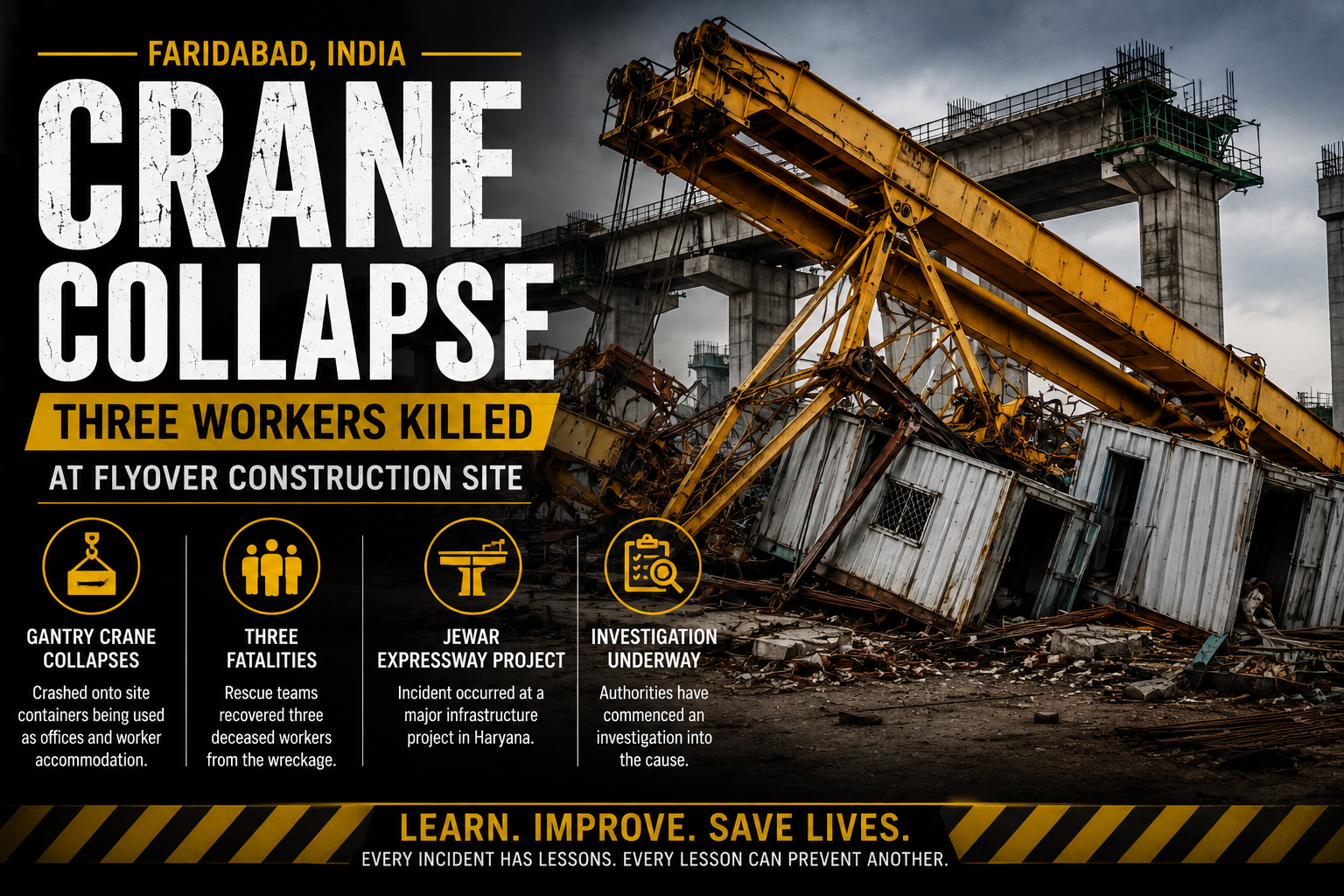
    Three workers have been killed following the collapse of a gantry crane at a major flyover construction project in Faridabad, Haryana, India, in what is shaping up to be one of the most significant workplace incidents reported globally this week.

    The incident occurred on 4 June 2026 at a construction site associated with the Jewar Expressway project. According to initial reports, a large gantry crane collapsed unexpectedly, striking site containers being used as offices and worker accommodation. Rescue teams responded to the scene and recovered three deceased workers from the wreckage. Investigations into the cause of the collapse are now underway.

    While many details remain unknown, the tragedy highlights several recurring themes that continue to feature prominently in serious construction incidents around the world: lifting operations, temporary works management, structural stability, and the protection of workers from line-of-fire hazards.

    What We Know

    Based on publicly available information:

    • The incident occurred on 4 June 2026.
    • The crane involved was reported to be a gantry crane used in flyover construction activities.
    • The crane collapsed onto site containers.
    • Three workers lost their lives.
    • Emergency responders conducted rescue operations following the collapse.
    • Authorities have commenced an investigation.

    At the time of writing, investigators have not publicly released information regarding:

    • The exact stage of construction being undertaken.
    • Whether lifting operations were underway at the time.
    • The condition of the crane prior to the incident.
    • Weather conditions.
    • Whether any mechanical or structural failures occurred.
    • Whether the containers were approved for occupancy within the crane operating zone.

    These questions are likely to form a key part of the investigation.

    Understanding the Hazard

    Large gantry cranes are commonly used on major infrastructure projects to move heavy structural components such as bridge segments, girders, formwork, and precast elements.

    These cranes can weigh hundreds of tonnes and operate under significant loads. As a result, any loss of stability can have catastrophic consequences.

    Unlike many workplace hazards, crane collapses typically provide little or no warning. Once structural failure begins, workers within the collapse zone often have only seconds—or less—to react.

    For this reason, modern lifting operations rely heavily on preventive controls designed to stop workers being exposed to potential collapse zones in the first place.

    ICAM Analysis

    Failed or Missing Defences

    Failure of Structural Integrity

    The most obvious failed defence appears to be the loss of structural stability of the crane itself.

    Investigators will likely examine:

    • Structural condition of the crane
    • Inspection and maintenance records
    • Engineering design requirements
    • Previous defects or repairs
    • Foundation and support arrangements

    Any weakness in these areas may have contributed to the collapse.

    Failure of Exclusion Zones

    One of the most significant questions relates to worker exposure.

    Reports indicate that the crane collapsed onto occupied site containers.

    This raises an important issue:

    Why were workers located within an area that could potentially be impacted by crane failure?

    While investigations may ultimately determine that the risk was considered acceptable, investigators will almost certainly examine whether adequate exclusion zones existed around the crane and whether worker facilities were appropriately located.

    Failure of Temporary Works Management

    Major infrastructure projects rely heavily on temporary works systems.

    These may include:

    • Crane foundations
    • Support structures
    • Bracing systems
    • Access platforms
    • Construction sequencing

    Failures within temporary works systems have been identified as contributing factors in numerous major construction disasters globally.

    Investigators are likely to review engineering approvals, inspections, and change management processes associated with the crane installation.

    Individual and Team Actions

    At this stage there is no evidence suggesting worker actions contributed directly to the incident.

    ICAM recognises that worker behaviour is influenced by the systems in which people operate.

    Accordingly, investigators will likely focus on organisational and engineering factors rather than individual decisions.

    Task and Environmental Conditions

    Several environmental factors commonly contribute to crane incidents:

    Wind Loading

    Strong winds can significantly affect crane stability and lifting operations.

    Investigators will likely review weather conditions at the time of the collapse.

    Ground Conditions

    Crane stability is heavily dependent on the integrity of supporting ground and foundations.

    Questions may include:

    • Were geotechnical assessments completed?
    • Were settlement issues identified?
    • Were support structures inspected?

    Construction Progression

    As projects evolve, loading conditions and crane configurations can change.

    Investigators may examine whether recent modifications, relocations, or changes in operating conditions affected the crane’s stability.

    Organisational Factors

    Engineering Verification

    Large lifting equipment should be subject to rigorous engineering oversight.

    Investigators may examine:

    • Design verification processes
    • Inspection regimes
    • Third-party certifications
    • Load calculations
    • Change management systems

    Critical Risk Management

    Crane collapse represents a low-frequency but high-consequence event.

    Organisations should identify crane operations as a critical risk and implement controls that are routinely verified rather than assumed.

    Worker Accommodation Placement

    One potentially significant issue emerging from early reports is the location of site containers.

    Where workers are routinely housed, accommodated, or working within the potential collapse radius of heavy lifting equipment, organisations should carefully assess whether the risk is reasonably practicable and adequately controlled.

    Potential Root Causes

    While definitive conclusions cannot be drawn at this stage, investigators may ultimately identify factors such as:

    Immediate Causes

    • Loss of crane structural stability
    • Mechanical or structural failure
    • Foundation or support system failure

    Potential Contributing Factors

    • Inadequate inspections
    • Design deficiencies
    • Poor maintenance
    • Excessive loading
    • Environmental influences
    • Inadequate exclusion zones
    • Deficiencies in temporary works management

    Potential Organisational Factors

    • Weak critical risk management systems
    • Inadequate engineering oversight
    • Poor verification of controls
    • Deficient planning processes
    • Inadequate change management

    Lessons for Industry

    Although the investigation has only just begun, several important lessons already emerge.

    1. Keep People Out of the Line of Fire

    The most effective protection is often separation.

    Workers should not be routinely exposed to potential collapse zones where practical alternatives exist.

    2. Review the Location of Site Facilities

    Site offices, lunchrooms, and accommodation should be located outside high-risk operating areas wherever possible.

    3. Strengthen Engineering Assurance

    All lifting equipment should be subject to robust inspection, maintenance, and engineering verification programs.

    4. Verify Critical Controls

    Critical controls should be actively verified through inspections and audits rather than assumed to be functioning.

    5. Improve Temporary Works Governance

    Temporary works should be treated with the same level of engineering discipline as permanent structures.

    6. Consider Worst-Case Scenarios

    Risk assessments should evaluate not only routine operations but also the consequences of catastrophic equipment failure.

    7. Strengthen Emergency Preparedness

    Rapid emergency response can significantly reduce the severity of outcomes following major incidents.

    Final Thoughts

    While investigators continue their work, the Faridabad crane collapse serves as a stark reminder of the immense forces involved in modern construction activities.

    Across industries, one lesson remains consistent: when critical assets fail, the consequences can be catastrophic. The organisations that achieve the strongest safety outcomes are often those that focus not only on preventing failures, but also on ensuring that people are protected when failures occur.

    As further information emerges, the findings from this investigation are likely to provide valuable lessons for construction, infrastructure, mining, manufacturing, and heavy industry operations around the world.


    Disclaimer

    This article is provided for educational and informational purposes only. It is based on publicly available information available at the time of writing. The investigation into this incident remains ongoing, and the causes, contributing factors, and circumstances discussed in this article are preliminary observations and potential considerations rather than confirmed findings.

    Nothing in this article should be interpreted as a legal determination of fault, liability, negligence, or regulatory non-compliance. Readers should rely on official investigation findings and seek advice from appropriately qualified safety, engineering, and legal professionals when assessing similar risks within their own organisations.

  • Worker Electrocuted

    Worker Electrocuted

    What can we learn from this tragedy?

    On 2 June 2026, a worker was fatally electrocuted while servicing a scissor lift in Victoria, Australia. According to WorkSafe Victoria, the 34-year-old worker was undertaking maintenance activities when the scissor lift came into contact with high-voltage overhead powerlines at approximately 1:50pm. The worker died as a result of the incident. WorkSafe Victoria has commenced an investigation.

    While details remain limited, the incident highlights one of the most persistent workplace hazards across construction, maintenance, logistics, agriculture, utilities, and industrial operations worldwide: working near overhead electrical assets.

    Sadly, fatalities involving mobile plant and overhead powerlines are not uncommon. Despite decades of awareness campaigns, regulations, exclusion zones, and guidance materials, workers continue to lose their lives after plant, equipment, or conductive materials enter unsafe proximity to energized powerlines.

    This tragedy serves as a reminder that electricity remains unforgiving. In many cases, a single momentary lapse or failed control can have irreversible consequences.

    What We Know

    Based on information released by WorkSafe Victoria:

    • The incident occurred on 2 June 2026.
    • The worker was 34 years old.
    • The worker was servicing a scissor lift.
    • The scissor lift made contact with high-voltage overhead powerlines.
    • The worker suffered a fatal electrocution.
    • WorkSafe Victoria has commenced an investigation.

    At the time of writing, no additional details regarding the exact work activity, worksite conditions, supervision arrangements, or planning processes have been released.

    Understanding the Hazard

    Many workers assume physical contact with a powerline is required for electrocution to occur.

    This is not always the case.

    Electricity can arc across air gaps when equipment comes within unsafe proximity of high-voltage conductors. WorkSafe Victoria has repeatedly warned that electrical current can “jump” from powerlines to nearby equipment even without direct contact.

    Scissor lifts present particular challenges because operators often focus on work tasks at height while simultaneously managing movement, positioning, and clearance distances.

    When overhead powerlines are present, the risk profile changes significantly.

    ICAM Analysis

    Absent or Failed Defences

    Failure of Separation from Electrical Hazards

    The primary failed defence appears to have been the loss of safe separation between the scissor lift and the overhead powerline.

    Whether through direct contact or electrical arcing, the worker was exposed to a fatal electrical hazard that should have been controlled through planning, exclusion zones, engineering controls, or work methods.

    Failure of Hazard Identification

    Overhead powerlines are generally visible hazards.

    One of the key questions investigators are likely to examine is whether the presence of the powerlines was identified during planning and risk assessment activities before work commenced.

    If the hazard was identified, investigators will likely assess whether adequate controls were implemented.

    If it was not identified, questions may arise regarding the effectiveness of pre-start inspections and risk assessment processes.

    Failure of Critical Risk Controls

    Most jurisdictions require specific controls when working near overhead powerlines, including:

    • Defined exclusion zones
    • Spotters or observers
    • Alternative work methods
    • Physical barriers
    • Isolation or de-energisation where practicable
    • Operator training

    The incident suggests one or more of these controls were either absent, ineffective, or unable to prevent exposure.

    Individual and Team Actions

    ICAM recognises that worker actions occur within systems designed by organisations.

    While investigators may examine operator actions immediately before the incident, modern safety investigations focus on understanding why the system allowed a worker to be placed in harm’s way.

    Questions investigators may consider include:

    • Was the worker trained in powerline hazards?
    • Was a spotter being used?
    • Had the work been adequately planned?
    • Was supervision appropriate?
    • Were exclusion distances clearly established?

    Task and Environmental Conditions

    Several environmental factors can increase the likelihood of powerline incidents:

    • Sun glare
    • Poor visibility
    • Visual distractions
    • Congested work areas
    • Powerline sag
    • Changing site conditions

    WorkSafe Victoria has previously highlighted that environmental conditions can make overhead powerlines difficult to see and can affect safe clearance distances.

    Investigators will likely assess whether any environmental conditions contributed to the event.

    Organisational Factors

    Work Planning and Risk Assessment

    One of the most common findings in powerline-related fatalities is inadequate planning.

    Where work activities involve elevated plant, the presence of overhead electrical assets should trigger additional controls before work begins.

    Investigators will likely examine:

    • Safe Work Method Statements (SWMS)
    • Job Safety Analyses (JSA)
    • Pre-start inspections
    • Permit systems
    • Site inductions

    Critical Risk Management

    Powerline contact is a well-known fatal risk.

    Organisations managing work near electrical infrastructure should have clearly defined critical controls that are routinely verified in the field.

    Investigators may examine whether those controls existed and whether they were functioning as intended.

    Potential Root Causes

    Based on currently available information, potential causal pathways may include:

    Immediate Causes

    • Scissor lift entered an unsafe proximity to overhead powerlines
    • Electrical energy transferred to the equipment and/or worker

    Potential Contributing Factors

    • Inadequate hazard identification
    • Failure to establish exclusion zones
    • Absence of a dedicated spotter
    • Inadequate work planning
    • Insufficient supervision
    • Training deficiencies
    • Environmental conditions affecting visibility

    Potential Organisational Causes

    • Weak critical risk management systems
    • Inadequate verification of controls
    • Insufficient electrical hazard awareness
    • Poor planning for high-risk work activities

    These remain possible contributing factors only until the official investigation is completed.

    Lessons for Industry

    Regardless of the final findings, several practical lessons emerge.

    1. Identify Powerlines Before Work Starts

    Every task involving elevated plant should include a formal assessment of nearby electrical assets.

    2. Establish and Enforce Exclusion Zones

    Safe approach distances should be clearly identified, communicated, and physically controlled where possible.

    3. Use Dedicated Spotters

    Where work occurs near overhead powerlines, trained spotters can provide an additional layer of defence.

    4. Consider Alternative Work Methods

    Where practicable, redesign the task to eliminate or reduce exposure to overhead electrical hazards.

    5. Strengthen Critical Control Verification

    Supervisors should routinely verify that powerline controls are implemented in the field rather than assuming compliance.

    6. Improve Electrical Hazard Awareness

    Workers operating mobile plant, elevated work platforms, cranes, and lifting equipment should receive regular training regarding powerline risks and electrical arcing.

    7. Review Emergency Response Arrangements

    Workers should understand the correct actions to take if equipment contacts overhead powerlines, including remaining within the equipment where appropriate and following established emergency procedures.

    Final Thoughts

    Although the investigation remains in its early stages, this incident appears to involve a hazard that is both well known and highly controllable.

    Every year, workers around the world are killed after equipment enters unsafe proximity to overhead powerlines. The technology, procedures, and knowledge needed to prevent these incidents already exist.

    The challenge for organisations is ensuring that critical controls are consistently applied whenever workers operate near electrical hazards.

    For the family, friends, and colleagues of the worker involved, this tragedy is a stark reminder that even routine tasks can become fatal when hazardous energy is not effectively managed.


    Disclaimer

    This article is provided for educational and informational purposes only. It is based on publicly available information available at the time of writing. The WorkSafe Victoria investigation remains ongoing, and the causes, contributing factors, and circumstances discussed in this article are preliminary observations rather than confirmed findings.

    Nothing in this article should be interpreted as a legal determination of fault, liability, negligence, or regulatory non-compliance. Readers should rely on official investigation findings and consult appropriately qualified safety, engineering, and legal professionals when assessing similar risks within their own organisations.

  • World Safety News – 01JUN26

    World Safety News – 01JUN26

    1. Chemical Tank Rupture Disaster — Longview, Washington, USA

    Incident Date: 26–28 May 2026

    At least eight workers were killed and several others injured following a catastrophic tank rupture at the Nippon Dynawave Packaging paper mill in Longview, Washington. The incident occurred when a large chemical storage vessel containing caustic white liquor collapsed during operations, releasing hundreds of thousands of gallons of hazardous chemical solution across the site.

    Investigators are examining vessel integrity, process safety management systems, maintenance controls, and potential structural failures associated with the storage tank. Recovery operations were complicated by chemical contamination and ongoing structural instability.


    2. Apprentice Lineman Fatality — Albany, Georgia, USA

    Incident Date: 27 May 2026

    A 20-year-old apprentice electrical lineman was killed while performing work for the City of Albany, Georgia. Limited details have been released regarding the incident; however, city officials confirmed the worker died while undertaking operational duties.

    Authorities have commenced an investigation into the circumstances surrounding the fatality, including work procedures, supervision, task planning, and electrical safety controls.


    3. Railway Tunnel Excavator Strike Fatality — Madrid, Spain

    Incident Date: 28 May 2026

    A 39-year-old contractor was killed while conducting maintenance activities inside a commuter rail tunnel in Madrid after being struck in the chest by the bucket of a backhoe excavator.

    Emergency crews attempted resuscitation for approximately 40 minutes but were unable to revive the worker. Investigators are reviewing plant movement controls, exclusion zones, communication procedures, and contractor supervision arrangements within the confined work area.


    4. River Mill Dam Testing Fatality — Oregon, USA

    Incident Date: 14–18 May 2026

    A specialist contractor was killed and a Portland General Electric employee injured during equipment testing activities at River Mill Dam in Clackamas County, Oregon.

    The incident occurred during operational testing procedures associated with dam infrastructure. Authorities have launched a workplace fatality investigation focusing on testing controls, energy isolation systems, procedural compliance, and contractor management arrangements.


    5. Wind Turbine Manufacturing Structure Collapse — Hull, United Kingdom

    Enforcement Outcome Published 26 May 2026

    Details emerged this week following regulatory action against Siemens Gamesa after a worker suffered life-changing injuries during wind turbine blade construction activities.

    The employee was working on a large internal turbine structure when support components were removed, causing an approximately 800-kilogram section to collapse onto her. Investigators found deficiencies in risk assessment processes, systems of work, and worker training relating to structural support controls.


    6. Telehandler Reversing Fatality — Cumbria, United Kingdom

    Enforcement Outcome Published 27 May 2026

    A waste and recycling company was fined following a fatal incident in which a worker was struck by a reversing telehandler at a recycling facility in Barrow-in-Furness.

    The investigation found inadequate traffic management arrangements and insufficient segregation between pedestrians and mobile plant operations. Authorities highlighted failures to ensure safe circulation routes within the operational yard.


    7. Machine Lifting Operation Crushing Incident — Leicestershire, United Kingdom

    Enforcement Outcome Published 22 May 2026

    A manufacturing worker suffered severe hand injuries requiring partial finger amputation after becoming trapped beneath a three-tonne industrial machine during a lifting operation.

    Investigators determined that the lifting task had not been adequately planned and that the worker’s hand was positioned beneath the suspended load when the lifting equipment unexpectedly lowered. The incident highlighted failures in lifting controls, exclusion zones, and task supervision.


    8. Power Sector Worker Fatalities Crisis — Uttar Pradesh, India

    Incident Date: Reported 29 May 2026

    Worker unions in Uttar Pradesh reported 36 workplace accidents within a 37-day period across the electricity distribution sector, resulting in 22 worker fatalities and numerous serious injuries.

    Union representatives cited chronic staffing shortages, inadequate safety controls, excessive workloads, and insufficient training as contributing factors. The incidents have prompted calls for statewide industrial action and safety reforms.


    9. Packaging Plant Implosion and Chemical Release — Longview, Washington, USA

    Incident Date: 26 May 2026

    Separate reporting following the Longview disaster revealed that emergency responders encountered a large-scale chemical release after a major industrial tank implosion occurred at the paper manufacturing facility.

    The event caused multiple serious burn injuries and exposed workers and responders to hazardous chemicals. Investigators are examining equipment condition, process safety systems, pressure management controls, and emergency response preparedness.


    10. Construction Contractor Workplace Manslaughter Case — Melbourne, Australia

    Court Proceedings Reported 25 May 2026

    Court proceedings this week detailed the circumstances surrounding a workplace manslaughter case involving a contractor who fell approximately four metres while replacing warehouse roof panels.

    Investigators found the worker had not received formal training, was not adequately supervised, and was working without effective fall protection systems despite available safety equipment on site. The case has been cited as a significant example of failures in contractor management and work-at-height controls.


    Key Themes Emerging This Week:

    Several recurring risk factors appear across these incidents:

    • Work at heights and fall protection failures
    • Mobile plant and pedestrian interaction hazards
    • Contractor management deficiencies
    • Inadequate supervision and task verification
    • Poor traffic management controls
    • Failures in lifting and suspended-load operations
    • Process safety and hazardous chemical risks
    • Organisational pressure and workforce shortages

    These incidents continue to demonstrate that many serious workplace events stem not from isolated errors, but from multiple control failures occurring simultaneously across operational, supervisory, and organisational levels.