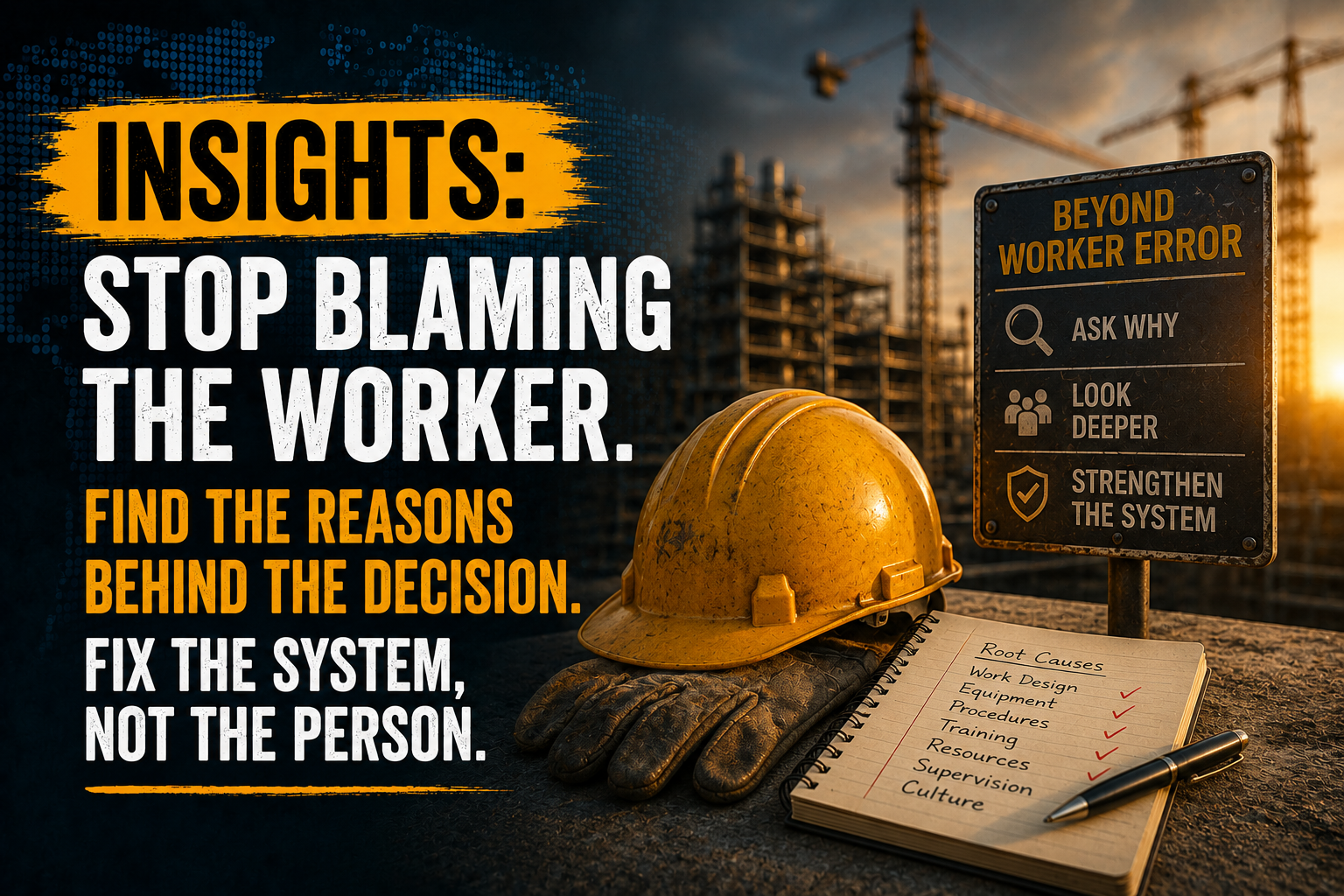
Why identifying an unsafe act isn’t the same as identifying the root cause
There is a statistic that has influenced workplace safety thinking for decades: the assertion that around 96% of workplace injuries resulted from unsafe acts. The figure is commonly associated with DuPont’s safety philosophy and was based on its analysis of lost-time accidents over a ten-year period.
It is a statistic that has been repeated throughout the safety profession, but somewhere along the way, “unsafe act” has become synonymous with “worker error”, and worker error has become synonymous with worker fault. That is a significant leap. An unsafe act may describe what happened immediately before an incident, but it does not necessarily explain why the person made that decision in the first place.
That distinction matters because if an investigation stops at the worker, it may never discover the conditions that helped create the incident.
The Worker Made a Bad Decision. Now What?
Imagine a worker bypasses a machine guard and is subsequently injured. The investigation appears straightforward. The worker knew the guard was there, the procedure required it to remain in place, and the worker deliberately bypassed it. The conclusion might therefore be recorded as a failure to follow procedure, followed by retraining or disciplinary action.
But what happens if we ask one more question?
Why?
Perhaps the guard regularly interfered with the task. Perhaps removing it made the job considerably quicker. Perhaps the machine could not be cleared efficiently with the guard in place. Perhaps workers had raised the problem previously. Perhaps supervisors knew that people routinely bypassed it. Perhaps production targets made downtime difficult to accept.
Suddenly, “worker failed to follow the procedure” doesn’t look much like a root cause. It looks like the beginning of the investigation.
Unsafe Act Does Not Mean Unsafe Worker
Workers make mistakes. They become distracted, misjudge situations, take shortcuts and sometimes deliberately deviate from procedures. Pretending otherwise would be unrealistic.
The question is whether we are prepared to investigate beyond the decision itself.
If one worker takes a shortcut that nobody else takes, there may genuinely be an individual performance issue. But if an entire team routinely ignores the same procedure, the organisation should be asking a different question.
Why has this behaviour become normal?
If workers repeatedly report a problem but nothing changes, who owns the resulting risk? If supervisors know that a particular shortcut is routinely taken but production continues without intervention, can the eventual incident reasonably be attributed solely to the person who happened to be involved when something went wrong?
These questions move an investigation away from blame and towards understanding.
People Don’t Make Decisions in a Vacuum
Workers make decisions within environments created by their organisations.
The organisation determines how the workplace is designed, what equipment is provided, how tasks are structured, how much time is available, how many people are required and what procedures look like. It also establishes the incentives that influence behaviour.
If production is rewarded while safety interventions are perceived as delays, workers receive a message about what the organisation truly values. If stopping a job is technically permitted but routinely criticised because it affects output, the formal policy and the practical culture are telling workers two different things.
Consider a task where the safest method requires additional equipment, another worker and a lengthy isolation, while an alternative takes five minutes and allows production to continue. The procedure may clearly state which option is required, but if the organisation repeatedly makes the safer option difficult, inconvenient or impractical, it should not be surprised when people find another way.
That doesn’t make the shortcut acceptable.
It does, however, make it worthy of investigation.
Are We Setting Workers Up to Fail?
Perhaps the most uncomfortable question an organisation can ask is:
Have we created conditions in which the unsafe decision is the easiest decision to make?
This is where the distinction between work as imagined and work as done becomes important.
Management may believe that a task is performed in a particular way because that is how the procedure describes it. The worker performing the task may know that reality is considerably more complicated. Equipment behaves differently, conditions change, procedures don’t account for every eventuality and competing demands emerge.
Workers adapt.
Most of the time, those adaptations allow work to continue successfully. Sometimes, however, an adaptation contributes to an incident.
The answer isn’t necessarily to eliminate all deviation from the prescribed method. It is to understand why workers need to adapt in the first place.
If a procedure routinely doesn’t reflect the reality of the job, perhaps the procedure needs changing. If equipment makes the safe method impractical, perhaps the equipment needs redesigning. If workers are taking shortcuts because they are under constant time pressure, perhaps the planning process needs to change.
The problem may not be that workers are failing to follow the system.
The system may be failing to support the way work actually has to be done.
When the Shortcut Becomes Normal
There is an important difference between an individual violation and an organisationally embedded practice.
If one worker ignores a procedure that everyone else follows, there may be a genuine individual behavioural problem.
But what if everyone ignores it?
At that point, describing the problem simply as “worker non-compliance” becomes increasingly difficult to defend.
The practice may have become normal. Experienced workers may teach new employees how to do it. Supervisors may see it happening without intervening. Previous occasions may have ended without consequence, reinforcing the belief that the shortcut is acceptable.
Eventually, something goes wrong.
The investigation identifies the unsafe act.
But the unsafe act may simply be the final expression of a much deeper organisational problem.
The Management Blind Spot
This is where incident investigation can become uncomfortable for senior management.
It is relatively easy to identify something a worker did wrong. It is considerably harder to ask whether management decisions contributed to the conditions in which that behaviour occurred.
Perhaps the risk assessment was inadequate. Perhaps the task was poorly designed. Perhaps the equipment was unsuitable. Perhaps there were insufficient resources. Perhaps training didn’t reflect the reality of the work. Perhaps supervisors tolerated shortcuts. Perhaps production targets were unrealistic. Perhaps workers had raised concerns that were never properly addressed.
These findings can be uncomfortable because they move responsibility away from the individual and towards the organisation.
But that is precisely why they are valuable.
A worker can only control the decisions they make within the environment they are given. Management controls many of the conditions that shape those decisions.
That is where organisational accountability becomes important.
Accountability Still Matters
None of this means workers should never be held accountable.
There are circumstances where deliberate or reckless behaviour warrants disciplinary action. Workers have responsibilities, just as organisations do.
But accountability should be based on an understanding of the circumstances rather than automatically assigned because a procedure was not followed.
There is a significant difference between a worker deliberately defeating a safety system for personal convenience and a worker adapting a procedure because the prescribed method is impractical under the conditions they face.
There is also a difference between an isolated individual decision and behaviour that has become normal practice across an entire workforce.
A mature organisation should understand those differences before deciding where accountability belongs.
The objective isn’t to remove accountability. It is to put accountability where it can actually change the outcome.
What Does a Good Investigation Look Like?
A good investigation should establish what the worker did. But it should then continue asking questions.
Why did they do it?
Was the task designed appropriately? Was the procedure realistic? Were adequate resources available? What pressures were present? What did supervisors know? Had the behaviour occurred before? Had anyone raised concerns? What incentives existed to complete the task quickly?
And perhaps the most important question:
Would another competent worker, placed in exactly the same circumstances, have been likely to make the same decision?
If the answer is yes, the organisation may have discovered something much more important than individual error.
It may have discovered a systemic weakness.
Set Workers Up for Success
Perhaps the most useful responsibility an organisation can take from this discussion is simple:
Don’t just tell people to make the safe choice. Create an environment where the safe choice is achievable.
That means designing workplaces to reduce hazards, designing machinery so safeguards don’t need to be defeated, designing tasks so the safest method is practical, writing procedures around the realities of the job and providing enough time and resources to do the work properly.
It also means listening when workers identify problems.
If people are repeatedly finding ways around a system, the answer shouldn’t simply be to punish them for doing so. The organisation should understand why the workaround exists.
The goal should be to create an environment where the safest way of doing the job is also the most practical way.
That is a much stronger form of safety management than simply telling people to “work safely.”
Key Takeaways
- An unsafe act is not automatically evidence of worker fault.
- Identifying what a worker did is only the beginning of an effective investigation.
- Investigators should examine the workplace conditions, equipment, task design, resources, supervision and pressures that influenced the decision.
- If an unsafe shortcut has become normal practice, the problem may be systemic rather than individual.
- Organisations need to understand the difference between work as imagined and work as done.
- Accountability remains important, but it should be based on understanding the circumstances rather than automatically assigning blame.
- The responsibility of an organisation is not simply to tell workers to work safely, but to design work so that safe decisions are practical and achievable.
FINAL THOUGHTS
Workers make mistakes. They make poor decisions and sometimes take shortcuts. A mature safety system doesn’t pretend otherwise. But identifying the worker’s action is not the same as identifying why the incident occurred.
The real test of an organisation is what happens next. Do we stop at “the worker made a bad choice”, or do we ask why that choice made sense at the time? The strongest organisations understand that people operate within systems they did not design and cannot always control. Their responsibility is therefore not simply to demand safe behaviour, but to create the conditions in which safe behaviour is the easiest, most practical and most supported choice available. When an incident occurs, the objective should not be to find someone to blame. It should be to understand what the organisation can change so that the same conditions do not exist for the next worker.
