Tag: Fire and Explosion

  • World Safety News – 22JUN26

    World Safety News – 22JUN26

    1. Fatal Train Collision – Bedford, United Kingdom

    Date of Incident: 19 June 2026

    Two East Midlands Railway passenger services collided near Elstow, south of Bedford, when a train travelling from Corby to London St Pancras struck the rear of a stationary service from Nottingham to London St Pancras. The collision killed the driver of the moving train and injured around 100 people, with several passengers remaining in critical condition. Emergency responders, including multiple air ambulances, attended the scene.

    Early information suggests the leading train had stopped because of a technical issue when it was struck from behind. Investigators from the Rail Accident Investigation Branch are examining signalling systems, onboard data recorders, automatic warning systems and operational procedures. At present, no definitive cause has been established, although the incident is expected to become a significant case study in rail safety and human factors.


    2. Construction Worker Death – Denver Broncos Training Facility, Colorado, USA

    Date of Incident: 15 June 2026

    A construction worker was found unresponsive in a confined ceiling space while working on the Denver Broncos’ new training facility in Centennial, Colorado. Fire crews used specialist equipment to reach the individual, but the worker was pronounced dead at the scene. OSHA has opened an investigation into the fatality.

    Authorities have not released the cause of death or indicated whether hazardous atmospheres, structural issues or medical factors were involved. The fact that the worker was discovered in a confined overhead area raises potential questions regarding access, emergency rescue capability and contractor management, although these remain speculative pending the official investigation.


    3. Trench Collapse – Coppell, Texas, USA

    Date of Incident: 18 June 2026

    A worker was fatally trapped after a trench collapsed during underground excavation work beneath a commercial structure. Emergency responders attempted rescue operations but were unable to reach the victim before conditions deteriorated.

    Although investigators have not yet identified the precise cause, trench collapses are commonly associated with inadequate protective systems, unstable soil conditions or failures to implement appropriate shoring or trench boxes. The investigation is expected to focus on excavation planning, soil classification, supervision and compliance with trench safety requirements.


    4. Farm Worker Fatality During Livestock Transport – Michigan, USA

    Date of Incident: 16 June 2026

    A farm worker died in an incident involving the transportation of livestock on a Michigan farm. Publicly available information remains limited, but authorities have confirmed the death occurred during routine agricultural operations.

    The investigation will likely consider vehicle operation, animal handling procedures, loading arrangements and work planning. Agriculture continues to experience disproportionately high fatality rates due to the combination of heavy machinery, unpredictable livestock behaviour and remote working environments.


    5. Major Industrial Estate Fire – Livingston, Scotland

    Date Reported: 14 June 2026

    Emergency services responded to a substantial fire involving industrial premises at an estate in Livingston, with large plumes of smoke visible over the surrounding area. Firefighters worked for several hours to contain the blaze and protect neighbouring businesses.

    The cause of the fire has not yet been publicly confirmed. Investigators are expected to examine ignition sources, storage arrangements, fire compartmentation and emergency response measures. Even in the absence of casualties, incidents of this type provide important lessons regarding fire prevention, housekeeping and business continuity planning.


    6. Fatal Fall at POSCO E&C Construction Site – South Korea

    Date of Incident: 12 June 2026

    A subcontractor working at a POSCO E&C construction project died after falling from height during site activities. Following the fatality, South Korean labour authorities reportedly ordered broader safety inspections across the company’s operations.

    Few technical details have been released publicly, but the case highlights continuing concerns around work-at-height controls, contractor supervision and the implementation of fall protection systems. Investigators are expected to review whether adequate barriers, harnesses and safe work procedures were in place.


    7. Bucket Truck Electrocution – Pennsylvania, USA

    Date of Incident: 10 June 2026

    A worker carrying out vegetation management operations suffered fatal injuries after equipment operating from a bucket truck reportedly came into contact with overhead power lines. Emergency responders attended but the worker could not be saved.

    The Coroner has ruled the death accidental, and the U.S. Occupational Safety and Health Administration (OSHA) has opened an investigation into the incident.

    The case highlights the ongoing risks associated with work near energised overhead lines and the investigation by OSHA is likely to focus on maintaining minimum approach distances from energised conductors, pre-job hazard assessments and spotter arrangements. Similar events have repeatedly demonstrated the importance of electrical isolation, planning and operator awareness when working near overhead utilities.


    8. Longview Chemical Tank Collapse – Washington State, USA

    Investigation Updates Reported: June 2026

    Investigators continue to examine the catastrophic chemical tank collapse at Nippon Dynawave Packaging in Longview, Washington, which claimed the lives of 11 workers. Although the official cause has not yet been determined, experts reviewing the damaged structure have suggested that the tank may have suffered an implosion rather than an explosion, with preliminary theories indicating that a vacuum could have developed if liquid was withdrawn faster than air could enter the vessel. If confirmed, the incident would highlight the critical importance of maintaining effective venting and pressure-relief systems on atmospheric storage tanks.

    The ongoing investigation is also expected to focus heavily on the facility’s inspection and maintenance programmes, including whether venting systems, structural integrity and asset condition were adequately monitored and maintained. Washington State’s Department of Labor & Industries has launched a formal investigation and is reviewing safety procedures, maintenance records and witness evidence to determine whether any workplace safety requirements were breached. The findings are likely to provide valuable lessons for organisations responsible for managing ageing infrastructure and safety-critical process equipment.

  • Lessons Learned from the Vibrantz Paint Factory Explosion

    Lessons Learned from the Vibrantz Paint Factory Explosion

    Preliminary Incident Analysis Following Fatal Explosion in Llodio, Spain

    Incident Overview

    A worker was killed following an explosion at the Vibrantz Technologies paint manufacturing facility in Llodio, Álava, Spain, during the early hours of 9 June 2026.

    According to initial reports from Spanish media and emergency services, the explosion occurred shortly after midnight in an area associated with industrial processing equipment. Early reports indicate that an industrial furnace or similar process equipment may have been involved, although authorities have not yet released a definitive explanation of the initiating event.

    Emergency services responded rapidly to the scene, however the worker sustained fatal injuries. Investigations by local authorities, workplace safety regulators and technical specialists are ongoing.

    At the time of writing, limited information has been released publicly regarding the exact circumstances of the incident. Nevertheless, the event highlights several important lessons applicable across manufacturing, chemical processing, coatings production and other industrial sectors.


    What We Know

    Based on publicly available information, the following appears reasonably established:

    • The incident occurred at the Vibrantz manufacturing facility in Llodio, Spain.
    • The facility is involved in the production of paints, pigments and specialty chemical products.
    • The incident occurred during night shift operations.
    • An explosion occurred within the facility.
    • One worker was fatally injured.
    • Emergency services attended the scene.
    • Authorities have commenced a formal investigation.

    What We Do Not Yet Know

    Several critical questions remain unanswered:

    • What substance was involved?
    • Was the explosion chemical, mechanical or thermal in nature?
    • Did the event originate inside a furnace, vessel, duct or process line?
    • Were flammable vapours or combustible dusts present?
    • Was maintenance being performed at the time?
    • Were safety systems operating as intended?
    • Were any alarms activated before the incident?
    • Were there any previous incidents or warning signs?

    These uncertainties mean that any analysis at this stage should be considered preliminary.


    Understanding the Hazard

    Paint manufacturing environments often contain a combination of hazards capable of generating catastrophic explosions, including:

    • Flammable solvents.
    • Combustible dusts.
    • Pressurised equipment.
    • Thermal processing systems.
    • Mixing operations.
    • Chemical reactions.
    • Electrical ignition sources.

    In many cases, a serious explosion requires three elements:

    1. A fuel source.
    2. An ignition source.
    3. Conditions allowing the energy release to propagate.

    Because these conditions are well understood, modern facilities typically employ multiple layers of protection to prevent such events.


    Preliminary Incident Analysis

    Potential Immediate Cause

    Loss of Control of Hazardous Energy

    Based on the limited information available, the most likely immediate cause was a loss of control of hazardous energy resulting in an explosion.

    Potential initiating mechanisms include:

    • Ignition of flammable vapours.
    • Combustible dust explosion.
    • Overpressure event within process equipment.
    • Failure of thermal processing equipment.
    • Mechanical failure leading to ignition.

    At present, investigators have not identified which mechanism occurred.


    Potential Contributing Factors

    Process Safety Management Deficiencies

    Many major industrial explosions are linked to failures in process safety management rather than traditional occupational safety issues.

    Investigators may examine whether:

    • Hazard studies were completed.
    • Critical controls were identified.
    • Safety systems were tested and maintained.
    • Operational limits were clearly defined.
    • Deviations from procedures were occurring.

    Where high-consequence hazards exist, failures in process safety controls can have catastrophic outcomes.


    Equipment Integrity and Maintenance

    Industrial furnaces, reactors, dryers and associated equipment operate under demanding conditions.

    Potential areas of investigation may include:

    • Equipment condition.
    • Maintenance records.
    • Inspection regimes.
    • Defect reporting systems.
    • Mechanical integrity programs.

    A deterioration in equipment condition may not immediately cause failure, but can create vulnerabilities that eventually lead to a catastrophic event.


    Ignition Source Management

    Where flammable materials are present, controlling ignition sources becomes critical.

    Investigators may assess:

    • Electrical equipment classification.
    • Static electricity controls.
    • Hot work controls.
    • Grounding and bonding systems.
    • Mechanical spark generation.

    Many industrial explosions occur when a combustible atmosphere develops unexpectedly and encounters an available ignition source.


    Change Management

    A common feature of major industrial incidents is unmanaged change.

    Potential changes that can introduce risk include:

    • New products.
    • Different raw materials.
    • Equipment modifications.
    • Maintenance activities.
    • Process parameter adjustments.
    • Production increases.

    Even seemingly minor changes can alter the risk profile of a process if not properly assessed.


    Night Shift Factors

    The incident reportedly occurred during overnight operations.

    While there is no evidence that shift timing contributed directly, investigations may consider:

    • Staffing levels.
    • Supervision arrangements.
    • Fatigue.
    • Availability of technical support.
    • Emergency response capability.

    Many organisations operate safely around the clock, but reduced staffing can increase vulnerability when abnormal situations develop.


    Potential Root Causes

    Although definitive conclusions cannot yet be drawn, investigators may ultimately identify root causes relating to one or more of the following areas:

    Process Hazard Management

    Failure to adequately identify, assess or control high-consequence hazards.

    Mechanical Integrity

    Failure to inspect, maintain or replace critical equipment.

    Operational Control

    Failure to ensure processes remained within safe operating limits.

    Management of Change

    Failure to recognise and manage changes affecting process safety.

    Organisational Learning

    Failure to identify and respond to warning signs, near misses or equipment defects before a catastrophic event occurred.


    Lessons for Industry

    1. Process Safety Is Different from Personal Safety

    Many organisations achieve excellent injury statistics while significant process safety risks remain unmanaged.

    The absence of injuries does not necessarily indicate that catastrophic hazards are under control.


    2. Critical Controls Must Be Identified and Verified

    Facilities handling flammable materials should clearly identify:

    • Explosion prevention controls.
    • Fire protection systems.
    • Gas detection systems.
    • Ventilation arrangements.
    • Emergency shutdown systems.

    These controls should be routinely verified to ensure they remain effective.


    3. Mechanical Integrity Programs Matter

    A robust mechanical integrity program is one of the most important defences against catastrophic process failures.

    Inspection, maintenance and defect management systems should focus on preventing loss of containment and equipment failure.


    4. Small Deviations Can Create Major Consequences

    Many major industrial disasters originate from seemingly minor departures from normal operating conditions.

    Strong supervision, procedural compliance and operational discipline remain essential.


    5. Learn from Near Misses

    Explosions are rarely completely unpredictable.

    They are often preceded by warning signs such as:

    • Equipment defects.
    • Process alarms.
    • Minor leaks.
    • Small fires.
    • Unusual operating conditions.

    Organisations should ensure these signals are identified, investigated and acted upon.


    Recommended Actions for Industry

    Organisations operating chemical manufacturing, coatings production, paint processing or similar facilities should consider:

    • Reviewing process hazard analyses.
    • Verifying explosion protection measures.
    • Auditing mechanical integrity programs.
    • Reviewing ignition source controls.
    • Confirming emergency shutdown arrangements.
    • Reviewing management of change procedures.
    • Auditing preventive maintenance systems.
    • Assessing night shift supervision arrangements.
    • Reviewing emergency response and evacuation procedures.
    • Re-evaluating critical process safety controls.

    Final Thoughts

    While the precise cause of the Llodio explosion remains under investigation, the incident serves as a reminder of the potentially devastating consequences associated with industrial processing operations.

    Regardless of the final findings, organisations handling flammable materials, combustible dusts, thermal processing systems or hazardous chemicals should take this opportunity to review their own controls and ensure that critical process safety risks remain effectively managed.

    Every major industrial incident offers lessons for industry. The value of those lessons lies not only in understanding what went wrong, but in applying those insights before a similar event occurs elsewhere.


    Disclaimer

    This article has been prepared for educational and informational purposes only and is based solely on publicly available information available at the time of writing. Official investigations remain ongoing, and many details surrounding the incident have not yet been confirmed. The analysis presented is preliminary in nature and includes reasonable assumptions based on common industrial hazards, process safety principles and historical incident trends. It should not be interpreted as a formal investigation, legal opinion or definitive determination of causation. Future findings may alter or clarify the circumstances discussed in this article.

  • World Safety News – 15JUN26

    World Safety News – 15JUN26

    1. Fatal Furnace Explosion at Vibrantz Paint Manufacturing Facility

    Llodio, Spain
    Date of Incident: 9 June 2026

    A 49-year-old worker was killed following an explosion involving an industrial furnace at the Vibrantz pigments and coatings manufacturing facility. Early reports suggest the worker may have been investigating operational issues with the furnace prior to the explosion. Authorities are examining equipment integrity, maintenance activities and process safety controls. This is a potentially strong process safety case study.


    2. Tree Worker Electrocuted During Vegetation Management

    Pennsylvania, USA

    Date of Incident: 10 June 2026

    A 31-year-old tree worker was killed while operating from a bucket truck when equipment reportedly contacted overhead power lines. The worker suffered fatal electrical injuries. OSHA has commenced an investigation into exclusion distances, work planning and electrical safety controls.


    3. Construction Worker Killed in 11th-Floor Fall

    Hong Kong
    Date of Incident: 8–9 June 2026

    A worker performing sealant work from scaffolding at a public housing development fell from the 11th floor and died. Authorities are investigating the adequacy of fall protection systems and scaffold arrangements. This is another reminder that falls remain one of the leading causes of workplace fatalities worldwide.


    4. Contract Worker Killed by Bobcat Loader

    Mumbai, India
    Date of Incident: 13 June 2026

    A 55-year-old municipal contract worker was killed at Juhu Beach after allegedly falling from the bucket of a Bobcat machine before being run over. Police have opened a negligence investigation against the equipment operator. The incident highlights ongoing issues associated with mobile plant and personnel transport.


    5. Workplace Electrocution at Agricultural Business

    Queensland, Australia
    Date of Incident: 10 June 2026

    A 40-year-old worker suffered critical injuries following an electrocution incident at an agricultural equipment business in Carole Park. Limited details have been released, however the worker was transported to hospital in a serious condition. Workplace inspectors are investigating the circumstances surrounding the electrical contact.


    6. Siemens Gamesa Worker Paralysed by 800kg Structure

    Hull, United Kingdom
    Regulatory outcome published 11 June 2026

    The HSE announced enforcement action against Siemens Gamesa after a 37-year-old worker was left paralysed when an 800kg wind turbine blade component collapsed during assembly. Investigators found failures relating to risk assessment, training and safe systems of work, with workers reportedly developing their own unsafe methods.


    7. Waste Recycling Worker Suffers Life-Changing Conveyor Injuries

    Bristol, United Kingdom
    HSE enforcement action published 8 June 2026

    A waste and recycling company was fined after a worker’s arm was pulled into an unguarded conveyor system, causing life-changing injuries. The HSE found failures to prevent access to dangerous moving machinery. While not a recent occurrence, the enforcement findings were published this week and contain useful lessons regarding machine guarding.


    8. Fatal Workplace Violence Incident at Amazon Facility

    Illinois, USA
    Developments reported 10 June 2026

    An Amazon employee has been charged with murdering a co-worker following a shooting at an Amazon fulfilment centre parking structure. Police believe the incident stemmed from a personal dispute; however, it occurred at a workplace and raises broader questions around workplace violence prevention, threat management and security controls.

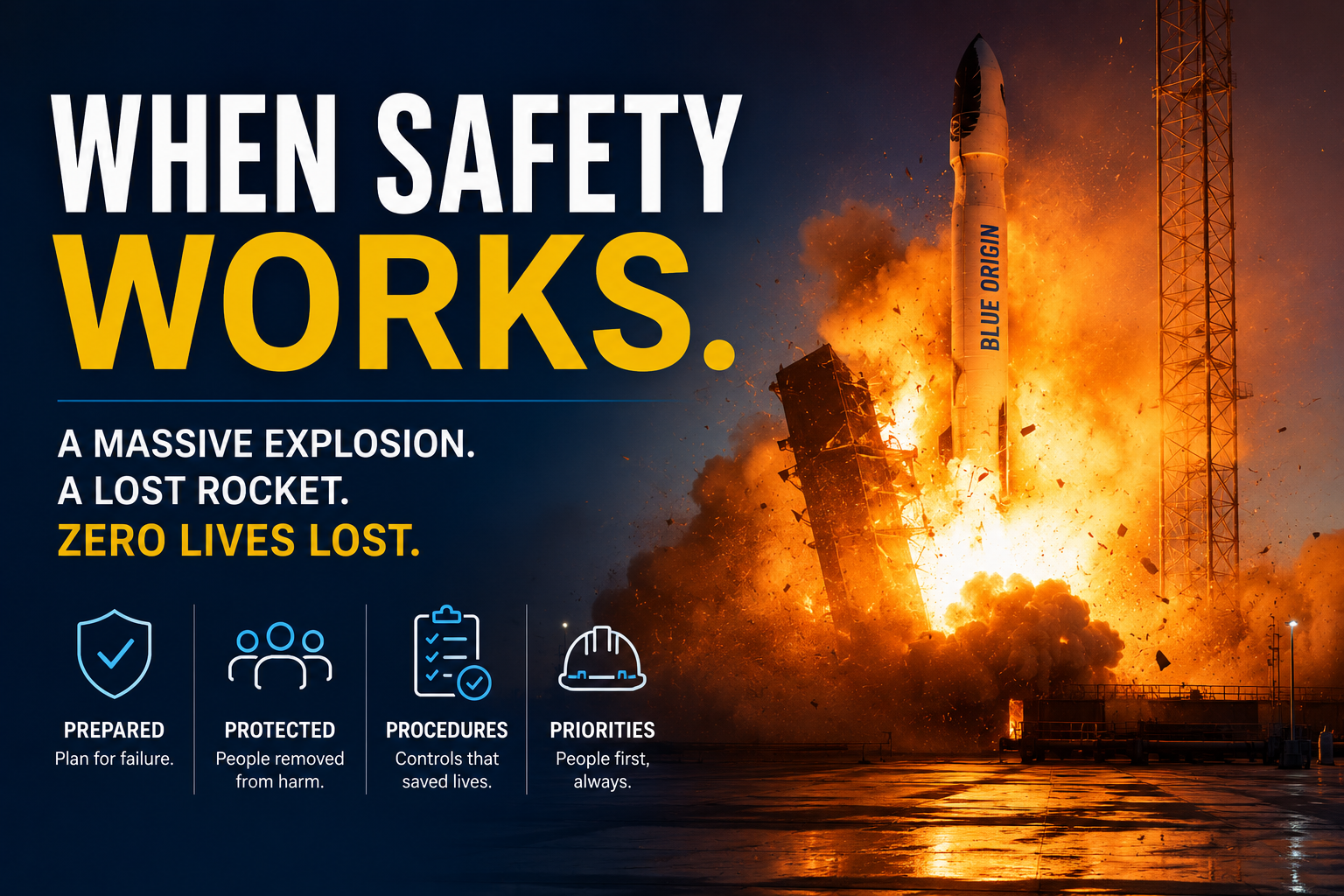
  • A Massive Explosion, a Lost Rocket, and Zero Fatalities: When Safety Works

    A Massive Explosion, a Lost Rocket, and Zero Fatalities: When Safety Works

    In an era where workplace incidents often dominate headlines because of the lives lost, the recent Blue Origin New Glenn launch pad explosion offers a different story—one that safety professionals should pay close attention to.

    On 28 May 2026, Blue Origin’s New Glenn rocket suffered a catastrophic failure during a static fire test at Cape Canaveral, Florida. Images of the incident showed an enormous fireball engulfing the launch pad, destroying the rocket and causing significant damage to surrounding infrastructure. The financial cost is expected to be substantial, and the impact on launch schedules may be felt for months.

    Yet despite the scale of the explosion, one critical fact stands out:

    Nobody was injured. Nobody was killed.

    For safety professionals, that outcome deserves just as much attention as the failure itself.

    While investigations will undoubtedly focus on the technical causes of the explosion, there is another equally important question worth asking:

    What went right?

    The Difference Between an Incident and a Tragedy

    The aerospace industry routinely works with some of the most hazardous materials and energy sources on the planet.

    Rocket engines operate at extreme temperatures and pressures. Cryogenic fuels are highly volatile. Propellant systems contain enormous amounts of stored energy.

    Everyone involved understands that the potential consequences of failure can be catastrophic.

    The reality is that a launch pad explosion is not simply a fire event—it is an uncontrolled release of massive amounts of energy capable of causing multiple fatalities if people are exposed.

    Yet in this case, despite the destruction of a multi-billion-dollar asset, human life was protected.

    That outcome was not luck.

    It was the result of planning.

    Safety Systems Doing Exactly What They Were Designed to Do

    One of the most important principles in modern safety management is recognising that controls exist for a reason.

    Too often, organisations only notice controls when they fail.

    The Blue Origin incident reminds us that effective controls often go unnoticed because they work.

    Before the test commenced, the launch facility was operating under established hazardous testing protocols. Personnel had been removed from the danger zone, exclusion areas had been established, and emergency response systems were in place.

    When the failure occurred, there were no workers standing next to the rocket.

    There were no maintenance crews operating nearby.

    There were no visitors observing from unsafe locations.

    The system had been designed around the assumption that something could go wrong.

    And when something did go wrong, people were protected.

    The Importance of Exclusion Zones

    Many industries can learn from this principle.

    In construction, mining, manufacturing, logistics, and energy production, organisations frequently rely on administrative controls and worker behaviour to manage risk.

    The aerospace industry often takes a different approach.

    Where catastrophic hazards exist, people are removed from exposure altogether.

    Launch facilities are designed with extensive exclusion zones because engineers accept that failures cannot always be prevented.

    The focus therefore shifts toward limiting consequences.

    This approach reflects a simple but powerful philosophy:

    If people are not exposed, they cannot be injured.

    The same thinking can be applied across many industries.

    Whether managing mobile plant, high-voltage systems, chemical processes, or heavy lifting operations, organisations should continually ask:

    “Can we remove people from the line of fire?”

    Planning for Failure

    One of the hallmarks of mature safety systems is recognising that failures will occur.

    No organisation sets out expecting a catastrophic event, but resilient organisations plan for them anyway.

    Blue Origin’s testing arrangements appear to have embraced this reality.

    Rather than assuming the rocket would perform perfectly, the testing environment was designed around a more important question:

    “What happens if it doesn’t?”

    This mindset is increasingly recognised as a critical component of modern safety thinking.

    The best organisations do not simply focus on preventing failure.

    They focus on ensuring failures do not become disasters.

    The Value of Emergency Preparedness

    Another lesson from the incident is the importance of emergency readiness.

    Large-scale explosions create confusion, uncertainty, and rapidly changing conditions.

    In these environments, emergency response arrangements become critical.

    Although details remain limited, the absence of injuries suggests emergency planning, communication systems, site access controls, and response coordination were all functioning effectively.

    Emergency preparedness is often viewed as a compliance requirement.

    Events like this demonstrate why it is much more than that.

    When serious incidents occur, preparation can be the difference between a recoverable event and a mass casualty incident.

    A Reminder for Industry Leaders

    The destruction of the New Glenn rocket will understandably generate significant technical investigation.

    Engineers will seek to understand the initiating event, contributing factors, and system failures.

    Those lessons will be important.

    However, there is another lesson that business leaders should not overlook.

    The most valuable asset on any site is not equipment.

    It is people.

    The rocket can be rebuilt.

    The launch pad can be repaired.

    Schedules can be adjusted.

    Lives cannot be replaced.

    The fact that no workers were harmed should be viewed as evidence that certain aspects of the safety system performed exceptionally well under extreme circumstances.

    Measuring Success Differently

    Many organisations evaluate safety performance primarily through injury statistics.

    While these metrics have value, they often fail to recognise successful risk management.

    A more mature perspective asks different questions:

    • Were workers exposed?
    • Did critical controls function?
    • Were emergency arrangements effective?
    • Did barriers prevent harm?

    By those measures, the Blue Origin incident provides a powerful example of safety systems working as intended.

    The technical failure was significant.

    The protection of human life was even more significant.

    Final Thoughts

    The explosion of Blue Origin’s New Glenn rocket will likely be studied for years within the aerospace industry.

    Investigators will identify technical causes, engineering lessons, and opportunities for improvement.

    Yet perhaps the most important lesson is already visible.

    A catastrophic event occurred.

    A major asset was destroyed.

    Millions of dollars in infrastructure were damaged.

    And every worker went home.

    In a profession dedicated to protecting people, that outcome should not be overlooked.

    Because sometimes the most important safety stories are not about what failed.

    They are about what worked.


    Disclaimer

    This article is provided for educational and informational purposes only. It is based on publicly available information available at the time of writing. Official investigations into the Blue Origin New Glenn incident remain ongoing, and conclusions regarding causes and contributing factors may change as additional information becomes available. Nothing in this article should be interpreted as a legal determination of fault, liability, negligence, or regulatory non-compliance.

  • World Safety News – 08JUN26

    World Safety News – 08JUN26

    1. Worker Dies After Fall From Height

    Tuscany, Italy
    Reported:
    4 June 2026

    A worker died after falling approximately six metres while undertaking work activities at the Sepe industrial facility on Via degli Artigiani in Rosignano, a coastal industrial area in Tuscany. The victim was a 30-year-old contractor of foreign origin working for an external company rather than the host employer.

    According to initial reports, the worker was conducting a site inspection on the roof/upper floor structure of an industrial warehouse in preparation for upcoming work. He was reportedly wearing the required personal protective equipment at the time. During the inspection, part of the structure appears to have suddenly failed, causing him to fall approximately six metres. Tragically, he then struck machinery that was operating below. Emergency responders arrived quickly, but he died at the scene from his injuries.


    2. Hanwha Aerospace Rocket Propellant Explosion

    Daejeon, South Korea
    Incident Date:
    1 June 2026

    Five workers were killed and two others seriously injured following a powerful explosion and subsequent fire at a Hanwha Aerospace facility involved in rocket propellant manufacturing. Initial reports indicate the incident occurred inside a production building where workers were reportedly cleaning equipment used in the handling of solid rocket propellant. Emergency services responded quickly, but the severity of the blast resulted in multiple fatalities.

    Subsequent reports suggest investigators are examining whether explosive residue remained on tools or equipment during cleaning activities. South Korean authorities later raided company offices and reportedly seized safety documentation, maintenance records, and operating procedures as part of the investigation.


    3. Lift Technician Crushed During Maintenance Work

    Mount Waverley, Victoria, Australia
    Incident Date:
    29 May 2026

    A lift technician died after becoming trapped and crushed while working on a residential lift system. WorkSafe Victoria confirmed the fatality and has commenced an investigation. While details remain limited, likely areas of focus include isolation procedures, stored energy hazards, maintenance task planning, and safe systems of work for lift servicing activities.


    4. Tata Steel Major Industrial Fire

    Port Talbot, Wales, United Kingdom
    Incident Date:
    3–4 June 2026

    A significant fire broke out at Tata Steel’s Port Talbot steelworks, generating large plumes of smoke and requiring a major emergency response. Approximately 100 responders attended the incident. Importantly, all personnel were successfully evacuated and accounted for. The event provides a strong example of emergency preparedness, evacuation management, and crisis response effectiveness in a major industrial facility.


    5. Forklift-Related Fatality During Truck Unloading

    Anderson County, South Carolina, USA
    Incident Date:
    1 June 2026

    Anthony Lamattina III, a warehouse worker and volunteer firefighter, was fatally crushed when a pallet fell from a forklift during unloading operations. The coroner determined the cause of death was traumatic asphyxiation. OSHA is investigating. The incident highlights persistent line-of-fire hazards, load stability issues, and the need for effective pedestrian exclusion zones around material handling operations.


    6. OSHA Findings Following Warehouse Fatality

    San Antonio, Texas, USA
    Incident Date:
    OSHA findings released 2 June 2026

    OSHA issued citations following a fatal forklift-related incident at an H-E-B warehouse. Investigators identified failures to conduct mandatory forklift operator re-evaluations and deficiencies relating to workplace infrastructure such as damaged guardrails. The case demonstrates how administrative controls and competency management failures can contribute to serious incidents.


    7. Fatal Fall During Solar Installation Work

    Sicily, Italy
    Reported:
    4 June 2026

    A 35-year-old worker involved in photovoltaic installation work was killed when a pallet of solar panels fell during unloading operations. The incident formed part of a series of workplace fatalities reported across Italy in a single day. Investigators are expected to examine load restraint, lifting procedures, and exclusion zones around unloading activities.


    8. Forklift Operator Killed in Logistics Facility

    Catania, Italy
    Reported:
    4 June 2026

    A 30-year-old worker died after being crushed by a forklift in an industrial logistics area. Limited details have been released, but the incident has renewed discussion around vehicle-pedestrian segregation, forklift operator competency, and traffic management controls in industrial facilities.

  • Legislative Updates

    Legislative Updates

    Germany

    Increased Enforcement of Heat Protection Measures in Industrial Workplaces

    German regulators are increasing scrutiny on workplace heat exposure following rising temperatures and concerns surrounding worker wellbeing during extreme weather events.

    Key Areas of Focus

    • Indoor heat management
    • Construction site heat controls
    • Hydration and rest break requirements
    • Ventilation standards
    • Worker exposure during heatwaves

    Why It Matters

    Climate-related safety risks are becoming a major European regulatory focus. Employers may increasingly be expected to demonstrate proactive heat risk management rather than relying solely on worker self-management.

    Industries Most Affected

    • Construction
    • Manufacturing
    • Warehousing
    • Logistics
    • Agriculture
    • Foundries and heavy industry

    Potential Business Considerations

    • Heat stress procedures
    • Environmental monitoring
    • Shift pattern changes during extreme temperatures
    • Emergency response arrangements

    Singapore

    Enhanced Workplace Safety Accountability Following Major Construction Incidents

    Singapore’s Ministry of Manpower continues strengthening enforcement expectations following several high-profile workplace fatalities and infrastructure incidents.

    Key Regulatory Themes

    • Increased director accountability
    • Stronger contractor oversight
    • Enhanced permit-to-work scrutiny
    • Safety culture assessments
    • Mandatory corrective action monitoring

    Why It Matters

    Singapore is increasingly positioning itself as a high-accountability regulatory environment where leadership responsibility and contractor management are central enforcement priorities.

    Industries Most Affected

    • Construction
    • Infrastructure
    • Marine and shipyard operations
    • Manufacturing
    • Energy

    Potential Business Considerations

    • Contractor auditing
    • Leadership safety governance
    • Permit-to-work reviews
    • Supervisory competency assessments

    Japan

    Growing Focus on Ageing Workforce Safety Risks

    Japanese regulators are increasingly focusing on occupational safety risks associated with ageing workforces and demographic pressures.

    Key Areas of Focus

    • Ergonomics
    • Manual handling
    • Fatigue management
    • Cognitive workload
    • Fall prevention
    • Extended working life support

    Why It Matters

    Many developed economies are facing similar workforce ageing challenges. Japan’s regulatory direction may influence future approaches globally.

    Industries Most Affected

    • Manufacturing
    • Logistics
    • Healthcare
    • Warehousing
    • Public transport
    • Maintenance operations

    Potential Business Considerations

    • Ergonomic redesign
    • Workforce capability assessments
    • Flexible task allocation
    • Physical workload reduction strategies

    United Arab Emirates

    Stricter Construction Safety Oversight and Summer Working Restrictions

    Authorities in the UAE continue reinforcing seasonal midday work bans and construction safety enforcement measures during extreme heat periods.

    Key Focus Areas

    • Outdoor worker protection
    • Hydration compliance
    • Rest shelter requirements
    • Construction supervision
    • Heat illness prevention

    Why It Matters

    Middle Eastern regulators are becoming increasingly active in climate-related worker protection enforcement.

    Industries Most Affected

    • Construction
    • Infrastructure
    • Oil & gas
    • Utilities
    • Transport and logistics

    Potential Business Considerations

    • Shift scheduling changes
    • Heat stress training
    • Worker welfare monitoring
    • Environmental exposure controls

    South Korea

    Industrial Accident Prevention Reform Following Manufacturing Fatalities

    South Korea continues strengthening industrial safety enforcement following several major manufacturing and heavy industry incidents.

    Key Themes

    • Executive accountability
    • Serious accident prevention
    • Contractor liability
    • Machinery safeguarding
    • Safety management systems

    Why It Matters

    South Korea’s Serious Accidents Punishment Act continues influencing how organisations manage executive-level accountability for workplace fatalities.

    Industries Most Affected

    • Heavy manufacturing
    • Shipbuilding
    • Automotive
    • Steel production
    • Chemical processing

    Potential Business Considerations

    • Executive due diligence
    • Contractor governance
    • Machinery risk assessments
    • Safety auditing improvements

    New Zealand

    Expanded Focus on Worker Mental Health and Agricultural Safety

    New Zealand regulators continue prioritising psychological wellbeing and rural workplace safety following ongoing injury and fatality concerns.

    Key Areas of Focus

    • Farm vehicle safety
    • Fatigue in agriculture
    • Worker isolation
    • Mental health support
    • Seasonal worker risks

    Why It Matters

    Agriculture remains one of the highest-risk sectors globally, and New Zealand’s approach may shape future rural safety regulation elsewhere.

    Industries Most Affected

    • Agriculture
    • Forestry
    • Transport
    • Rural contracting
    • Food production

    Potential Business Considerations

    • Fatigue controls
    • Vehicle safety reviews
    • Lone worker procedures
    • Rural emergency response planning

    France

    Increased Scrutiny of Chemical Exposure and Occupational Cancer Prevention

    French occupational safety authorities are expanding focus on long-term exposure management and occupational disease prevention.

    Key Focus Areas

    • Chemical exposure limits
    • Carcinogen controls
    • Worker health surveillance
    • Exposure documentation
    • Ventilation standards

    Why It Matters

    European regulators continue moving toward stronger occupational health protection and long-term illness prevention.

    Industries Most Affected

    • Chemicals
    • Pharmaceuticals
    • Manufacturing
    • Laboratories
    • Waste management

    Potential Business Considerations

    • Exposure monitoring
    • Occupational hygiene reviews
    • Health surveillance programs
    • PPE reassessment

    India

    Growing Regulatory Attention on Industrial Fire and Process Safety

    Following multiple industrial fires and explosions, Indian authorities are increasing focus on industrial emergency preparedness and hazardous process safety.

    Key Themes

    • Fire safety systems
    • Hazardous chemical storage
    • Emergency response capability
    • Permit-to-work systems
    • Industrial inspections

    Why It Matters

    Rapid industrial growth is increasing pressure for stronger operational safety governance across manufacturing and process industries.

    Industries Most Affected

    • Chemicals
    • Pharmaceuticals
    • Manufacturing
    • Warehousing
    • Oil & gas

    Potential Business Considerations

    • Fire risk assessments
    • Emergency drills
    • Process safety management reviews
    • Hazardous materials controls

    Nordic Countries

    Increased Focus on Sustainable Workplaces and Work-Life Balance

    Nordic regulators continue integrating worker wellbeing into broader occupational health frameworks.

    Key Themes

    • Burnout prevention
    • Flexible working risks
    • Work-life balance
    • Psychosocial safety
    • Remote work ergonomics

    Why It Matters

    Nordic countries often influence future European workplace wellbeing standards.

    Industries Most Affected

    • Professional services
    • Technology
    • Government
    • Education
    • Healthcare

    Potential Business Considerations

    • Remote work assessments
    • Burnout prevention strategies
    • Workload management
    • Ergonomic support for hybrid workers

    Emerging Global Trends Worth Monitoring

    Several additional themes are emerging globally that businesses should watch closely:

    1. Climate-Related Safety Regulation

    Heat exposure, severe weather, wildfire smoke, and environmental hazards are increasingly entering workplace safety frameworks.

    2. Executive Liability Expansion

    More jurisdictions are strengthening director and officer accountability following major incidents.

    3. Human Factors & Fatigue

    Regulators are increasingly recognising fatigue, cognitive overload, and human performance limitations as systemic risks.

    4. Technology Governance

    AI, automation, surveillance systems, and robotics are becoming emerging regulatory focus areas.

    5. Occupational Illness Prevention

    Long-term health exposure risks are increasingly receiving the same attention as immediate physical safety hazards.

    These developments suggest global workplace safety regulation is continuing to evolve beyond traditional hazard control toward broader organisational governance, worker wellbeing, and operational resilience.