Tag: Crane

  • World Safety News – 27JUL26

    World Safety News – 27JUL26

    INCIDENTS

    1. Worker Killed in Haul Truck Collision at Peak Downs Mine

    Incident Date: 24 July 2026

    Location: Peak Downs Mine, Moranbah, Queensland, Australia

    One worker was killed and another sustained serious injuries after a light vehicle collided with a large mining haul truck at BHP Mitsubishi Alliance’s (BMA) Peak Downs Mine near Moranbah. The two workers were travelling in a contractor-operated light vehicle when it became involved in the collision with the haul truck during mining operations. Emergency services responded to the incident; however, one worker died at the scene while the second was transported to hospital with serious injuries.

    The incident prompted BMA to suspend operations across its Bowen Basin coal mines for 24 hours while emergency response activities and initial investigations commenced. Resources Safety and Health Queensland and Queensland Police have commenced investigations into the circumstances surrounding the fatal collision. The incident represents one of Australia’s most significant mining fatalities reported this year.

    2. Multiple Workers Killed Following Tunnel Explosion

    Incident Date: 20 July 2026

    Location: Teesta Hydroelectric Project, Sikkim, India

    Multiple construction workers were killed following a methane explosion inside an underground tunnel being excavated for the Teesta Hydroelectric Project in Sikkim. The explosion resulted in a partial tunnel collapse, trapping numerous workers underground and creating an extremely hazardous atmosphere for rescue personnel.

    Emergency rescue operations continued for several days as specialist teams worked in confined conditions affected by toxic gases and unstable ground. The incident is one of the most serious underground construction disasters reported internationally this year and has highlighted the significant hazards associated with tunnel construction in confined environments.

    3. Underground Locomotive Accident Claims Mine Worker’s Life

    Incident Date: 24 July 2026

    Location: Impala Platinum Mine, Rustenburg, South Africa

    A mine worker was killed during an underground locomotive accident at Impala Platinum’s 14 Shaft operation near Rustenburg. The worker was reportedly operating underground rail transport equipment when the fatal incident occurred during normal mining activities.

    Mine rescue personnel responded immediately, however the worker succumbed to injuries sustained in the incident. Underground transport systems remain critical to mining operations but continue to present significant risks where personnel and mobile equipment interact in confined underground environments.

    4. Worker Killed in Power Haulage Incident at Lime Mine

    Incident Date: 6 July 2026

    Location: St. Clair Mine, Marble City, Oklahoma, United States

    A miner was fatally injured at the United States Lime Company’s St. Clair Mine in Marble City, Oklahoma, after becoming crushed between a rail car and a structural beam. The incident occurred during mining operations and was classified by the Mine Safety and Health Administration (MSHA) as a Powered Haulage fatality. Emergency response personnel attended the scene; however, the worker succumbed to injuries sustained in the incident.

    Powered haulage incidents continue to be one of the leading causes of fatalities within the U.S. mining industry. MSHA has commenced a formal investigation into the circumstances surrounding the incident, with a detailed fatal accident report expected following completion of its examination.

    5. Construction Worker Killed Following Tower Crane Collapse

    Incident Date: 16 July 2026

    Location: JP North Residential Complex, Mira Road (East), Thane District, Maharashtra, India

    One construction worker was killed and three others were injured after a tower crane collapsed from the 13th floor of an under-construction residential tower at the JP North residential complex in Mira Road, near Mumbai. The crane fell from the upper levels of the building onto the podium area below, crushing several parked vehicles and trapping workers beneath the steel structure. Emergency services, including the fire brigade, police and disaster response personnel, carried out a rescue operation to extricate those trapped. Twenty-year-old construction worker Mujammil Khokhar sustained fatal injuries, while three other workers were transported to hospital for treatment.

    Police have registered a case and commenced an investigation into the circumstances surrounding the collapse. Authorities are examining whether failures in crane installation, maintenance, operation or site management contributed to the incident. The collapse has renewed attention on the risks associated with tower crane operations on high-rise construction projects, particularly where lifting activities are undertaken above occupied areas and where falling equipment has the potential to endanger both workers and members of the public.

    6. Contractor Killed During Maintenance at Copper Mine

    Incident Date: 26 July 2026

    Location: United States

    A contractor was killed while carrying out maintenance work at a copper mining operation in the United States after the gantry bridge on which they were working collapsed into a thickener tank. The worker was reportedly assisting with the removal of a rake shaft from the thickener when the structural failure occurred, causing the worker to fall into the tank. Despite emergency response efforts, the contractor died as a result of injuries sustained during the incident. The mine operator confirmed the fatality and temporarily suspended work in the affected area while emergency services and investigators attended the scene.

    An investigation has been commenced to determine the circumstances leading to the collapse, including the condition of the gantry bridge, the maintenance procedures being undertaken and the controls in place for the task. The incident highlights the significant risks associated with maintenance activities in the mining industry, particularly where workers are exposed to structural hazards, work at height and heavy mechanical equipment during planned shutdown and repair operations.

    7. Worker Dies During Trenching Operations at Texas Construction Site

    Incident Date: 21 July 2026

    Location: New Braunfels, Texas, United States

    A construction worker was killed following a workplace incident while working with a trenching crew at a construction site in New Braunfels, Texas. Emergency services were called to the site shortly before midday after reports of a serious workplace accident. The worker, identified as Cornelio Martinez, 34, of Somerset, Texas, was pronounced dead at the scene. The Comal County Sheriff’s Office has confirmed the incident and is investigating the circumstances surrounding the fatality. Authorities have not yet released details regarding the specific work being undertaken or the cause of the incident.

    Trenching and excavation activities remain among the highest-risk operations undertaken within the construction industry due to the potential for ground collapse, contact with underground services, hazardous atmospheres and the operation of heavy plant in confined work areas. While the precise cause of this incident has not yet been determined, the investigation is expected to examine the work practices, site conditions and controls that were in place at the time of the accident.

    8. Contractor Fatally Injured in Engulfment Incident at Bituminous Coal Mine

    Incident Date: 11 July 2026

    Location: Bailey Mine, Wind Ridge, Pennsylvania, United States

    A contractor was fatally injured following an engulfment incident at Bailey Mine near Wind Ridge, Pennsylvania. According to the U.S. Mine Safety and Health Administration (MSHA), the worker was engulfed by falling coal spillage while shovelling beneath a silo at the bituminous coal mining operation. Emergency response procedures were initiated following the incident; however, the contractor later died as a result of injuries sustained. MSHA has classified the incident as an engulfment fatality and has commenced a formal investigation into the circumstances surrounding the accident.

    The cause of the incident has not yet been determined, and investigators are expected to examine the conditions that led to the release of the material, the work being undertaken at the time, and the controls that were in place to protect workers operating in the area. Engulfment hazards remain a significant risk wherever workers are required to work around stored bulk materials, highlighting the importance of effective hazard identification, exclusion zones and safe systems of work during maintenance and operational activities.
  • Three Workers Killed in India Crane Collapse

    Three Workers Killed in India Crane Collapse

    Early Lessons from a Fatal Infrastructure Construction Incident

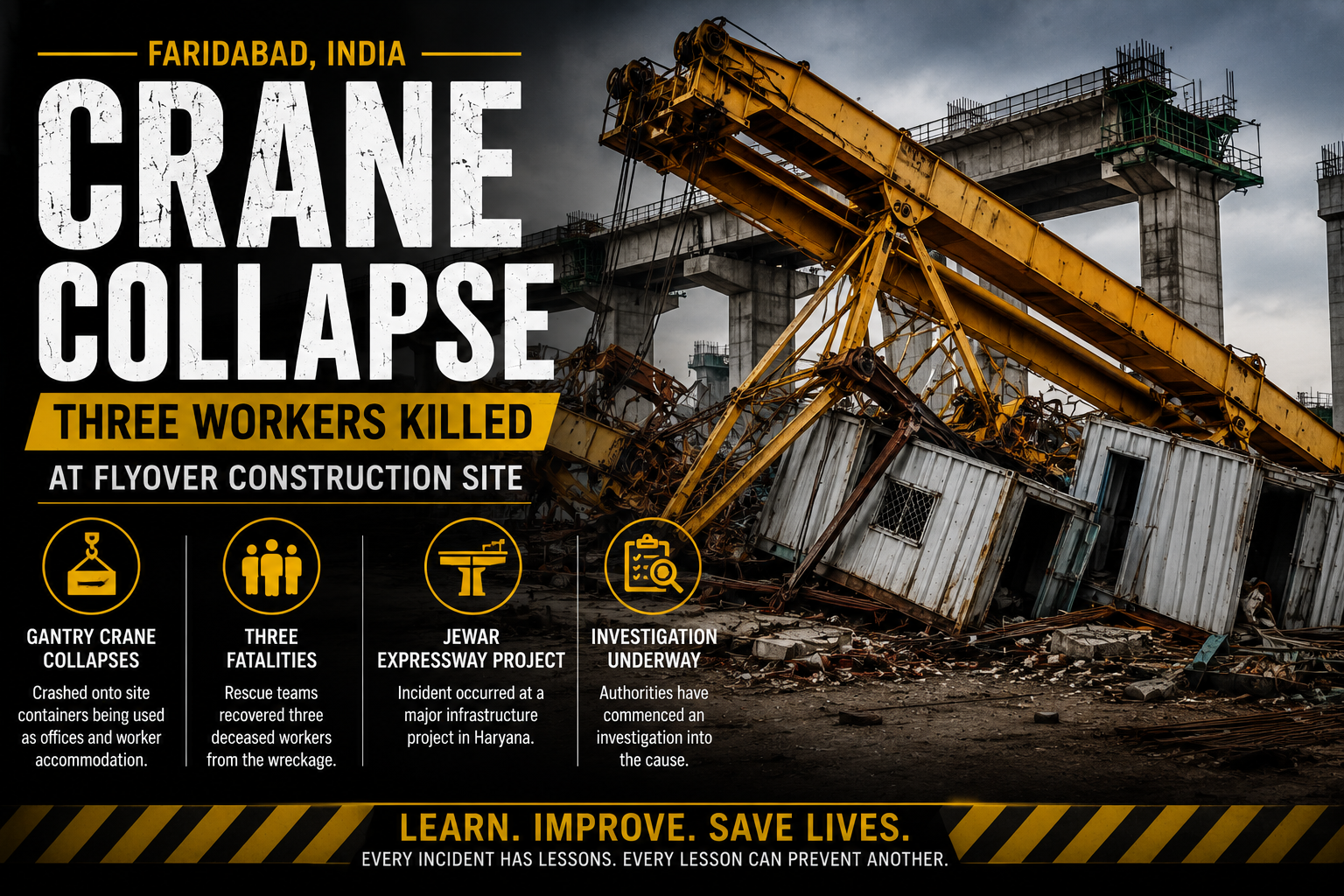
    Three workers have been killed following the collapse of a gantry crane at a major flyover construction project in Faridabad, Haryana, India, in what is shaping up to be one of the most significant workplace incidents reported globally this week.

    The incident occurred on 4 June 2026 at a construction site associated with the Jewar Expressway project. According to initial reports, a large gantry crane collapsed unexpectedly, striking site containers being used as offices and worker accommodation. Rescue teams responded to the scene and recovered three deceased workers from the wreckage. Investigations into the cause of the collapse are now underway.

    While many details remain unknown, the tragedy highlights several recurring themes that continue to feature prominently in serious construction incidents around the world: lifting operations, temporary works management, structural stability, and the protection of workers from line-of-fire hazards.

    What We Know

    Based on publicly available information:

    • The incident occurred on 4 June 2026.
    • The crane involved was reported to be a gantry crane used in flyover construction activities.
    • The crane collapsed onto site containers.
    • Three workers lost their lives.
    • Emergency responders conducted rescue operations following the collapse.
    • Authorities have commenced an investigation.

    At the time of writing, investigators have not publicly released information regarding:

    • The exact stage of construction being undertaken.
    • Whether lifting operations were underway at the time.
    • The condition of the crane prior to the incident.
    • Weather conditions.
    • Whether any mechanical or structural failures occurred.
    • Whether the containers were approved for occupancy within the crane operating zone.

    These questions are likely to form a key part of the investigation.

    Understanding the Hazard

    Large gantry cranes are commonly used on major infrastructure projects to move heavy structural components such as bridge segments, girders, formwork, and precast elements.

    These cranes can weigh hundreds of tonnes and operate under significant loads. As a result, any loss of stability can have catastrophic consequences.

    Unlike many workplace hazards, crane collapses typically provide little or no warning. Once structural failure begins, workers within the collapse zone often have only seconds—or less—to react.

    For this reason, modern lifting operations rely heavily on preventive controls designed to stop workers being exposed to potential collapse zones in the first place.

    ICAM Analysis

    Failed or Missing Defences

    Failure of Structural Integrity

    The most obvious failed defence appears to be the loss of structural stability of the crane itself.

    Investigators will likely examine:

    • Structural condition of the crane
    • Inspection and maintenance records
    • Engineering design requirements
    • Previous defects or repairs
    • Foundation and support arrangements

    Any weakness in these areas may have contributed to the collapse.

    Failure of Exclusion Zones

    One of the most significant questions relates to worker exposure.

    Reports indicate that the crane collapsed onto occupied site containers.

    This raises an important issue:

    Why were workers located within an area that could potentially be impacted by crane failure?

    While investigations may ultimately determine that the risk was considered acceptable, investigators will almost certainly examine whether adequate exclusion zones existed around the crane and whether worker facilities were appropriately located.

    Failure of Temporary Works Management

    Major infrastructure projects rely heavily on temporary works systems.

    These may include:

    • Crane foundations
    • Support structures
    • Bracing systems
    • Access platforms
    • Construction sequencing

    Failures within temporary works systems have been identified as contributing factors in numerous major construction disasters globally.

    Investigators are likely to review engineering approvals, inspections, and change management processes associated with the crane installation.

    Individual and Team Actions

    At this stage there is no evidence suggesting worker actions contributed directly to the incident.

    ICAM recognises that worker behaviour is influenced by the systems in which people operate.

    Accordingly, investigators will likely focus on organisational and engineering factors rather than individual decisions.

    Task and Environmental Conditions

    Several environmental factors commonly contribute to crane incidents:

    Wind Loading

    Strong winds can significantly affect crane stability and lifting operations.

    Investigators will likely review weather conditions at the time of the collapse.

    Ground Conditions

    Crane stability is heavily dependent on the integrity of supporting ground and foundations.

    Questions may include:

    • Were geotechnical assessments completed?
    • Were settlement issues identified?
    • Were support structures inspected?

    Construction Progression

    As projects evolve, loading conditions and crane configurations can change.

    Investigators may examine whether recent modifications, relocations, or changes in operating conditions affected the crane’s stability.

    Organisational Factors

    Engineering Verification

    Large lifting equipment should be subject to rigorous engineering oversight.

    Investigators may examine:

    • Design verification processes
    • Inspection regimes
    • Third-party certifications
    • Load calculations
    • Change management systems

    Critical Risk Management

    Crane collapse represents a low-frequency but high-consequence event.

    Organisations should identify crane operations as a critical risk and implement controls that are routinely verified rather than assumed.

    Worker Accommodation Placement

    One potentially significant issue emerging from early reports is the location of site containers.

    Where workers are routinely housed, accommodated, or working within the potential collapse radius of heavy lifting equipment, organisations should carefully assess whether the risk is reasonably practicable and adequately controlled.

    Potential Root Causes

    While definitive conclusions cannot be drawn at this stage, investigators may ultimately identify factors such as:

    Immediate Causes

    • Loss of crane structural stability
    • Mechanical or structural failure
    • Foundation or support system failure

    Potential Contributing Factors

    • Inadequate inspections
    • Design deficiencies
    • Poor maintenance
    • Excessive loading
    • Environmental influences
    • Inadequate exclusion zones
    • Deficiencies in temporary works management

    Potential Organisational Factors

    • Weak critical risk management systems
    • Inadequate engineering oversight
    • Poor verification of controls
    • Deficient planning processes
    • Inadequate change management

    Lessons for Industry

    Although the investigation has only just begun, several important lessons already emerge.

    1. Keep People Out of the Line of Fire

    The most effective protection is often separation.

    Workers should not be routinely exposed to potential collapse zones where practical alternatives exist.

    2. Review the Location of Site Facilities

    Site offices, lunchrooms, and accommodation should be located outside high-risk operating areas wherever possible.

    3. Strengthen Engineering Assurance

    All lifting equipment should be subject to robust inspection, maintenance, and engineering verification programs.

    4. Verify Critical Controls

    Critical controls should be actively verified through inspections and audits rather than assumed to be functioning.

    5. Improve Temporary Works Governance

    Temporary works should be treated with the same level of engineering discipline as permanent structures.

    6. Consider Worst-Case Scenarios

    Risk assessments should evaluate not only routine operations but also the consequences of catastrophic equipment failure.

    7. Strengthen Emergency Preparedness

    Rapid emergency response can significantly reduce the severity of outcomes following major incidents.

    Final Thoughts

    While investigators continue their work, the Faridabad crane collapse serves as a stark reminder of the immense forces involved in modern construction activities.

    Across industries, one lesson remains consistent: when critical assets fail, the consequences can be catastrophic. The organisations that achieve the strongest safety outcomes are often those that focus not only on preventing failures, but also on ensuring that people are protected when failures occur.

    As further information emerges, the findings from this investigation are likely to provide valuable lessons for construction, infrastructure, mining, manufacturing, and heavy industry operations around the world.


    Disclaimer

    This article is provided for educational and informational purposes only. It is based on publicly available information available at the time of writing. The investigation into this incident remains ongoing, and the causes, contributing factors, and circumstances discussed in this article are preliminary observations and potential considerations rather than confirmed findings.

    Nothing in this article should be interpreted as a legal determination of fault, liability, negligence, or regulatory non-compliance. Readers should rely on official investigation findings and seek advice from appropriately qualified safety, engineering, and legal professionals when assessing similar risks within their own organisations.