Tag: Australia

  • Lessons Learned: When Stored Energy Becomes the Hazard

    Lessons Learned: When Stored Energy Becomes the Hazard

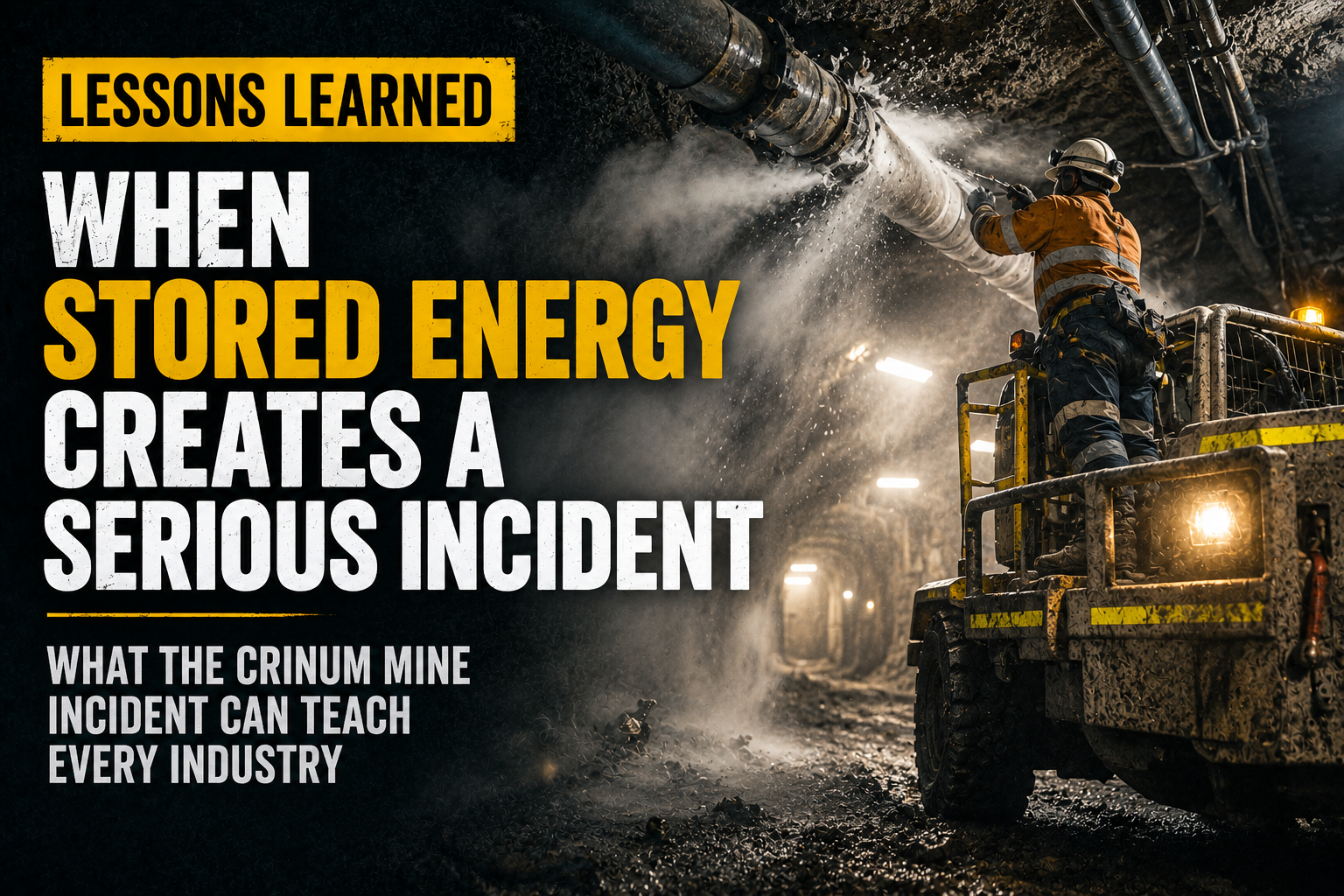
    What the Crinum Mine incident can teach every industry about isolation, line of fire and changing conditions

    On 12 September 2026, a worker at the Crinum underground coal mine in Queensland sustained life-threatening injuries during maintenance work involving a pressurised compressed-air pipeline. What began as maintenance on a pipe assembly developed into a sequence involving stored energy, a sudden release of compressed air, reduced visibility, a fall from a mobile vehicle and subsequent contact between the worker and that vehicle.

    The worker, a 71-year-old man, suffered significant injuries to his chest, face, arms and abdomen. He was initially taken to Emerald Hospital before being transferred to Rockhampton Hospital and then flown to the Royal Brisbane and Women’s Hospital in Brisbane in a critical condition. A subsequent report said he required surgery to his jaw and that his condition was improving. Further details about the full extent of his injuries and his recovery have not been publicly released.

    Resources Safety and Health Queensland (RSHQ) issued a Safety Alert following the incident, stating that the precise sequence of events and circumstances remained subject to investigation and verification. The regulator’s preliminary information provides enough detail, however, to examine a set of hazards that exists in almost every industry: stored energy, isolation, line-of-fire exposure, work positioning and interaction with mobile equipment.

    That is what makes the Crinum incident particularly valuable as a safety case study. The lesson is not simply about compressed air or underground mining. It is about what can happen when one unexpected release of energy changes the conditions around a worker and allows several hazards to interact.

    What happened?

    According to RSHQ’s preliminary account, the worker was undertaking maintenance on a pressurised compressed-air pipeline system. He was standing on the front bumper bar of a drift runner — a heavy-duty utility vehicle used to transport workers and materials — to access the pipework.

    While the worker was tightening a clamp, the pressurised clamp and pipe assembly reportedly failed. The failure released compressed air, creating significant dust and reducing visibility. The worker subsequently fell from the front of the drift runner.

    RSHQ says that, for reasons yet to be determined, the operator of the drift runner then moved the vehicle and it made contact with the fallen worker. The worker suffered serious injuries. The investigation into the precise sequence and circumstances remains ongoing.

    The important point is that the eventual injury was not the result of one isolated hazard. There was pressure energy within the compressed-air system. There was the physical exposure created by the worker’s position on the vehicle. There was gravitational energy associated with the elevated position. There was the sudden release of compressed air and the resulting loss of visibility. And there was mechanical energy associated with the movement of the drift runner.

    The incident became serious because those hazards interacted.

    The first question: Why was the system capable of releasing energy?

    Compressed air is one of the most familiar utilities in industry. It is used for tools, instrumentation, cleaning, conveying, control systems and countless other applications. Its familiarity can make it easy to underestimate.

    Compressed air is stored energy. Until that energy has been positively isolated and released or otherwise controlled, the system can remain capable of causing serious harm.

    RSHQ’s guidance following the incident specifically tells mine operators to verify that effective controls are in place for work involving pressurised systems and stored energy. Its broader guidance also emphasises the need to isolate and depressurise pressurised systems before maintenance and to verify that the energy has been removed.

    The principle is universal. A hydraulic accumulator can contain stored pressure. A steam line can contain heat and pressure. A pneumatic cylinder can move unexpectedly. A suspended load contains gravitational potential energy. An electrical capacitor can remain energised after equipment has been switched off. A rotating flywheel can continue to store kinetic energy after its drive has stopped.

    The critical question is therefore not simply:

    “Has the equipment been switched off?”

    It is:

    “What energy could still be present, and how do we know that it has been made safe?”

    Isolation is not the same as switching off

    One of the recurring weaknesses in maintenance work across many industries is the assumption that stopping equipment means the equipment has been made safe.

    A valve may be closed while pressure remains downstream. A circuit breaker may be open while another energy source remains connected. A hydraulic system may have stopped moving while pressure remains trapped within the system. A machine may be stationary while gravity, stored tension or another mechanical force remains capable of producing movement.

    Effective isolation therefore needs to address the complete energy pathway. The source needs to be identified and isolated. Stored energy needs to be dissipated, restrained or otherwise controlled. And, critically, the absence of hazardous energy needs to be verified.

    Verification is the step that turns an assumption into evidence.

    The second question: Where was the worker positioned?

    RSHQ’s preliminary information indicates that the worker was standing on the front bumper bar of the drift runner to access the pipework. The regulator subsequently advised mine operators to ensure that suitable work platforms are used and that mobile equipment is not used for that purpose.

    This is an important part of the story because work positioning can determine how a person is exposed when something goes wrong. The worker was not simply beside a pressurised pipe. He was positioned on a mobile vehicle, close to the component being worked on.

    When the pipe assembly reportedly failed, the consequences extended beyond the pressure release itself. Dust was generated, visibility was reduced, the worker fell and the vehicle subsequently made contact with him.

    This illustrates a broader principle:

    A work method should be assessed not only for whether it allows a task to be completed, but for what happens if the task does not go according to plan.

    A worker may be able to reach a component by standing on a vehicle, climbing onto machinery or working from an improvised position. But if the component fails, what happens next? Where does the worker go? Where does the released energy go? What happens to the equipment? And what happens if visibility disappears?

    The third question: What happened when conditions changed?

    Perhaps the most important lesson from the incident is what happened immediately after the component reportedly failed.

    The release of compressed air created significant dust and reduced visibility. The environment had changed. The task that existed seconds earlier was no longer the same task. This is a critical point in maintenance safety.

    Risk assessments, job safety analyses and work procedures are generally developed around an anticipated sequence of events. But real work is dynamic. Components fail. Conditions change. Unexpected noises occur. Equipment moves. Pressure changes. Visibility disappears. A robust safety system therefore needs a mechanism for recognising when the original risk assessment is no longer valid.

    RSHQ’s Safety Alert specifically tells workers to identify hazards, assess risks and verify that controls remain effective before commencing work and whenever conditions change. That principle applies whether the workplace is a mine, refinery, factory, warehouse, construction site, power station or transport depot. When conditions change significantly, the correct response may be to stop the task, withdraw to a safe position and reassess.

    The chain matters more than the individual event

    It would be easy to focus on the pipe failure, but consider the sequence more broadly:

    Pressurised system → component failure → uncontrolled release of energy → dust and reduced visibility → worker falls → mobile equipment moves → worker is struck.

    Each event changed the conditions for what followed. If the system had been fully isolated and depressurised, the pipe failure would not have had the same energy available to release. If the worker had been positioned on a suitable work platform, the consequences of the sudden release may have been different. If the vehicle had been positively isolated against movement while the maintenance task was being performed, the subsequent interaction may not have occurred. If the worker and vehicle had been physically separated, the fall and vehicle movement would not necessarily have resulted in contact.

    This is why high-consequence risk management should not depend on one control. A strong system uses multiple layers of protection so that if one control fails, another prevents the event from escalating.

    The importance of line of fire

    “Line of fire” is sometimes used as a simple safety slogan. The Crinum incident illustrates why it should be treated as a practical risk-management concept. A line of fire exists wherever a person could be struck by released energy, moving equipment, falling objects, pressure, stored force or another uncontrolled physical effect.

    For pressurised systems, the line of fire may include the direction in which a component could move or rupture. For mobile equipment, it includes the machine’s movement envelope. For suspended loads, it includes the area beneath or around the load. For electrical systems, it can include the area affected by an arc or electrical contact.

    The objective is not simply to warn workers about these zones. Where reasonably practicable, the system of work should keep people out of them.

    What underlying conditions should organisations examine?

    The investigation at Crinum will determine which factors actually contributed to the event. It would be inappropriate at this stage to declare particular management failures as established facts. The incident nevertheless provides an opportunity for other organisations to examine their own systems.

    The first area is stored-energy management.

    Do maintenance procedures identify all relevant energy sources? Are isolation points clearly defined? Can the system be depressurised? Is residual energy accounted for? Is isolation locked and controlled? Can the zero-energy state be verified?

    The second is work positioning.

    Does the task require workers to climb onto machinery, vehicles or structures to gain access? If so, is that the intended method of work, or has a workaround become normal?

    The third is mobile-plant interaction.

    Can a vehicle or machine move while someone is working on or beside it? If movement is possible, what prevents it? Is the isolation controlled by the person exposed to the hazard?

    The fourth is line of fire.

    If a component fails, where will the energy go? Where will the worker move? Where could equipment move? Could a person instinctively move into another hazard while trying to escape the first one?

    The fifth is change management at the task level.

    What happens when the job doesn’t proceed as expected? Does the work procedure require a stop and reassessment? Do workers have the authority to stop? Does the work environment make it practical to withdraw safely?

    A serious incident does not need a complex cause to have complex consequences

    One of the useful lessons from Crinum is that the initiating event does not have to be particularly complicated.

    A clamp and pipe assembly reportedly failed. That single event then interacted with the way the work had been positioned and the presence of mobile equipment.

    This is a common feature of serious incidents. The component that fails may be relatively simple. The consequences become severe because the surrounding system has allowed several hazards to interact.

    This is why safety professionals should examine interfaces, not just individual hazards.

    The interface between maintenance and operations.

    The interface between people and mobile plant.

    The interface between stored energy and access.

    The interface between a changing environment and a fixed risk assessment.

    These interfaces are often where controls become weakest.

    Universal recommendations

    1. Identify every source of stored energy

    Before maintenance or intervention begins, identify pressure, electrical energy, hydraulic energy, pneumatic energy, gravity, heat, mechanical movement, stored tension and any other energy capable of causing harm. Do not assume that because the primary machine is switched off, all hazardous energy has disappeared.

    2. Isolate and verify

    Isolation should prevent hazardous energy from reaching the work area. Stored energy should then be dissipated, restrained or otherwise controlled. Finally, verify the zero-energy condition before work begins. The verification step should be practical and observable rather than simply relying on someone stating that the system is isolated.

    3. Keep people outside the line of fire

    Where possible, design the task so that workers do not occupy the area into which energy could be released. If the hazard cannot be eliminated, consider engineering controls such as barriers, remote operation, physical separation or other means of preventing exposure.

    4. Provide a suitable means of access

    Workers should not need to improvise access to complete routine maintenance. If a task requires elevated access, provide a suitable work platform. If the equipment cannot safely be used as a work platform, the system should make that clear and provide an alternative.

    5. Physically control mobile equipment

    Where maintenance workers are exposed to mobile plant, ask whether the equipment can be physically prevented from moving. Communication and awareness remain important, but physical isolation is generally more reliable than relying on people to anticipate one another’s actions.

    6. Design for unexpected failure

    Do not assess the task only under normal conditions. Ask what happens if:

    • the component breaks;
    • pressure is released;
    • a hose ruptures;
    • visibility disappears;
    • a machine moves;
    • a worker falls;
    • a load shifts; or
    • someone reacts instinctively to an unexpected event.

    The resulting answers can reveal hazards that a conventional task assessment may overlook.

    7. Stop when conditions change

    An unexpected event should be treated as a trigger to reassess. A change in pressure, unexpected movement, unusual noise, loss of visibility or component failure can invalidate the assumptions on which the original task assessment was based. Stopping is not a failure of the job. Sometimes stopping is the control.

    8. Make critical controls visible

    High-consequence controls should be clearly identified. Workers and supervisors should be able to determine whether those controls are actually present before the task proceeds. This is particularly important for isolation, exclusion zones, access equipment and mobile-plant controls.

    9. Give workers a genuine stop-work authority

    Workers need both the authority and the practical ability to stop a task when conditions become unsafe. That authority needs to be supported by supervisors and management. A system in which workers technically have “stop-work authority” but are discouraged from using it is not an effective control.

    10. Examine interactions, not just individual hazards

    The Crinum event demonstrates why risk assessments should ask more than:

    “What are the hazards?”

    They should also ask:

    “What happens if these hazards interact?”

    Pressure plus access. Access plus mobile plant. A fall plus moving equipment. An unexpected release plus reduced visibility. It is often the interaction between hazards that produces the serious outcome.

    What happened afterwards?

    Following the incident, RSHQ directed that the scene be isolated and that certain operations be suspended until they could be performed at an acceptable level of risk. The regulator subsequently lifted the directive to suspend particular operations, and Sojitz Blue began a staged recommencement of activity at the Crinum underground mine while the detailed investigation continued.

    That sequence is important. A serious incident does not automatically mean that every activity at a site must remain suspended indefinitely. Equally, resuming operations does not mean that the investigation is complete or that every causal question has been answered.

    The important principle is that work should only recommence where the relevant controls have been reviewed and the regulator and operator are satisfied that the affected activities can be performed at an acceptable level of risk.

    The broader lesson

    The Crinum incident is a reminder that stored energy is not simply an engineering problem. It is a management problem.

    Every industry has its equivalent of the pressurised compressed-air pipeline. It might be a hydraulic accumulator in a manufacturing plant. A steam line in a power station. An electrical distribution system on a construction project. A suspended load in a warehouse. A compressed-gas cylinder in a laboratory. A tensioned component in a transport system. The energy may be invisible. The controls cannot be.

    The safest maintenance task is not necessarily the one with the longest procedure. It is the one where the organisation can demonstrate that the energy has been identified, the hazardous state has been controlled, the worker is positioned outside the credible line of fire and the equipment cannot unexpectedly interact with the person performing the work.

    The investigation at Crinum will ultimately determine how the incident developed and which controls were effective or ineffective. Until those findings are available, it would be inappropriate to assign responsibility or draw conclusions about individual decisions. Organisations do not need to wait for the final investigation to examine their own exposure.

    Where is our stored energy?

    How do we isolate it?

    How do we prove it is isolated?

    Where would the energy go if something failed?

    And what happens if the conditions suddenly change?

    Those questions are relevant in almost every workplace.

    Regulatory source

    Resources Safety and Health Queensland — Safety Alert No. 485, 14 September 2026

    Serious accident involving a pressurised compressed-air system and mobile equipment — RSHQ

    The RSHQ alert remains the principal regulatory source for this incident. It states that the precise sequence and circumstances remain subject to investigation and verification, and provides specific guidance concerning stored energy, pressurised systems, suitable work platforms, mobile equipment and reassessment when conditions change.

    Disclaimer

    This article has been prepared by World Safety News for general information, learning and safety-awareness purposes. It is not a substitute for professional safety, engineering, legal or regulatory advice. The circumstances surrounding the Crinum mine incident remain subject to investigation, and information available at the time of publication may change as further evidence becomes available. References to possible contributing factors, control weaknesses or safety considerations in this article should not be interpreted as findings about the incident, its causes or the conduct of any individual or organisation. Organisations should assess their own risks and controls in accordance with applicable legislation, standards, manufacturer requirements and competent professional advice.


  • World Safety News – 01OCT26

    World Safety News – 01OCT26

    Workplace incidents around the world during the past week included mining fatalities, industrial and process-safety incidents, machinery entrapment, work-at-height events, crane instability, road-worker exposure, hot-work fire and explosion hazards, and incidents involving members of the public or multiple workers. Several incidents involved multiple fatalities or serious injuries, while others demonstrate how workers can be exposed when maintenance, mobile plant, construction, transport and surrounding operations interact.

    As always, the incidents below are presented for learning rather than speculation. In many cases, investigations are still in their earliest stages, so the information available at publication does not establish root cause. For managers and health and safety professionals, however, the circumstances provide useful prompts for reviewing critical controls, emergency arrangements, supervision, competence and the way risk is managed in practice.

    1. Antofagasta, Chile — Worker killed during maintenance at Escondida copper mine

    23 September 2026

    A worker was fatally injured during maintenance work at BHP’s Escondida copper mine, the world’s largest copper mine. BHP confirmed that the fatality occurred on 23 September and that operational activities at the mine were suspended following the incident. Reuters reported that the incident reportedly involved a front-end loader, although BHP did not publicly confirm the mechanism. Chile’s mining regulator began an investigation and operations were subsequently allowed to resume progressively following safety assessments.

    The incident highlights the risks that can arise when maintenance work is carried out around heavy mobile equipment and potentially hazardous energy sources. Managers should consider whether isolation arrangements are robust and verified, whether workers and mobile plant are physically separated where practicable, and whether maintenance tasks have been planned to account for unexpected equipment movement or changing site conditions.

    2. Dandenong South, Victoria, Australia — Teenager killed by falling concrete panel

    24 September 2026

    A 15-year-old boy was killed at a precast-concrete manufacturing facility after an adjacent concrete panel weighing more than two tonnes fell onto him. WorkSafe Victoria confirmed that the teenager had been fixing defects on a precast concrete panel when the adjacent panel fell. The regulator is investigating the circumstances.

    The incident highlights the hazards associated with stored or supported precast elements and work around heavy materials. Managers should consider whether panels and other loads are adequately stabilised, whether exclusion zones prevent people entering potential collapse areas, and whether lifting, storage, defect-repair and material-handling arrangements remain safe throughout the task.

    3. Fairfield, Connecticut, USA — Road worker killed after being struck by vehicle

    25 September 2026

    A Connecticut Department of Transportation worker was struck and killed while working on Interstate 95 in Fairfield. Police said the incident occurred at approximately 10:35am when a vehicle left the traffic lanes and entered the shoulder where the worker was operating. The driver was subsequently arrested on charges including second-degree manslaughter involving a motor vehicle and operating under the influence. Police said the worker was struck as he exited a parked DOT dump truck to remove debris.

    Roadside work exposes workers to a continually changing interface with live traffic. Managers should consider whether work areas are physically separated from moving vehicles, whether traffic-management arrangements provide adequate protection against vehicle intrusion, and whether workers have safe procedures for entering and leaving vehicles or retrieving debris. The incident also demonstrates the potential consequences when road users fail to remain within designated traffic lanes.

    4. Calaca City, Batangas, Philippines — Worker killed by molten steel

    25 September 2026

    A crane mechanical technician was killed after suffering severe burns when a ladle containing molten steel fell during work on a malfunctioning ladle crane at the SteelAsia Calaca Works facility. Police reporting stated that the incident occurred at approximately 5:40pm while the worker was attending to a mechanical malfunction. The ladle reportedly fell, releasing molten steel onto the worker, who subsequently died from his injuries.

    The incident demonstrates the extreme consequences that can arise when maintenance is undertaken around heavy industrial equipment and molten material. Managers should consider whether equipment can be safely isolated before intervention, whether suspended loads are effectively controlled, whether workers can be kept out of potential release zones, and whether maintenance arrangements adequately address stored mechanical and thermal energy.

    5. Osiri-Matanda, Migori County, Kenya — Two killed following gold-mine collapse

    25 September 2026

    Two women were killed after a section of a gold-mining operation collapsed in Migori County. Later police-based reporting said the two miners became trapped underground on the morning of Friday 25 September, with their bodies recovered the following day during a joint operation involving national and county authorities. Some early reporting described the collapse as occurring shortly before midnight on Thursday 24 September, so the precise timing remains subject to qualification.

    The incident highlights the risks associated with ground instability and underground mining, particularly where multiple workings may exist close to populated areas. Managers and regulators should consider whether ground conditions are adequately assessed and monitored, whether underground workings are properly surveyed and controlled, and whether exclusion arrangements prevent people entering areas where collapse or subsidence may occur. The final investigation should establish the physical mechanism of the collapse and the conditions that preceded it.

    6. Banagher, County Offaly, Ireland — Two people killed in workplace incident

    28 September 2026

    Two people were killed in a workplace incident at an industrial premises in Banagher. Gardaí and emergency services responded at approximately 11:40am. A man in his 50s and a woman in her 20s were pronounced dead at the scene. Ireland’s Health and Safety Authority confirmed that it was aware of the incident and had launched an investigation. At the time of reporting, authorities had not released sufficient information to establish the mechanism.

    Because the mechanism had not been publicly established at the time of reporting, it would be inappropriate to draw conclusions about the immediate cause. The incident nevertheless reinforces the importance of maintaining effective emergency arrangements and ensuring that investigations preserve evidence and establish the sequence of events before assumptions about cause or responsibility are made.

    7. Tanjong Rhu, Singapore — Construction worker killed in fall

    28 September 2026

    A 22-year-old construction worker died after falling from height during concreting work at a Build-to-Order construction project. Singapore’s Ministry of Manpower said the worker was using a mobile concrete pump while carrying out concrete-casting work on the 12th storey. He fell at approximately 4:15pm and was pronounced dead at the scene. The circumstances surrounding the fall remain under investigation.

    The incident demonstrates the high-consequence nature of work at height during construction activities involving mobile plant and temporary work arrangements. Managers should consider whether suitable edge protection and fall-prevention systems remain effective throughout each stage of the work, whether workers can safely operate and move around concrete-pumping equipment, and whether changes in the work area are reassessed as the task progresses.

    8. Tirupati, Andhra Pradesh, India — Three killed after crane overturns

    29 September 2026

    Three people were killed and three others seriously injured after a crane overturned into an excavated pit at a construction site in Tirupati. Local reporting stated that the crane was being used to excavate earth when it tilted and capsized into the excavation. Those killed included a site engineer, a worker and a security/watchman, while three others, including crane operators, suffered serious injuries. Authorities said an investigation would examine the circumstances and potential causes.

    The incident highlights the interaction between crane stability, ground conditions and excavation work. Managers should verify that plant is positioned on ground capable of supporting the imposed loads, maintain appropriate stand-off distances from excavations, assess the effect of changing ground conditions and ensure lifting or excavation equipment is operated within its designed limits. Site planning should also consider people who may be outside the immediate operating crew.

    9. Monessen, Pennsylvania, USA — Worker crushed between machinery at coke plant

    27 September 2026

    A worker was killed after becoming trapped between two heavy-duty door machines at the Cleveland-Cliffs coke plant in Monessen. Local reporting and the Westmoreland County coroner placed the incident at approximately 4:15pm on 27 September. The Occupational Safety and Health Administration is investigating.

    The incident raises familiar but critical questions about machinery movement, crushing zones and isolation. Managers should consider whether workers can be exposed to moving equipment during operation, maintenance, adjustment or troubleshooting; whether hazardous energy is isolated and verified before intervention; and whether physical guarding or interlocks prevent access to trapping points.

    10. M’rirt, Morocco — Three miners killed in mine explosion

    25 September 2026

    Three miners were killed following an explosion during drilling operations at the Touissit mine in M’rirt. IndustriALL reported that two workers died at the scene and a third died later in hospital. The incident occurred during drilling operations on 25 September. The precise circumstances and cause of the explosion remain subject to investigation.

    The incident demonstrates the potential consequences of uncontrolled energy and hazardous conditions during mining and drilling operations. Managers should consider whether explosives, combustible materials and ignition sources are adequately controlled, whether drilling activities are planned around known hazards, and whether underground ventilation, exclusion and emergency arrangements are appropriate to the work being undertaken.

    11. Ancona, Italy — Subcontractor killed and another critically injured in shipyard fire

    29 September 2026

    One worker was killed and another critically injured after a fire or sudden flash occurred while two subcontractor workers were carrying out work on a vessel at the Fincantieri shipyard in Ancona. Reporting indicated that the workers were undertaking welding or hot-work activities. The exact ignition mechanism had not been established. Suggestions involving welding equipment or a gas-related release were preliminary and should not be treated as confirmed findings.

    The incident highlights the hazards associated with hot work on vessels, particularly where combustible materials, gases, confined spaces or adjacent systems may be present. Managers should consider whether hot-work permits are effective, whether sources of fuel and stored energy have been identified and isolated, whether atmospheric testing is appropriate, and whether subcontractors are fully integrated into the host site’s safety controls. The final investigation should establish the source of the fire and the effectiveness of the controls in place.

    12. Mangaluru, Karnataka, India — Refinery explosion kills one and injures nine

    30 September 2026

    One worker was killed and nine others injured following an explosion at the Mangalore Refinery and Petrochemicals Limited facility in Jokatte. Local reporting stated that the explosion occurred in Unit 3 during the afternoon and triggered a major fire and heavy smoke. Firefighters brought the fire under control after approximately two hours. The incident occurred at a major petroleum-processing facility and an investigation into the circumstances was expected.

    The incident highlights the potential for process-safety events to cause multiple injuries and significant consequences beyond the immediate point of failure. Managers at refineries and other hydrocarbon facilities should consider whether process hazards are understood and controlled, whether plant conditions and maintenance activities are safely managed, whether emergency isolation and firefighting systems are effective, and whether workers can be protected during abnormal operating conditions.

    What Can Managers Take From This Week?

    Several themes appear repeatedly across this week’s incidents: maintenance and non-routine work, interaction with mobile and heavy plant, ground stability and underground work, work at height, crane and excavation interfaces, machinery isolation, hot work, process safety and the protection of workers from surrounding operations.

    Many of the incidents also demonstrate the importance of looking beyond the immediate task. Maintenance can expose workers to stored hazardous energy; construction plant can become unstable because of ground conditions; hot work can interact with hidden fuel sources; and roadside work can place people directly alongside moving traffic.

    Another recurring management lesson is the importance of verifying critical controls at the point where work is performed. Procedures and training remain important, but organisations also need to establish whether people, equipment, work areas and surrounding operations make those controls practical and effective.

    Key themes this week

    • Maintenance and non-routine work can create a substantially different risk profile from normal operations.

    • Mobile plant, pedestrians and heavy loads should be physically separated wherever practicable.

    • Ground conditions must be continually assessed during underground, excavation and crane operations.

    • Isolation needs to be verified rather than simply assumed.

    • Work at height requires controls that remain effective as the work area changes.

    • Hot work requires deliberate control of ignition sources, fuel sources and atmospheric hazards.

    • Process-safety controls must account for abnormal conditions as well as normal operations.

    • Contractor and subcontractor activities require active integration into the host organisation’s risk controls.

    • Roadside work requires protection from live traffic and vehicle intrusion.

    • Investigations should distinguish confirmed facts from preliminary explanations and avoid premature conclusions.

    Final Thoughts

    This week’s incidents demonstrate that workplace safety rarely comes down to one hazard in isolation. Many of the events involved interactions between people, equipment, energy sources, hazardous materials, temporary conditions and the way work was organised.

    For safety professionals, the most useful question is therefore not simply “Do we have a procedure for this?” but “What would prevent this event from happening here, and how do we know that control is actually working?”

    Because many of these incidents remain under investigation, further information may change our understanding of the circumstances. The purpose of monitoring them is not to speculate about cause or responsibility, but to identify hazards and control weaknesses that may be relevant elsewhere.

    Stay informed with World Safety News.

    For more international workplace incident coverage, Insights, Lessons Learned investigations and health and safety developments, visit World Safety News and subscribe to receive new articles and updates by email.

  • World Safety News – 23SEP26

    World Safety News – 23SEP26

    Workplace incidents around the world this week ranged from industrial explosions and toxic-gas releases to mining fatalities, mobile-plant incidents, electrical contact, trench collapse, transport-related deaths and a fatal helicopter crash involving contract wildfire pilots. Several incidents involved multiple fatalities or serious injuries, while others demonstrate how workers, contractors and members of the public can be exposed when workplace activities interact with surrounding operations.

    As always, the incidents below are presented for learning rather than speculation. In many cases, investigations are still in their earliest stages, so the information available at publication does not establish root cause. For managers and health and safety professionals, however, the circumstances provide useful prompts for reviewing critical controls, emergency arrangements, supervision, competence and the way risk is managed in practice.

    1. Jáltipan, Mexico — Three killed in salt-processing plant explosion

    14 September 2026

    Three people were killed and another injured following an explosion and fire at the PMV Minera salt-processing plant in Jáltipan, Veracruz. Veracruz State Civil Protection reported that the incident involved a brine well containing diesel within the plant. Emergency services established a command post and cordoned off the area while firefighting and emergency operations continued.

    The precise cause of the explosion has not been established. The incident is nevertheless relevant to organisations managing industrial processes and hazardous materials, particularly where flammable substances, process equipment and maintenance or operational activities interact. Managers should consider whether ignition sources, hazardous inventories, isolation arrangements, emergency response and process-safety controls remain effective when equipment or systems are being worked on.

    2. West Rand, South Africa — Worker killed following seismic event at Mponeng mine

    14 September 2026

    A worker was killed following a seismic event in an underground working area at Harmony Gold’s Mponeng mine in the West Rand of Gauteng. Harmony confirmed that the incident occurred on 14 September and that work in the affected area was suspended while an investigation was undertaken.

    The event highlights the continuing challenge of managing ground and seismic hazards in deep underground mining. The cause and circumstances remain under investigation, so no conclusions should yet be drawn about the adequacy of the controls in place. For mine operators, however, the incident reinforces the importance of ground-control systems, seismic monitoring, exclusion arrangements and verification that controls remain appropriate to changing underground conditions.

    3. Aqaba, Jordan — Eleven injured in ammonia gas leak

    14 September 2026

    Eleven people were injured following an ammonia gas leak at an industrial complex in Aqaba. According to the Aqaba Special Economic Zone Authority, the incident occurred during maintenance work on an old pump or pressure unit. Ammonia that had accumulated within the equipment was released during the maintenance activity. The injuries ranged from minor to moderate, and parts of the southern port area were evacuated as a precaution.

    The incident is a reminder that maintenance can expose workers to hazards that may not be obvious during normal operation. Organisations handling toxic substances should consider whether hazardous inventories and residual contents are understood before intervention, whether isolation and atmospheric controls are adequate, and whether emergency arrangements are capable of protecting both workers and people in surrounding areas.

    4. Tarragona, Spain — Worker killed and another critically injured during drainage maintenance

    15 September 2026

    One worker died and another was critically injured while carrying out maintenance work involving a drainage or septic system at Tarragona’s Central Market. Emergency services found both workers unconscious. Local reporting, citing emergency authorities, said an accumulation of carbon monoxide was associated with the incident.

    The event demonstrates how apparently routine maintenance can rapidly become a life-threatening atmospheric hazard. Confined or restricted spaces, drainage systems and tanks can contain or accumulate toxic gases without obvious warning. Managers should consider whether atmospheric testing, ventilation, isolation, access controls, standby arrangements and emergency rescue plans are appropriate before work begins, and whether workers can become exposed while attempting to assist a colleague.

    5. Los Angeles, USA — Three killed in news helicopter crash

    15 September 2026

    A television news helicopter crashed in Chatsworth, Los Angeles, while crews were covering a separate fatal road incident. Three people were killed in the helicopter crash, including people aboard the aircraft and a person on the ground. Another person was taken to hospital. The helicopter was operating in support of television news coverage at the time.

    The incident illustrates the risks associated with aviation operations conducted in support of time-sensitive activities. The cause of the crash remains under investigation, so no conclusions should be drawn about the flight operation or decision-making. For organisations using aircraft for news gathering, surveying, emergency response or other specialist work, the event is a reminder to consider operational interfaces, site selection, communications, changing conditions and the risks to people on the ground as well as those aboard the aircraft.

    6. Tottenham, Victoria, Australia — Worker crushed by dislodged load

    15 September 2026

    A worker was killed at a Tottenham warehouse after being crushed against pallet racking by a load that dislodged from a reach stacker. WorkSafe Victoria confirmed that the incident occurred at approximately 9:30am and said the worker had been standing beside the reach stacker when the load became dislodged.

    The incident highlights the potential consequences of people working close to mobile plant and elevated or unstable loads. Managers should consider whether pedestrian and plant movements can be physically separated, whether loads and attachments are suitable and secure, and whether workers can enter trapping or line-of-fire zones during normal operations. The investigation may establish further information about the circumstances.

    7. Uljin, South Korea — Worker killed and another injured in underground mine rockfall

    17 September 2026

    One worker was killed and another injured after a rockfall inside a tunnel at a gold mine in Uljin. Police reported that the incident occurred at approximately 11:28am, around 245 metres into the tunnel, while workers were clearing the tunnel using a small excavator. No blasting was taking place at the time.

    The event highlights the importance of ground-control arrangements in underground work and the need to understand how ground conditions can interact with mobile equipment and workers. The precise cause of the rockfall remains under investigation. Managers should consider whether ground conditions are being continually assessed, whether exclusion zones are effective and whether work can be stopped when conditions change.

    8. Incheon, South Korea — Contractor killed after becoming trapped in ladder truck

    18 September 2026

    An independent contractor was killed after becoming trapped between the boom and body of a ladder truck at an apartment complex in Incheon. South Korean reporting said the incident occurred at approximately 9:25am while the worker was packing up after using the ladder truck to transport a bed. Emergency responders took the worker to hospital, where he later died.

    The incident highlights the danger of working around mobile equipment during pack-up, repositioning and other activities that can be treated as lower risk than the primary task. Managers should consider whether workers can be exposed to crush points during setup and shutdown, whether equipment controls are protected from unintended movement, and whether contractors understand the isolation and exclusion requirements for the equipment they are using.

    9. Nairobi, Kenya — Factory machine operator killed by metal component

    18 September 2026

    A machine operator was killed after being struck in the neck by a metal component while operating machinery at a factory in Nairobi. Local police reporting said the worker was operating a cutting machine when the component struck him. He was taken to hospital but died from his injuries.

    The incident raises questions around machinery guarding, containment of components and the potential release of stored or moving energy. Managers should consider whether guards and barriers are capable of preventing access to hazardous moving parts and whether components that could fracture, eject or become detached are adequately controlled. Routine operation should not be assumed to be low risk simply because the machine is familiar.

    10. Hickman, California, USA — Worker killed in trench collapse

    18 September 2026

    An excavation worker was killed after a trench collapsed at a worksite near Hickman in Stanislaus County. Firefighters responded shortly before 10:30am and found that a large trench had collapsed while an excavation crew was working, trapping one worker underground. More than 30 firefighters and technical rescue personnel were involved in the recovery operation.

    The cause of the collapse has not been established and Cal/OSHA is investigating. The incident is nevertheless a reminder that excavation hazards can change rapidly and that a trench can become a life-threatening environment in seconds. Managers should verify ground conditions, protective systems, access and egress, competent-person assessments and the controls required for the actual excavation rather than relying solely on an initial site assessment.

    11. Nairobi–Naivasha Highway, Kenya — Two mechanics killed after lorry strikes stalled vehicle

    18 September 2026

    Two mechanics were killed when a cargo lorry lost control and struck a stalled vehicle on the Nairobi–Naivasha highway. The mechanics were working around the disabled vehicle when it was struck. Two other people survived the collision with serious injuries, according to local reporting.

    Roadside maintenance presents a difficult interface between workers and live traffic. Managers should consider whether breakdown and repair activities can be carried out away from moving traffic, whether advance warning and traffic control are adequate, and whether workers and disabled vehicles are physically protected from passing vehicles. Communication and high-visibility clothing alone may not provide sufficient protection where traffic remains close to the work area.

    12. Kolasib district, Mizoram, India — Three killed after contact with 11 kV overhead line

    19 September 2026

    Three workers were killed and three injured while a group was involved in moving an electrical pole during highway construction work in Mizoram. Local reporting stated that the pole came into contact with a nearby 11 kV overhead electrical line. The work was associated with a highway project and reportedly involved a contractor.

    The incident demonstrates the potentially catastrophic consequences of work near overhead electrical infrastructure. Construction projects should identify electrical services before work begins and establish appropriate clearances, exclusion zones, isolation arrangements and supervision. Long materials, poles, cranes, concrete pumps and other equipment can encroach on electrical lines without the operator or worker fully appreciating the distance involved.

    13. Ashulia, Bangladesh — Eight killed in gas-cylinder explosion near garment factory

    20 September 2026

    At least eight people were killed and numerous others injured after gas cylinders exploded in a covered vehicle at an industrial premises in Ashulia. The explosion occurred at approximately 6:45pm near a garment factory and triggered a fire involving several vehicles. Flying debris also struck people outside the immediate workplace. Local reporting said the death toll increased as injured people later died in hospital.

    The incident demonstrates how a hazardous-material event can extend well beyond the immediate task and expose workers, transport personnel and members of the public. Authorities said the exact cause remained under investigation. Managers handling gas cylinders or other pressurised hazardous materials should consider storage and transport arrangements, unloading controls, segregation from people and vehicles, ignition sources, emergency planning and the potential consequences of a release beyond the immediate work area.

    14. Yosemite, California, USA — Two contract pilots killed in firefighting helicopter crash

    20 September 2026

    Two contract pilots were killed when a helicopter crashed while supporting wildfire-suppression operations during the Dome Fire in Yosemite National Park. The aircraft was conducting water drops when it crashed southeast of Ostrander Lake. The two pilots were the only people aboard.

    The Federal Aviation Administration and National Transportation Safety Board are investigating the cause of the crash. The incident highlights the risks associated with specialist contractor operations conducted in emergency environments, where aircraft may operate over difficult terrain, changing weather and time-critical situations. Organisations using specialist contractors should consider how operational control, competence, communications, emergency arrangements and contractor interfaces are managed during high-risk response activities.

    15. Fairmont, West Virginia, USA — Construction worker killed after bridge fall

    22 September 2026

    One construction worker was killed and two others injured after three workers fell from a bridge at an Interstate 79 construction site. Emergency services reported that a vehicle incident caused the workers to fall from the bridge at approximately 9am. The incident occurred at a construction site above White Day Creek Road.

    The circumstances remain under investigation, but the event highlights the complex interaction between temporary traffic arrangements, construction activities and work at height. Managers should consider whether traffic-control measures adequately protect construction workers from vehicle movements, whether work areas are physically separated from live traffic and whether barriers and edge protection remain effective throughout changing construction stages.

    What Can Managers Take From This Week?

    Several themes appear repeatedly across this week’s incidents: hazardous materials and toxic atmospheres, underground ground control, maintenance and non-routine work, interaction with mobile equipment, machinery energy, excavation, overhead electricity, roadside work and specialist contractor operations.

    Many of the incidents also demonstrate the importance of looking beyond the immediate task. A maintenance activity can expose workers to stored hazardous materials; a vehicle breakdown can place mechanics directly beside live traffic; a construction activity can bring long materials into the vicinity of overhead lines; and emergency-response work can create additional risks for specialist contractors.

    Another recurring management lesson is the importance of verifying critical controls at the point where work is performed. Procedures and training remain important, but organisations also need to establish whether people, equipment, work areas and surrounding operations make those controls practical and effective.

    Key themes this week

    • Hazardous substances can create consequences beyond the immediate work area.

    • Maintenance and non-routine work can create a substantially different risk profile from normal operations.

    • Ground conditions must be continually assessed during underground and excavation work.

    • Mobile plant and pedestrians should be physically separated wherever practicable.

    • Isolation needs to be verified rather than simply assumed.

    • Work near overhead electrical lines requires deliberate planning before equipment or materials are positioned.

    • Roadside maintenance exposes workers to the interaction between workplace activities and live traffic.

    • Contractor activities require active integration into the host organisation’s risk controls.

    • Specialist emergency-response operations can involve significant additional operational risk.

    • Routine or familiar tasks can still contain high-consequence hazards.

    Final Thoughts

    This week’s incidents demonstrate that workplace safety rarely comes down to one hazard in isolation. Many of the events involved interactions between people, equipment, energy sources, hazardous materials, temporary conditions and the way work was organised.

    For safety professionals, the most useful question is therefore not simply “Do we have a procedure for this?” but “What would prevent this event from happening here, and how do we know that control is actually working?”

    Because many of these incidents remain under investigation, further information may change our understanding of the circumstances. The purpose of monitoring them is not to speculate about cause or responsibility, but to identify hazards and control weaknesses that may be relevant elsewhere.

    Stay informed with World Safety News.

    For more international workplace incident coverage, Insights, Lessons Learned investigations and health and safety developments, visit World Safety News and subscribe to receive new articles and updates by email.

  • World Safety News – 14SEP16

    World Safety News – 14SEP16

    Workplace incidents this week ranged from a major shipyard fire in China that killed 25 people to individual fatalities involving machinery, lifting operations, electrical contact, falls from height and agricultural work. Several incidents also involved maintenance, non-routine work or interaction between workers and moving equipment — areas where seemingly familiar tasks can carry significant risk when conditions change or controls are not fully effective.

    As always, the incidents below are presented for learning rather than speculation. In many cases, investigations are still in their earliest stages, so the information available at publication does not establish root cause. For managers and health and safety professionals, however, the circumstances provide useful prompts for reviewing critical controls, emergency arrangements, supervision, competence and the way risk is managed in practice.

    1. Qingdao, China — 25 killed in shipyard fire during repairs

    10 September 2026

    A fire aboard the Ocean Melody, a 20-year-old Liberia-flagged dry bulk carrier, killed 25 people while the vessel was undergoing repair and inspection work at Qingdao Beihai Shipyard. The fire began at approximately 11:15am on 10 September and was extinguished by around 2:30pm. There were 42 people aboard; 12 were evacuated safely and five others were taken to hospital with injuries. The vessel had been at the shipyard since 31 August for repair and inspection work. Chinese authorities launched an investigation, while the shipyard’s parent company, China State Shipbuilding Corporation, confirmed that the fire occurred during maintenance work.

    The incident is particularly relevant to organisations managing maintenance, ship repair and other non-routine activities. Repair work can fundamentally change the risk profile of an otherwise familiar workplace through hot work, temporary configurations, isolation activities, simultaneous operations, changes to ventilation and the presence of contractors or specialist teams. It is too early to say what caused this fire, but the scale of the consequences reinforces the importance of robust permit-to-work systems, fire prevention, control of simultaneous activities, emergency evacuation arrangements and verification that critical controls remain effective throughout maintenance.

    2. Piotta, Switzerland — Two workers killed in hydroelectric plant explosion

    9 September 2026

    Two workers were killed following an explosion inside the old Ritom hydroelectric power station at Piotta in Ticino on 9 September. The incident was reported shortly after 9:30am, when a fire was detected inside the historic facility. Both workers suffered fatal injuries. The plant sustained substantial structural damage and the Ticino authorities opened an investigation into the circumstances and cause of the explosion. The two victims were employees of Azienda Elettrica Ticinese (AET).

    The incident highlights the particular risks associated with working in ageing infrastructure and energy facilities, where normal operations can involve stored energy, electrical systems, mechanical equipment and potentially hazardous conditions within confined or restricted areas. The cause remains under investigation, so no conclusions should yet be drawn about the adequacy of controls. For managers, however, it is a reminder that risk assessments should account for the actual condition and configuration of older installations, particularly where maintenance, modification or work near operational equipment is involved.

    3. Truganina, Victoria, Australia — Worker killed when scissor lift toppled

    9 September 2026

    A 59-year-old worker died at a factory in Truganina after a scissor lift toppled while he was servicing an overhead bridge crane. WorkSafe Victoria reported that the crane started moving while the worker was working from the lift, causing the lift to topple and ejecting him from the basket. He died at the scene. WorkSafe is investigating the incident, which was recorded as Victoria’s 32nd confirmed workplace fatality of 2026 at the time of reporting.

    The incident raises important questions around isolation and interaction between mobile elevating work platforms and fixed plant. Servicing equipment while another item of plant can move creates a potentially serious interface risk. Controls need to consider not only the equipment being worked on, but also whether other people or systems can energise, move or otherwise affect it. Lockout/tagout, isolation verification, exclusion zones, control of keys or controls, and clear coordination between those undertaking maintenance and those controlling plant are all areas worth examining when reviewing similar tasks.

    4. Jurong Port Road, Singapore — Worker killed by compressed-air hose

    11 September 2026

    A 35-year-old construction worker died after being struck by a hose connected to a compressed-air pump during foundation works at Jurong Port Road. Singapore’s Ministry of Manpower began an investigation and the company involved was ordered to stop concreting works. Initial reports indicated that the worker was struck by the hose during the construction activity.

    Compressed air is often treated as a relatively routine workplace utility, yet hoses, couplings and associated equipment can contain significant stored energy. A hose failure, coupling failure, uncontrolled movement or unexpected release can result in serious injury. The incident provides a useful prompt for managers to consider whether compressed-air systems are included adequately in task risk assessments, whether hoses and connections are inspected and secured, whether workers understand the potential energy involved, and whether equipment is properly isolated before intervention or maintenance.

    5. Peyia, Cyprus — Worker electrocuted by concrete pump

    12 September 2026

    A 52-year-old worker was seriously injured after a folding concrete pump came into contact with overhead electrical lines while concrete work was being carried out in Peyia. The worker suffered an electric shock and was taken to hospital. Police and Cyprus’s Department of Labour Inspection attended the scene and began investigations into the circumstances. Reports indicate that the overhead lines carried approximately 11kV.

    The incident is a reminder of the importance of planning work around overhead power lines before plant arrives on site. Concrete pumps, cranes, MEWPs and other equipment with long or articulated booms can create significant encroachment risks. Physical clearances, exclusion zones, positioning of plant, competent supervision and effective communication with equipment operators all need to be considered. Where work is planned close to electrical infrastructure, relying solely on operator awareness is unlikely to provide the level of control required for a potentially fatal hazard.

    6. Jamshedpur, India — Contract worker killed during MEWP maintenance

    11 September 2026

    A contract worker died during maintenance work on a mobile elevated work platform (MEWP) at the Tata Steel Tinplate project site in Jamshedpur. The worker was employed by a contractor and was involved in maintenance of the MEWP when the fatal incident occurred. Tata Steel confirmed the incident and said an investigation was underway to establish the facts and circumstances.

    The incident again brings maintenance and contractor management into focus. MEWPs are highly useful pieces of equipment, but maintenance can introduce different hazards from those present during normal operation, particularly where stored mechanical or hydraulic energy is involved. Organisations should ensure maintenance procedures identify all potential energy sources, isolation arrangements are clearly defined and isolation is verified before work begins. Where contractors undertake maintenance on site, the host organisation also needs confidence that contractor procedures, competence and interfaces with site systems are properly controlled.

    7. Pune, India — Worker killed by falling load during crane operation

    11 September 2026

    A worker in Pune died after a load of iron angles weighing approximately two tonnes fell during crane operations. Reports stated that a belt slipped from the crane hook while the load was being moved, causing the material to fall onto the worker. Police subsequently registered a case concerning alleged negligence involving the crane operator.

    Lifting operations are a classic example of an activity where a relatively simple task can contain catastrophic stored energy. The incident reinforces the importance of lift planning, suitable lifting accessories, inspection and identification of lifting points, load stability, exclusion zones and keeping people out of the line of fire. Managers should also consider whether routine lifts are receiving the same level of planning and control as more complex operations. Familiarity with a task can easily create an assumption that the risk is low.

    8. Sham Shui Po, Hong Kong — Construction worker killed in fall

    11 September 2026

    Hong Kong’s Labour Department is investigating a fatal construction accident in Sham Shui Po on 11 September in which a worker died. Local reporting indicated that the worker fell from scaffolding, although the precise circumstances remained under investigation. The Labour Department immediately deployed investigators to the scene.

    Falls from height remain one of the most persistent sources of serious workplace injury internationally, despite the availability of established control measures. The incident is therefore another reminder that having a working-at-height procedure is not enough by itself. Managers should verify that suitable access equipment, edge protection, scaffolding, inspection arrangements and supervision are actually being provided and used in the conditions in which the work takes place. The investigation will be important in determining whether the immediate circumstances reveal wider control failures.

    9. Sjenica, Serbia — Worker buried beneath wheat at farm

    11 September 2026

    A 25-year-old worker died at a farm in Sjenica after becoming buried beneath wheat while unloading a truck. Reports indicated that the worker was trapped by the material during the unloading operation and could not be recovered in time. Local reporting also raised questions about the worker’s employment status, although the full circumstances remain subject to investigation.

    The incident illustrates the potentially fatal hazards associated with bulk agricultural materials, which can behave in ways that are difficult to appreciate from ground level. Grain and other bulk materials can engulf a person rapidly, particularly where unloading, storage or material movement is involved. Employers should consider whether workers can enter or become exposed to areas containing unstable bulk material, whether vehicles and unloading arrangements create entrapment risks, and whether emergency rescue arrangements are realistic. Informal or poorly controlled agricultural workforces can add another layer of risk where competence, supervision and emergency arrangements are uncertain.

    10. Calgary, Canada — Worker killed following fall at job site

    11 September 2026

    A worker died following a fall at a residential construction site on Kincora Drive in northwest Calgary on 11 September. Emergency crews attended shortly after 2pm and initially found the worker in a critical, life-threatening condition. The worker subsequently died at the scene. Occupational Health and Safety was notified and is investigating. The employer, exact nature of the work and circumstances of the fall had not been released at the time of reporting.

    Because the available information remains limited, it would be inappropriate to speculate about the cause or whether fall protection was required or provided. For managers, however, the incident reinforces the value of pre-task verification of fall hazards, particularly on construction sites where conditions can change quickly. Work areas, openings, roof edges, temporary structures and access arrangements should be reassessed as the job progresses rather than relying solely on an initial site assessment.

    11. Ottawa, Canada — Worker killed beneath heavy equipment

    9 September 2026

    A 23-year-old worker died after becoming trapped beneath heavy equipment during a workplace incident on Barnsdale Road in Ottawa on 9 September. Emergency crews responded at approximately 12:30pm and the worker was pronounced dead at the scene. Ottawa Police are supporting the Ministry of Labour’s investigation, while the circumstances surrounding the incident remain under investigation.

    Incidents involving heavy equipment frequently demonstrate the importance of exclusion zones, movement control and effective isolation. Even where equipment operators are competent and procedures exist, people can be exposed to crushing hazards when workers and mobile or powered equipment occupy the same space. Managers should consider whether physical separation is possible, whether communication systems are reliable, whether workers can enter danger zones inadvertently and whether equipment can be rendered incapable of movement before people work beneath or around it.

    12. Alcalá de Henares, Spain — Worker killed after falling from roof

    9 September 2026

    A 71-year-old worker died after falling approximately eight metres from the roof of an industrial building in Alcalá de Henares while carrying out cleaning work on 9 September. Emergency medical teams attempted resuscitation at the scene but were unable to save him. The incident occurred while the worker was undertaking cleaning activities at a company in the Azque industrial area.

    The circumstances provide another reminder that cleaning and other apparently low-complexity tasks can expose workers to high-consequence hazards. Work at height should not be assessed according to how simple the task appears; the exposure, duration, access method and potential consequences all matter. Organisations should ask whether work at height can be eliminated, whether safer access equipment is available, and whether workers have the appropriate competence and supervision before beginning tasks such as roof cleaning or inspection.

    13. San Manuel, Honduras — Worker killed by dump truck

    8 September 2026

    A 31-year-old worker was killed at a private construction site in San Manuel, Cortés, after a dump truck reportedly lost its braking capability and struck him. Initial reports indicated that a failure involving the vehicle’s transmission system resulted in damage to an air line, affecting the truck’s braking system before the vehicle struck the worker. The incident was reported as occurring on 8 September.

    The incident highlights the relationship between vehicle maintenance, defect identification and pedestrian segregation. Even where a mechanical failure is sudden and unexpected, the consequences can be substantially reduced if pedestrians are physically separated from moving vehicles and vehicles are subject to effective inspection and maintenance regimes. Managers should consider whether vehicle routes, pedestrian areas, parking and loading arrangements provide genuine physical separation rather than relying primarily on awareness, communication or driver reaction.

    14. Lenswood, South Australia — Worker killed in workplace vehicle incident

    13 September 2026

    A 60-year-old man died following a traffic-related incident at a horticultural property in Lenswood, South Australia, on 13 September. South Australia Police attended the scene and indicated that a report would be prepared for the coroner, with SafeWork SA involved in the investigation. The incident occurred in a working agricultural/horticultural environment and remains subject to investigation.

    Workplace vehicle incidents remain an important issue for agricultural and rural businesses, where roads, fields, loading areas, machinery and pedestrian activity can overlap. The circumstances of this incident are not yet sufficiently established to draw conclusions about its cause, but it is a useful reminder for managers to consider traffic management in non-traditional workplace environments. Agricultural premises should not automatically be treated as low-risk simply because vehicle movements occur at relatively low speeds or outside conventional roads.

    What Can Managers Take From This Week?

    Several themes appear repeatedly across this week’s incidents: maintenance and non-routine work, stored energy, lifting operations, interaction with mobile or moving equipment, falls from height, electrical interfaces and workplace transport. None of these hazards is new. What remains challenging is ensuring that established controls continue to work when conditions change, particularly during maintenance, construction and other activities that differ from normal operations.

    There is also a common management lesson in several of these events: the task itself may be familiar, but the risk profile can change significantly depending on what else is happening around it. A crane being serviced, a concrete pump operating near power lines, a vessel undergoing repair or a vehicle moving through a worksite can all appear routine until another system interacts with the task. Effective safety management therefore requires more than having procedures in place; it requires organisations to verify that critical controls are actually present, understood and effective at the point where work is being performed.

    Key themes this week

    • Maintenance can create a very different risk profile from normal operations.
    • Stored energy remains a major source of serious injury and fatality.
    • Isolation needs to be verified, not simply assumed.
    • Lifting operations require effective control of both loads and people.
    • Falls from height continue to occur during relatively routine activities such as cleaning.
    • Mobile plant and pedestrians should be physically separated wherever practicable.
    • Overhead electrical lines require deliberate planning before long-reach equipment is positioned.
    • Contractor activities and maintenance interfaces require active management.
    • Agricultural and rural workplaces need the same level of traffic and machinery control as more conventional industrial sites.
    • A familiar task is not necessarily a low-risk task.

    Final Thoughts

    This week’s incidents demonstrate that workplace safety rarely comes down to one hazard in isolation. Many of the events involved interactions between people, equipment, energy sources, temporary conditions and the way work was organised.

    For safety professionals, the most useful question is therefore not simply “Do we have a procedure for this?” but “What would prevent this event from happening here, and how do we know that control is actually working?”

    Stay informed with World Safety News.
    For more international workplace incident coverage, Insights, Lessons Learned investigations and health and safety developments, visit World Safety News and subscribe to receive new articles and updates by email.

  • Legislative Updates – 08SEP26

    Legislative Updates – 08SEP26

    Health and safety legislation and regulatory frameworks continue to evolve across several jurisdictions, with recent developments ranging from combustible-dust controls in Canada and workplace-temperature guidance in the UK to changes affecting PPE standards in the European Union and electrical safety requirements in Queensland. While some of these developments introduce substantive changes, others are intended to simplify or clarify existing obligations.

    For businesses operating internationally, the developments also demonstrate the importance of regularly reviewing not only legislation but regulatory guidance, standards and forthcoming consultations.

    Canada: British Columbia expands combustible-dust requirements

    British Columbia has approved amendments to its Occupational Health and Safety Regulation concerning combustible dust, with the changes scheduled to take effect on 4 January 2027. The revised requirements are intended to address combustible-dust hazards across a broader range of workplaces and materials, with sectors such as bakeries, metal foundries and sawmills specifically identified as potentially affected. WorkSafeBC warns that fine combustible dust can ignite rapidly when suspended in air, potentially resulting in fires or explosions.

    Businesses that generate or handle combustible dust should begin reviewing their existing arrangements before the changes take effect. This could include identifying combustible-dust sources, reviewing dust-collection and housekeeping arrangements, assessing ignition sources and explosion risks, and checking whether existing risk assessments adequately address the hazards. WorkSafeBC is also developing additional guidance to support implementation.

    United Kingdom: HSE to consult on workplace-temperature guidance

    The UK Government has confirmed that the Health and Safety Executive (HSE) intends to consult on revisions to the Approved Code of Practice for the Workplace (Health, Safety and Welfare) Regulations 1992, including the approach to workplace temperatures. The development follows increasing concern over the risks associated with extreme heat. The UK currently has no statutory maximum workplace temperature, although employers already have duties to assess and manage risks to workers’ health and safety.

    Businesses should therefore not wait for any future regulatory change before addressing heat risks. Employers can review heat-related risk assessments, consider ventilation and cooling, provide suitable drinking water and rest arrangements, and consider modifying working hours or activities during periods of extreme heat. Businesses with outdoor workers or heat-generating processes may particularly benefit from establishing documented trigger points and response arrangements before the next period of extreme weather.

    European Union: PPE standards updated

    The European Commission has adopted Implementing Decision (EU) 2026/1971, which took effect on 4 September 2026. The decision updates the harmonised standards supporting the EU’s Personal Protective Equipment Regulation, including standards relating to protective gloves for hairdressers, protective clothing against rain, and occupational eye and face protection.

    The change is particularly relevant to PPE manufacturers, importers, suppliers and businesses that specify or purchase PPE. Organisations should review their PPE specifications and procurement arrangements to ensure that equipment continues to meet applicable requirements and that suppliers are providing products aligned with the current harmonised standards. Businesses should also ensure that their PPE registers and purchasing specifications do not rely on obsolete standard references.

    Australia: Queensland replaces its Electrical Safety Regulation

    Queensland’s Electrical Safety Regulation 2026 commenced on 1 September 2026, replacing the 2013 Regulation. The Queensland Government says the new regulation does not introduce new policy or regulatory obligations; instead, it restructures and clarifies the existing requirements, including provisions concerning work near electric lines, licensing, high-voltage live-line work and safety management systems.

    Businesses should nevertheless review their electrical safety documentation because the regulation has been substantially reorganised and section numbers have changed. Queensland specifically recommends that businesses familiarise themselves with the new structure and update policies, procedures and other documents that refer to provisions of the former regulation. The safety-management-system provisions for prescribed electricity entities have a 12-month transition period and commence on 1 September 2027.

    Australia: Queensland updates seven WHS Codes of Practice

    Queensland has also issued amendments to its Work Health and Safety (Codes of Practice) Notice, with the latest changes commencing on 1 September 2026. The amendments are described as minor and machinery changes to seven WHS Codes of Practice, principally intended to ensure consistency with the Work Health and Safety Act 2011 and Work Health and Safety Regulation 2011.

    Although these changes are not a fundamental overhaul of Queensland’s WHS system, businesses should ensure that the versions of Codes of Practice used within their safety-management systems are current. Organisations can use the updated codes when reviewing risk assessments, safe work procedures, training materials and contractor requirements. Particular attention should be paid to documents that reproduce or directly reference legislative provisions.

    European Union: Quality Jobs Act moves towards legislation

    The European Commission has begun formal preparations for a proposed Quality Jobs Act, publishing a call for evidence for an impact assessment on 1 September 2026. The initiative is expected to address working conditions, occupational health and safety and workers’ rights, with the Commission considering issues including psychosocial and heat-related risks, telework and the ‘right to disconnect’, subcontracting chains, enforcement and the impact of digitalisation on work. A legislative proposal is currently envisaged for Q4 2026, although the Commission stresses that the final content and timing remain subject to change.

    For businesses operating within the EU, this is a development to watch rather than an immediate compliance change. Organisations may nevertheless benefit from reviewing areas likely to receive greater regulatory attention, particularly psychosocial risks, excessive working hours, digital communications outside working time, heat exposure and health and safety risks within complex subcontracting arrangements. Early review can give businesses time to identify weaknesses before any new requirements are formally introduced.

    What businesses should take from these developments

    These six developments illustrate an important point: regulatory change does not always mean a new legal duty appearing overnight. Some changes create new requirements, while others update standards, restructure existing regulations or begin the process that could eventually produce new legislation.

    Businesses should therefore maintain a forward-looking regulatory process that tracks legislation, regulatory guidance, approved codes, standards and proposed reforms. For organisations operating internationally, this should ideally be supported by a jurisdiction-specific legal register and periodic reviews of risk assessments, procedures, training and assurance activities.

    World Safety News is committed to keeping safety professionals and business leaders informed about significant developments affecting workplace health and safety around the world.

    If you found this update valuable, subscribe to World Safety News for future legislative updates, incident reporting, investigation findings and emerging safety issues from around the world.

    This article is provided for general information and does not constitute legal, regulatory or professional advice. Legislative and regulatory requirements vary between jurisdictions and may change. Organisations should consult the relevant government agency, regulator or qualified professional to determine the requirements applicable to their specific circumstances.

  • World Safety News – 01SEP26

    World Safety News – 01SEP26

    INCIDENTS

    1. Construction Workers Trapped Following Building Collapse

    Incident Date: 25 August 2026
    Location: South Austin, Texas, United States

    A section of an under-construction residential building collapsed in South Austin, trapping two construction workers beneath the structure. Emergency services responded to the site and rescued one worker, who was transported to hospital with injuries. A second worker was killed in the collapse. Local authorities are investigating the circumstances surrounding the incident.

    The incident highlights the risks associated with structural stability during construction, particularly where temporary works, partially completed structures, construction sequencing and environmental conditions may affect the integrity of a building.

    2. Two Workers Killed After Falling into Slurry Tank

    Incident Date: 26 August 2026
    Location: Aston by Budworth, Cheshire, United Kingdom

    Two workers died after falling into an industrial slurry tank at a farm on Cann Lane in Aston by Budworth. Police, fire and ambulance services attended the site shortly after approximately 12:20 p.m. on 26 August. Emergency services recovered both workers from the tank, but they were pronounced dead at the scene.

    The incident highlights the serious hazards associated with industrial tanks and agricultural slurry systems, including the potential for falls, engulfment and hazardous atmospheres. The circumstances surrounding the incident are being investigated by police and the Health and Safety Executive.

    3. Worker Killed Following Vehicle Incident at Parcel Hub

    Incident Date: 27 August 2026
    Location: Hoyland, Barnsley, South Yorkshire, United Kingdom

    A worker in his 30s died after being struck by a vehicle at a major parcel distribution facility in Hoyland. Emergency services were called shortly after 8:00 p.m. on 27 August following reports of a serious workplace incident. The worker was pronounced dead at the scene.

    Police have commenced an investigation into the circumstances surrounding the incident, with the Health and Safety Executive also involved. The incident highlights the risks associated with vehicle movements within logistics and distribution facilities, particularly where pedestrians and mobile vehicles operate in close proximity.

    4. Worker Killed Following Machinery Entanglement

    Incident Date: 31 August 2026
    Location: Kuria West, Migori County, Kenya

    A worker died following an incident involving gold-processing machinery at a mining operation in Kuria West. Initial local reports indicate that the worker’s clothing became caught in moving components of crushing equipment during processing operations and was fatally injured.

    The incident highlights the risks associated with machinery entanglement in mining and mineral-processing operations. Effective guarding, isolation and control of access to moving machinery remain critical controls for this type of equipment.

    5. Worker Killed by Falling Steel Beam

    Incident Date: 27 August 2026
    Location: Pinellas County, Florida, United States

    A worker was killed after being struck by a large steel beam during work at an industrial property in Pinellas County. Emergency services responded to the incident at approximately 10:00 a.m. after the beam reportedly fell while being supported or moved using a forklift. A second worker was also taken to hospital for treatment.

    The incident highlights the risks associated with lifting and material-handling operations, particularly where workers are positioned close to heavy loads or mobile plant. The circumstances surrounding the movement and control of the steel beam remain under investigation.

    6. Worker Killed Following Fall from Roof

    Incident Date: 27 August 2026
    Location: Grosse Ile Township, Michigan, United States

    A 55-year-old worker died after falling from the roof of a two-storey residential property while carrying out gutter installation work. Michigan’s Occupational Safety and Health Administration (MIOSHA) has recorded the incident as a workplace fatality involving a fall from elevation.

    Falls from height remain a significant cause of fatal workplace injuries, including during relatively routine construction and maintenance activities. The investigation is expected to consider the fall-protection arrangements in place at the time of the work.

    7. Railway Worker Killed During Shunting Operation

    Incident Date: 29 August 2026
    Location: Uiwang, Gyeonggi Province, South Korea

    A railway worker was killed after being struck by a train during shunting operations at Uiwang Station. Emergency services responded at approximately 7:20 a.m. on 29 August and recovered the worker from beneath the rail vehicle.

    Authorities have commenced an investigation into the circumstances of the incident, including whether required railway safety procedures were followed during the shunting operation. The incident highlights the significant crushing and struck-by hazards associated with workers operating in close proximity to moving rail vehicles.

    Status: Investigation ongoing.

    8. Construction Worker Killed in Flyover Collapse

    Incident Date: 25 August 2026
    Location: Samba, Jammu and Kashmir, India

    A section of an under-construction flyover collapsed at a major infrastructure project in Samba, killing one construction worker and critically injuring another. Emergency services responded to the site and rescue operations were undertaken following the collapse.

    The incident highlights the risks associated with structural stability during major construction projects. Investigators are expected to examine factors including temporary works, structural design, construction sequencing and the controls used during the construction of the flyover.

    9. Electrical Worker Killed During High-Voltage Work

    Incident Date: 29 August 2026
    Location: Ludhiana, Punjab, India

    A contractual electrical worker died after receiving an electric shock while undertaking work near a 66-kV electrical substation in Ludhiana. Reports indicate that the worker was involved in replacing a faulty jumper when he suffered the electrical contact and fell from a ladder. He was taken to hospital but was pronounced dead.

    The incident highlights the potentially fatal consequences of electrical work where high-voltage systems are involved. Investigators are expected to examine isolation arrangements, verification of electrical de-energisation, safe working procedures and supervision.

    10. Worker Seriously Injured in Crane Incident

    Incident Date: 25 August 2026
    Location: Near Norfolk, Nebraska, United States

    A worker sustained serious injuries after becoming pinned beneath part of a crane at a steel manufacturing facility near Norfolk. Emergency services responded at approximately 10:00 a.m. on 25 August and freed the worker before he was transported to hospital for treatment.

    The incident highlights the risks associated with heavy lifting equipment and the potential for workers to become trapped or crushed during crane operations. Investigation areas are likely to include equipment positioning, exclusion zones, lifting procedures and control of stored or suspended energy.

    11. Utility Worker Seriously Injured in Electrical Incident

    Incident Date: 28 August 2026
    Location: Chambersburg, Pennsylvania, United States

    A utility worker sustained serious injuries in an electrical incident while working on equipment at a municipal electric utility facility in Chambersburg. Emergency medical crews responded at approximately 7:56 a.m. on 28 August. The worker was initially transported to hospital before being transferred to a specialist medical facility for further treatment.

    The incident highlights the continuing risks associated with electrical maintenance and utility work. Investigators are expected to examine isolation procedures, electrical energy controls, work practices and the arrangements in place for employees working on utility infrastructure.

    12. Worker Injured After Being Struck by Excavator

    Incident Date: 31 August 2026
    Location: Kialla, Victoria, Australia

    A worker was seriously injured after being struck by an excavator at a worksite in Kialla, near Shepparton. Emergency services attended the site on the afternoon of 31 August and provided treatment before the worker was airlifted to hospital. The injuries were reported as non-life-threatening. WorkSafe Victoria has been notified of the incident.

    The incident highlights the risks associated with interaction between workers on foot and mobile plant. Excavator operations require effective exclusion zones, communication and visibility controls to prevent workers entering areas where plant can move or slew unexpectedly.

    An investigation by WorkSafe Victoria is expected.

    13. Delivery Worker Killed in Road Traffic Collision

    Incident Date: 27 August 2026
    Location: Seoul, South Korea

    A delivery worker died following a multi-vehicle road traffic collision in Seoul while undertaking delivery work. The worker was riding a motorcycle when the collision occurred late on 27 August. Several other people were injured in the incident.

    Police arrested a driver in connection with the collision and commenced an investigation into the circumstances. The incident highlights the occupational road-risk exposure faced by delivery workers, particularly those operating motorcycles in urban traffic environments.

  • World Safety News – 19AUG26

    World Safety News – 19AUG26

    INCIDENTS

    1. Two Workers Killed in Industrial Explosion

    Incident Date: 18 August 2026

    Location: Toledo, Ohio, United States

    Two workers were killed following two explosions and a subsequent fire at Brent Industries, an industrial recycling facility in Toledo, Ohio. The explosions occurred at approximately 5:00 a.m. during a shift change, with emergency crews responding to a major fire and significant structural damage to the facility. Two or three other workers reportedly suffered minor injuries. Firefighters also faced hazardous materials and the possibility of further explosions while conducting search and rescue operations.

    The Occupational Safety and Health Administration (OSHA) has commenced an investigation into the incident. Environmental monitoring reportedly found no airborne hazardous threat to the surrounding community, although emergency operations continued at the site. The incident is particularly significant given the facility’s use of flammable mineral spirits and a previous fatal explosion at a Brent Industries facility in Alabama.

    2. Worker Killed in Towing Yard Incident

    Incident Date: 18 August 2026

    Location: Osborne Park, Perth, Western Australia

    A 29-year-old woman died following a workplace incident at a towing yard in Osborne Park, Perth. Initial reports indicate that the worker became trapped beneath a vehicle while unloading a car from a truck. Emergency services attended the site, but the worker died as a result of her injuries.

    Police and workplace safety authorities have commenced investigations into the circumstances surrounding the fatality. The incident highlights the significant risks associated with vehicle recovery and towing operations, where workers may be exposed to moving vehicles, raised loads and uncontrolled vehicle movement.

    3. Workers Killed Following Toxic Gas Exposure at Shipbreaking Yard

    Incident Date: 14 August 2026

    Location: Sitakunda, Chattogram, Bangladesh

    Multiple workers were killed and others injured following suspected toxic-gas exposure at the Ferdous Steel shipbreaking yard in Sitakunda, Bangladesh. The incident occurred while workers were undertaking dismantling activities involving the LNG-linked vessel MT RASI. Initial reports described a suspected gas leak, while subsequent inspections reportedly detected hydrogen sulphide within the vessel.

    The incident has prompted investigations into the circumstances surrounding the deaths and the safety arrangements in place during the shipbreaking operation. The event highlights the potentially fatal consequences of entering vessels or enclosed spaces where toxic gases may be present, particularly where atmospheric testing, ventilation and controlled entry arrangements are inadequate.

    4. Seven Workers Killed in Hydroelectric Tunnel Incident

    Incident Date: 13 August 2026

    Location: Vishnugad-Pipalkoti Hydroelectric Project, Chamoli, Uttarakhand, India

    At least seven workers were killed after a sudden surge of water and debris entered an under-construction tunnel at the Vishnugad-Pipalkoti Hydroelectric Project in Chamoli district. Twenty-two workers were reportedly inside the tunnel when the incident occurred. Rescue teams recovered a number of workers alive while searches continued for others who remained missing.

    The incident has raised questions regarding the management of underground construction hazards in the region, where difficult geology, water ingress and unstable ground conditions can present significant risks. Reports have also indicated that workers had previously raised concerns about falling debris within the tunnel. Investigations and rescue operations remain ongoing.

    5. Six Workers Killed Following Explosion at Colombian Coal Mine

    Incident Date: 14 August 2026

    Location: El Porvenir 1 Mine, Cucunubá, Cundinamarca, Colombia

    Six miners were killed following an explosion at the El Porvenir 1 coal mine in Cucunubá, Cundinamarca, Colombia. The incident occurred on the morning of 14 August, with at least seven workers reportedly underground at the time. One worker managed to escape, while the remaining six became trapped underground. Rescue teams subsequently recovered the bodies of all six workers. The Governor of Cundinamarca, Jorge Emilio Rey, confirmed the deaths following the completion of the rescue operation.

    Initial information from the Cundinamarca authorities indicated that the explosion may have been associated with an accumulation of gases within the mine. However, the precise cause of the explosion has not yet been established and will be determined through the investigation by Colombia’s National Mining Agency (ANM). The mine was reportedly undergoing a formalisation process and had recently been inspected by the ANM, which identified safety issues requiring improvement and ordered a temporary suspension of operations while an improvement plan was implemented. Authorities are now expected to examine why mining activity was reportedly continuing despite the suspension order.

    The incident highlights the potentially catastrophic consequences of underground mining hazards, particularly where combustible or toxic atmospheres may develop. Until the investigation is complete, however, it would be premature to attribute the explosion to a specific gas, ignition source or failure of a particular control.

    6. Electrical Worker Electrocuted During Overhead Line Work

    Incident Date: 13 August 2026

    Location: Henderson, Michigan, United States

    A 48-year-old lineman employed by Consumers Energy died after being electrocuted while undertaking overhead electrical work in Henderson, Michigan. The fatality was reported by the company and Michigan workplace safety authorities, with an investigation commencing into the circumstances surrounding the incident.

    Electrical distribution and overhead line work remain inherently high-risk activities, particularly where workers are exposed to energised conductors and other sources of stored or uncontrolled electrical energy. Investigators are expected to examine the work being undertaken, electrical isolation arrangements and the controls used to protect workers from contact with energised equipment.

    7. Steel Plant Worker Killed While Operating Heavy Machinery

    Incident Date: 13 August 2026

    Location: Burns Harbor, Indiana, United States

    A 28-year-old worker was killed while operating heavy machinery at the Cleveland-Cliffs Burns Harbor steel plant in Indiana. The worker was reportedly operating a specialised pot hauler used to transport extremely hot slag when the fatal incident occurred.

    The incident is being investigated by workplace safety authorities and local agencies. The use of large mobile equipment within steelmaking environments presents significant risks because heavy vehicles operate alongside complex industrial processes and extremely hot materials. The investigation is expected to examine vehicle movement, operator visibility and controls governing interaction between workers and mobile equipment.

    8. Forestry Worker Killed Following Logging Truck Incident

    Incident Date: 17 August 2026

    Location: Golden, British Columbia, Canada

    A man died following a workplace incident at a forestry business in Golden, British Columbia. The Royal Canadian Mounted Police responded at approximately 9:51 a.m. following reports of a serious workplace incident. Initial information indicates that the worker had been working alone on a logging truck when the vehicle moved and caused fatal injuries.

    The circumstances surrounding the incident are being investigated. The event highlights the risks associated with heavy vehicles in forestry operations and the additional hazards that may arise when workers undertake tasks alone around mobile equipment.

    9. Construction Worker Killed in Work-Zone Collision

    Incident Date: 10 August 2026

    Location: Nesconset, New York, United States

    A construction worker was killed and two others injured after a vehicle entered a construction work zone in Nesconset, Suffolk County, and struck a group of workers. The incident occurred at the intersection of Townline and Terry roads. Police reported that the vehicle was travelling on the wrong side of the road and subsequently struck three construction workers.

    The driver was subsequently arrested and faced charges relating to impaired driving. The incident highlights the continuing risk posed to construction and road-maintenance personnel by public traffic operating adjacent to work zones, particularly where vehicles breach designated traffic controls.

    10. Worker Killed in Woodchipper Incident

    Incident Date: 11 August 2026

    Location: Charleston, Adelaide Hills, South Australia

    A 26-year-old worker, Josh Thomson-Parkin, died following an incident involving a commercial woodchipper at a worksite in the Adelaide Hills. His father discovered him at the site after he failed to return home. Reports indicate that the worker had been operating the machinery alone and that the equipment had experienced problems before the fatal incident.

    SafeWork SA is investigating the circumstances surrounding the death. The incident has highlighted the serious risks associated with woodchippers and other high-energy machinery, particularly where workers may be exposed to entanglement, crushing or contact with moving components. Any conclusions regarding the condition of the machine or the precise mechanism of death should await the outcome of the investigation.

    11. Worker Killed in Tractor Incident

    Incident Date: 11 August 2026

    Location: Aughawillian, Garadice, near Ballinamore, County Leitrim, Ireland

    A man in his nineties died following a workplace incident involving a tractor near Ballinamore in County Leitrim. Emergency services attended the scene at approximately 4:40 p.m., where the man was fatally injured. The Health and Safety Authority was notified and commenced an investigation, while arrangements were made for a post-mortem examination and a report to the coroner.

    Agricultural machinery remains a significant source of workplace fatalities, particularly where tractors and other mobile equipment are operated in environments involving uneven ground, slopes and other uncontrolled hazards. The circumstances of this particular incident remain under investigation.

    12. Worker Seriously Injured in Forklift Incident

    Incident Date: 13 August 2026

    Location: Flint, Michigan, United States

    A worker at the General Motors Flint Truck Assembly plant sustained serious, reportedly life-altering injuries after being struck by a reversing forklift during a night shift. Initial reports indicate that the incident occurred during the early hours of the morning. The circumstances surrounding the collision remain subject to investigation.

    The incident highlights the continuing risk of pedestrian interaction with powered industrial trucks, particularly within large manufacturing facilities where forklifts and workers may operate in close proximity. Investigation findings will be important in establishing the effectiveness of traffic segregation, visibility controls, pedestrian exclusion measures and forklift operating procedures.

    13. Worker Found Dead Inside Sludge Tank

    Incident Date: 16 August 2026

    Location: Pasir Gudang Industrial Area, Johor, Malaysia

    A 26-year-old worker was found dead inside a large sludge tank at the Pasir Gudang Industrial Area in Johor. The tank was reportedly approximately 15,000 cubic metres in capacity. Local authorities responded to the incident and investigations are underway to establish how the worker entered the tank and the circumstances that led to his death.

    The incident has obvious relevance to confined-space safety, particularly given the potential for toxic or oxygen-deficient atmospheres, engulfment and difficulties associated with emergency rescue. The circumstances remain preliminary, and further information is required before conclusions can be drawn regarding the immediate cause of death or the adequacy of the controls in place.

  • World Safety News – 10AUG26

    World Safety News – 10AUG26

    INCIDENTS

    1. Worker Killed in Mobile Equipment Incident at United Wambo Mine

    Incident Date: 3 August 2026

    Location: United Wambo Open Cut Mine, Hunter Valley, New South Wales, Australia

    A mine worker believed to be in his 50s was killed after being struck by a truck during a mobile equipment incident at the United Wambo Open Cut Mine near Singleton in New South Wales. Emergency services attended the site shortly after the incident; however, the worker died at the scene. The mine, operated by the United Wambo Joint Venture and managed by Glencore, immediately suspended operations while emergency response activities and preliminary investigations commenced.

    New South Wales Police, relevant mining authorities and union safety representatives have commenced investigations into the circumstances surrounding the fatality. Mobile equipment interactions remain one of the leading causes of fatalities within the mining industry, particularly where heavy haulage vehicles and personnel operate in close proximity. Investigators are expected to examine traffic management arrangements, operator visibility, communication systems and the controls that were in place to manage vehicle–person interactions at the time of the incident.

    2. Safety Manager Dies Following Fall at Construction Site

    Incident Date: 3 August 2026

    Location: Former Regal Oriental Hotel Redevelopment, Kowloon City, Hong Kong

    A 39-year-old site safety manager died after falling approximately ten storeys while inspecting the rooftop of the former Regal Oriental Hotel redevelopment site in Kowloon City, Hong Kong. Emergency responders located the worker trapped between the external wall of the building and scaffolding on the fourth floor. Firefighters undertook a complex rescue operation before the man was transported to Kwong Wah Hospital, where he was later pronounced dead. Police have classified the incident as an industrial accident.

    Hong Kong’s Labour Department immediately commenced an investigation and issued suspension notices prohibiting further rooftop work until appropriate safety measures are implemented. Authorities will investigate the circumstances leading to the fall, including fall prevention measures, edge protection, access arrangements, supervision and compliance with workplace safety requirements. The incident serves as a reminder that work at height continues to present one of the most significant fatal hazards within the construction industry, even for experienced safety professionals responsible for overseeing site operations.

    3. Fairground Worker Dies During Ride Dismantling

    Incident Date: 5 August 2026

    Location: Hull, East Yorkshire, United Kingdom

    A fairground worker in his twenties died after suffering serious head injuries while dismantling amusement ride equipment in Hull, East Yorkshire. Emergency services attended the scene following reports of a serious workplace incident; however, the worker later died as a result of his injuries. The incident occurred during dismantling operations following a travelling fair and has prompted an investigation into the circumstances surrounding the fatal accident.

    Police have confirmed the worker’s death and the Health and Safety Executive (HSE) has commenced a formal investigation. Authorities are expected to examine the work activities being undertaken at the time of the incident, including dismantling procedures, supervision, lifting operations and the adequacy of risk controls associated with the assembly and disassembly of temporary amusement structures. The incident highlights the significant hazards associated with fairground installation and dismantling activities, where workers routinely undertake high-risk manual handling and structural tasks under tight operational timeframes.

    4. Worker Killed Following Industrial Gas Release

    Incident Date: 23 July 2026

    Location: Future Automation Ltd, Bedford, United Kingdom

    A man in his thirties was killed following a high-pressure industrial gas release at Future Automation Ltd on Brunel Road in Bedford. Emergency services responded to reports of an incident involving a bank of twelve oxygen cylinders, where one worker was pronounced dead at the scene. A second individual was transported to hospital as a precaution, while two other people were assessed by paramedics at the site. The circumstances surrounding the release have not yet been confirmed.

    Bedfordshire Police and the Health and Safety Executive (HSE) have commenced a joint investigation into the incident. Investigators are expected to examine the storage, handling and maintenance of compressed gas cylinders, the integrity of the cylinder manifold system, and the controls in place for managing high-pressure gas hazards. The incident highlights the significant risks associated with compressed gases, where the sudden release of stored energy can have catastrophic consequences for workers operating in industrial environments.

    5. Contractor Injured in Explosion at Ballarat Gold Mine

    Incident Date: 6 August 2026

    Location: Mount Clear, Ballarat, Victoria, Australia

    A subcontractor in his thirties sustained serious upper-body injuries following an explosion at the Ballarat Gold Mine in Mount Clear, Victoria. The incident occurred while the worker was unpacking equipment on an elevated gantry when a small gas canister reportedly ignited. Emergency services responded to the scene and safely rescued the injured worker from height before transporting him to hospital, where he was reported to be in a stable condition.

    WorkSafe Victoria has commenced an investigation into the incident to determine the circumstances leading to the explosion. Although the worker survived, the incident demonstrates the significant hazards associated with compressed gases, ignition sources and maintenance activities undertaken in elevated work areas. Investigators are expected to examine the handling and storage of gas canisters, work planning, ignition source controls and the safety measures in place during the task.

    PROSECUTIONS & COURT PROCEEDINGS

    6. Dragon Alfa Cement Limited Fined £1 Million Following Fatal Machinery Incident

    Court Outcome: 21 July 2026

    Location: Sharpness, Gloucestershire, United Kingdom

    Dragon Alfa Cement Limited has been fined £1 million following the death of 35-year-old employee Martin Bennett, who was fatally crushed by a 1.6-tonne concrete counterweight at the company’s cement bagging plant in August 2021. The Health and Safety Executive (HSE) investigation found that a substantial section of the perimeter safety fencing surrounding dangerous machinery had been routinely removed, allowing workers to enter hazardous areas while equipment remained operational.

    The company pleaded guilty to breaching Section 2(1) of the Health and Safety at Work etc. Act 1974, with the court imposing a fine of £1 million. The prosecution reinforces the importance of maintaining effective machinery guarding and preventing unauthorised access to dangerous moving equipment. HSE stated that the fatality could have been prevented had appropriate physical safeguards remained in place and been properly managed.

    7. Food Process Engineering Limited Fined Following Fatal Cleanroom Dismantling Incident

    Court Outcome: 6 July 2026

    Location: Renfrew, Scotland, United Kingdom

    Food Process Engineering Limited has been fined £50,000 following the death of 32-year-old Steven Tervit, who sustained fatal injuries while dismantling a cleanroom at the National Manufacturing Institute Scotland (NMIS) facility in Renfrew in November 2022. Mr Tervit was working from a scissor lift approximately four metres above the ground when unsupported cleanroom wall panels collapsed, striking the elevated work platform and ejecting him onto the concrete floor below. He died in hospital the following day as a result of his injuries.

    The Health and Safety Executive found that the company had failed to adequately assess the structural stability of the cleanroom during dismantling and had not communicated a suitable risk assessment or method statement to workers undertaking the task. The prosecution highlights the importance of thorough planning for dismantling activities, particularly where temporary or partially dismantled structures may become unstable. It also reinforces the need for effective risk assessment, engineering controls and clear communication to workers undertaking high-risk construction and maintenance activities.

  • World Safety News – 03AUG26

    World Safety News – 03AUG26

    INCIDENTS

    1. Fatality at the Port of Mackay

    Incident Date: 30 July 2026

    Location: Port of Mackay, Queensland, Australia

    A worker was fatally injured while working aboard a vessel at the Port of Mackay after reportedly being struck by a falling metal beam. Emergency services responded to the incident; however, the worker died from injuries sustained at the scene. The fatality occurred within Queensland’s busy maritime and port logistics sector, where lifting operations involving heavy loads remain among the highest-risk activities undertaken on vessels and wharves.

    Queensland Police and Workplace Health and Safety Queensland have commenced investigations into the circumstances surrounding the incident. At the time of writing, only limited information has been released publicly and no findings regarding the cause of the accident have been reported. Investigators are expected to examine the planning and execution of lifting activities, including rigging arrangements, suspended load management, exclusion zones, supervision and communication between vessel and shore personnel.

    2. Fatal Explosion During Welding Operations at Boat Yard

    Incident Date: 30 July 2026

    Location: Enterprise Road, West Melbourne, Victoria, Australia

    A 49-year-old worker was killed following an explosion while undertaking welding work on a vessel at a boat yard on Enterprise Road in West Melbourne. Emergency services were called to the scene shortly after 10:00 a.m., but despite their efforts the worker died as a result of injuries sustained in the explosion. Initial reports indicate the incident occurred during hot work activities, although the precise circumstances remain under investigation.

    WorkSafe Victoria has commenced an investigation into the fatal incident, which has reportedly become the twenty-fourth workplace fatality investigated by the regulator during 2026. The incident has renewed attention on the significant hazards associated with hot work on vessels, particularly where confined spaces, fuel residues or flammable vapours may be present. Investigators are expected to examine the adequacy of hot work permits, atmospheric testing, vessel preparation, gas-free certification and ignition source controls.

    3. Four Workers Killed Following Molten Metal Explosion

    Incident Date: 26 July 2026

    Location: KADE Global Infrastructure LLP, Cachar, Assam, India

    Four workers were killed and two others were seriously injured after molten metal escaped during processing operations at KADE Global Infrastructure LLP in Assam, India. Emergency services responded to the incident while rescue efforts were undertaken at the facility. The fatal accident has become the subject of a significant criminal investigation, reflecting the seriousness of the incident and the potential failures in industrial safety controls.

    The National Human Rights Commission (NHRC) has formally intervened in the investigation, while five individuals, including company director Rakesh Kumar Surana, have reportedly been arrested. Authorities are expected to examine the management of molten metal operations, engineering controls, furnace integrity, operator training, emergency preparedness and supervisory arrangements. The NHRC’s involvement elevates the matter beyond a routine industrial accident and places additional focus on organisational accountability and worker protection.

    4. Tree Worker Electrocuted During Arboriculture Work

    Incident Date: 29 July 2026

    Location: Lexington, North Carolina, United States

    A tree service worker was fatally electrocuted after an aerial lift reportedly came into contact with an energised overhead power line while undertaking tree maintenance work in Lexington, North Carolina. Emergency services responded to the incident; however, the worker died from injuries sustained following the electrical contact. The incident highlights one of the most common fatal hazards encountered within the arboriculture industry.

    OSHA has commenced an investigation into the circumstances surrounding the fatality. Investigators are expected to examine the planning of the work, minimum approach distances to overhead power lines, electrical hazard assessments, coordination with the utility provider, the use of spotters, worker competency and the suitability of insulated equipment. Electrocution continues to be one of the leading causes of fatal injuries among tree workers throughout North America.

    5. Worker Killed Following Explosion at Vinegar Manufacturing Facility

    Incident Date: 27 July 2026

    Location: Corinth, Greece

    A 67-year-old worker was killed following an explosion at a vinegar manufacturing facility in Corinth, Greece. Emergency services attended the site after the explosion, while authorities commenced enquiries into the circumstances surrounding the fatal incident. Preliminary reports indicate the explosion may have occurred during welding activities after leaking propane was ignited; however, investigations remain ongoing and the exact sequence of events has not yet been confirmed.

    Greek authorities have reportedly arrested several individuals while investigations continue. If the preliminary findings are confirmed, the incident will reinforce recurring international themes associated with hot work, including the importance of effective gas isolation, permit-to-work systems, atmospheric testing and the control of ignition sources. Similar incidents continue to occur across a wide range of industries where welding and cutting activities are undertaken in hazardous environments.

    6. Worker Dies During Trenching Operations at Construction Site

    Incident Date: 21 July 2026

    Location: New Braunfels, Texas, United States

    A construction worker was killed following a workplace incident while working with a trenching crew at a construction site in New Braunfels, Texas. Emergency services responded shortly before midday after reports of a serious workplace accident. The worker, identified as Cornelio Martinez, 34, of Somerset, Texas, was pronounced dead at the scene. The Comal County Sheriff’s Office has confirmed the incident and continues to investigate the circumstances surrounding the fatality. Authorities have not yet released details regarding the precise mechanism of injury or the work being undertaken at the time of the incident.

    Trenching and excavation activities remain among the highest-risk operations undertaken within the construction industry due to the potential for ground collapse, contact with underground services, hazardous atmospheres and the operation of heavy plant in confined work areas. Although the circumstances surrounding this incident have not yet been determined, the investigation is expected to examine the work practices, site conditions and safety controls that were in place. The incident serves as a reminder of the importance of effective planning and risk management during excavation and civil construction activities.

    7. Contractor Fatally Injured in Engulfment Incident at Bailey Mine

    Incident Date: 11 July 2026

    Location: Bailey Mine, Wind Ridge, Pennsylvania, United States

    A contractor was fatally injured following an engulfment incident at Bailey Mine near Wind Ridge, Pennsylvania. According to the U.S. Mine Safety and Health Administration (MSHA), the worker was engulfed by falling coal spillage while shovelling beneath a silo at the bituminous coal mining operation. Emergency response procedures were initiated following the incident; however, the contractor later died as a result of injuries sustained. MSHA has classified the incident as an engulfment fatality and commenced a formal investigation into the circumstances surrounding the accident.

    The cause of the incident has not yet been determined, and investigators are expected to examine the conditions that led to the release of the material, the work being undertaken at the time and the controls that were in place to protect workers operating in the area. Engulfment hazards remain a significant risk wherever workers are required to work around stored bulk materials, highlighting the importance of effective hazard identification, exclusion zones and safe systems of work during maintenance and operational activities.

    8. Contractor Seriously Injured in Arc Flash Explosion

    Incident Date: 30 July 2026

    Location: Patapsco Wastewater Treatment Plant, Baltimore, Maryland, United States

    A contractor sustained serious burn injuries following an electrical arc flash at Baltimore’s Patapsco Wastewater Treatment Plant. Emergency responders attended the facility and the worker was transported to hospital for treatment after suffering severe burns. The contractor survived the incident, which has prompted an investigation into the circumstances surrounding the electrical event.

    The Occupational Safety and Health Administration (OSHA) has reportedly opened an investigation into the incident. Arc flash events continue to present significant risks wherever workers interact with high-voltage electrical equipment, particularly within ageing municipal infrastructure. Investigators are expected to examine electrical isolation procedures, maintenance activities, switching operations, arc flash assessments, personal protective equipment and the condition of electrical systems operating within the treatment facility.

    INVESTIGATION UPDATES

    9. Investigation Continues Following Fatal Ammonia Leak

    Original Incident Date: 21 June 2026

    Location: Tamil Nadu, India

    Authorities in Tamil Nadu have completed extensive follow-up inspections following the fatal ammonia leak that claimed the lives of 18 migrant workers in June. Inspectors examined dozens of facilities using ammonia as part of their industrial processes and identified safety deficiencies at thirty-four factories. One of the most significant findings was that workers were being housed within industrial premises in contravention of applicable regulations, prompting eighteen facilities to relocate worker accommodation while further inspections continue.

    The investigation has now broadened beyond the original incident and is driving wider regulatory enforcement across the state. Rather than focusing solely on the immediate causes of the ammonia release, authorities are using the findings to examine systemic issues relating to hazardous chemical management, worker accommodation and compliance across ammonia-handling industries. The follow-up inspections demonstrate how a single catastrophic incident can lead to broader improvements in workplace safety and regulatory oversight.

    10. Investigation Concludes into Gwangju Representative Library Collapse

    Original Incident Date: December 2025

    Location: Gwangju, South Korea

    Investigators have released significant findings following their investigation into the collapse of the Gwangju Representative Library construction project, which occurred in December 2025. The investigation reportedly concluded that critical structural welds achieved only a fraction of their required design strength and that foreign material had been deliberately inserted into some welds during construction. Authorities have indicated that criminal referrals are expected as a result of the investigation findings.

    Although the collapse did not occur during the current reporting period, the investigation outcome represents an important development for the construction industry. The findings highlight the potentially catastrophic consequences of inadequate quality assurance, poor workmanship and failures in construction oversight. The investigation is expected to influence future construction quality management practices and regulatory oversight within South Korea.

    11. Investigation Underway Following Storm Sewer Fatality

    Incident Date: 27 July 2026

    Location: Downers Grove, Illinois, United States

    A worker was killed while undertaking storm sewer rehabilitation work in Downers Grove, Illinois, after severe thunderstorms affected the work area during underground operations. Two workers had entered the storm sewer while carrying out pipe rehabilitation work for Vortex Lining Systems. One worker was able to escape; however, the second became trapped underground. Recovery operations continued until the following day, when the worker’s body was recovered.

    The Occupational Safety and Health Administration (OSHA) has commenced an investigation into the fatal incident. Weather reports indicate that a Level 3 severe weather risk and tornado warnings were active during the work. Investigators are expected to examine weather monitoring procedures, confined space risk management, emergency response planning and the authority to suspend work when deteriorating weather conditions present an increased risk to workers operating below ground.

    12. Investigation Commences Following Machinery-Related Fatality

    Incident Date: 29 July 2026

    Location: Boyle, County Roscommon, Ireland

    Ireland’s Health and Safety Authority (HSA) has commenced an investigation following a fatal machinery-related workplace incident in Boyle, County Roscommon. At the time of writing, only limited information has been released publicly regarding the circumstances of the incident. The fatality reportedly followed another workplace death in the same locality one day earlier, prompting renewed attention to workplace safety within the region.

    The circumstances surrounding the machinery incident remain under investigation, and no findings regarding the cause of the accident have been released. Further information is expected once investigators have completed their preliminary enquiries. Until then, the incident serves as a reminder of the continuing risks associated with machinery operation and the importance of effective safeguarding, maintenance and safe systems of work across all industrial sectors.

    REGULATORY & INDUSTRY DEVELOPMENTS

    13. Telangana Proposes Reforms for High-Risk Work

    Date: 29 July 2026

    Location: Telangana, India

    The Telangana Government has announced plans to strengthen workplace safety requirements following a series of recent industrial accidents across the state. The state’s Labour Minister has directed officials to develop new regulations that would require hazardous work to be undertaken only by permanent employees rather than contract labour. The proposal reflects growing concern regarding contractor management, worker competency and the supervision of high-risk activities.

    If implemented, the reforms could represent a significant change in the way hazardous work is managed across a range of industries within Telangana. The proposal also highlights a broader international trend of regulators examining contractor management practices following serious workplace incidents, particularly where concerns exist regarding training, experience and organisational oversight.

  • World Safety News – 27JUL26

    World Safety News – 27JUL26

    INCIDENTS

    1. Worker Killed in Haul Truck Collision at Peak Downs Mine

    Incident Date: 24 July 2026

    Location: Peak Downs Mine, Moranbah, Queensland, Australia

    One worker was killed and another sustained serious injuries after a light vehicle collided with a large mining haul truck at BHP Mitsubishi Alliance’s (BMA) Peak Downs Mine near Moranbah. The two workers were travelling in a contractor-operated light vehicle when it became involved in the collision with the haul truck during mining operations. Emergency services responded to the incident; however, one worker died at the scene while the second was transported to hospital with serious injuries.

    The incident prompted BMA to suspend operations across its Bowen Basin coal mines for 24 hours while emergency response activities and initial investigations commenced. Resources Safety and Health Queensland and Queensland Police have commenced investigations into the circumstances surrounding the fatal collision. The incident represents one of Australia’s most significant mining fatalities reported this year.

    2. Multiple Workers Killed Following Tunnel Explosion

    Incident Date: 20 July 2026

    Location: Teesta Hydroelectric Project, Sikkim, India

    Multiple construction workers were killed following a methane explosion inside an underground tunnel being excavated for the Teesta Hydroelectric Project in Sikkim. The explosion resulted in a partial tunnel collapse, trapping numerous workers underground and creating an extremely hazardous atmosphere for rescue personnel.

    Emergency rescue operations continued for several days as specialist teams worked in confined conditions affected by toxic gases and unstable ground. The incident is one of the most serious underground construction disasters reported internationally this year and has highlighted the significant hazards associated with tunnel construction in confined environments.

    3. Underground Locomotive Accident Claims Mine Worker’s Life

    Incident Date: 24 July 2026

    Location: Impala Platinum Mine, Rustenburg, South Africa

    A mine worker was killed during an underground locomotive accident at Impala Platinum’s 14 Shaft operation near Rustenburg. The worker was reportedly operating underground rail transport equipment when the fatal incident occurred during normal mining activities.

    Mine rescue personnel responded immediately, however the worker succumbed to injuries sustained in the incident. Underground transport systems remain critical to mining operations but continue to present significant risks where personnel and mobile equipment interact in confined underground environments.

    4. Worker Killed in Power Haulage Incident at Lime Mine

    Incident Date: 6 July 2026

    Location: St. Clair Mine, Marble City, Oklahoma, United States

    A miner was fatally injured at the United States Lime Company’s St. Clair Mine in Marble City, Oklahoma, after becoming crushed between a rail car and a structural beam. The incident occurred during mining operations and was classified by the Mine Safety and Health Administration (MSHA) as a Powered Haulage fatality. Emergency response personnel attended the scene; however, the worker succumbed to injuries sustained in the incident.

    Powered haulage incidents continue to be one of the leading causes of fatalities within the U.S. mining industry. MSHA has commenced a formal investigation into the circumstances surrounding the incident, with a detailed fatal accident report expected following completion of its examination.

    5. Construction Worker Killed Following Tower Crane Collapse

    Incident Date: 16 July 2026

    Location: JP North Residential Complex, Mira Road (East), Thane District, Maharashtra, India

    One construction worker was killed and three others were injured after a tower crane collapsed from the 13th floor of an under-construction residential tower at the JP North residential complex in Mira Road, near Mumbai. The crane fell from the upper levels of the building onto the podium area below, crushing several parked vehicles and trapping workers beneath the steel structure. Emergency services, including the fire brigade, police and disaster response personnel, carried out a rescue operation to extricate those trapped. Twenty-year-old construction worker Mujammil Khokhar sustained fatal injuries, while three other workers were transported to hospital for treatment.

    Police have registered a case and commenced an investigation into the circumstances surrounding the collapse. Authorities are examining whether failures in crane installation, maintenance, operation or site management contributed to the incident. The collapse has renewed attention on the risks associated with tower crane operations on high-rise construction projects, particularly where lifting activities are undertaken above occupied areas and where falling equipment has the potential to endanger both workers and members of the public.

    6. Contractor Killed During Maintenance at Copper Mine

    Incident Date: 26 July 2026

    Location: United States

    A contractor was killed while carrying out maintenance work at a copper mining operation in the United States after the gantry bridge on which they were working collapsed into a thickener tank. The worker was reportedly assisting with the removal of a rake shaft from the thickener when the structural failure occurred, causing the worker to fall into the tank. Despite emergency response efforts, the contractor died as a result of injuries sustained during the incident. The mine operator confirmed the fatality and temporarily suspended work in the affected area while emergency services and investigators attended the scene.

    An investigation has been commenced to determine the circumstances leading to the collapse, including the condition of the gantry bridge, the maintenance procedures being undertaken and the controls in place for the task. The incident highlights the significant risks associated with maintenance activities in the mining industry, particularly where workers are exposed to structural hazards, work at height and heavy mechanical equipment during planned shutdown and repair operations.

    7. Worker Dies During Trenching Operations at Texas Construction Site

    Incident Date: 21 July 2026

    Location: New Braunfels, Texas, United States

    A construction worker was killed following a workplace incident while working with a trenching crew at a construction site in New Braunfels, Texas. Emergency services were called to the site shortly before midday after reports of a serious workplace accident. The worker, identified as Cornelio Martinez, 34, of Somerset, Texas, was pronounced dead at the scene. The Comal County Sheriff’s Office has confirmed the incident and is investigating the circumstances surrounding the fatality. Authorities have not yet released details regarding the specific work being undertaken or the cause of the incident.

    Trenching and excavation activities remain among the highest-risk operations undertaken within the construction industry due to the potential for ground collapse, contact with underground services, hazardous atmospheres and the operation of heavy plant in confined work areas. While the precise cause of this incident has not yet been determined, the investigation is expected to examine the work practices, site conditions and controls that were in place at the time of the accident.

    8. Contractor Fatally Injured in Engulfment Incident at Bituminous Coal Mine

    Incident Date: 11 July 2026

    Location: Bailey Mine, Wind Ridge, Pennsylvania, United States

    A contractor was fatally injured following an engulfment incident at Bailey Mine near Wind Ridge, Pennsylvania. According to the U.S. Mine Safety and Health Administration (MSHA), the worker was engulfed by falling coal spillage while shovelling beneath a silo at the bituminous coal mining operation. Emergency response procedures were initiated following the incident; however, the contractor later died as a result of injuries sustained. MSHA has classified the incident as an engulfment fatality and has commenced a formal investigation into the circumstances surrounding the accident.

    The cause of the incident has not yet been determined, and investigators are expected to examine the conditions that led to the release of the material, the work being undertaken at the time, and the controls that were in place to protect workers operating in the area. Engulfment hazards remain a significant risk wherever workers are required to work around stored bulk materials, highlighting the importance of effective hazard identification, exclusion zones and safe systems of work during maintenance and operational activities.