New Zealand Advances Health and Safety Reform Bill
New Zealand’s proposed Health and Safety at Work Amendment Bill has reached another important milestone, having been reported back from the Education and Workforce Committee. The Bill forms part of the Government’s broader effort to refine the country’s work health and safety framework by reducing unnecessary compliance burdens while maintaining a strong focus on preventing serious workplace harm. The proposed changes are intended to provide greater clarity around duties and responsibilities, particularly for lower-risk businesses, while preserving robust protections in higher-risk industries. Although the legislation has not yet been enacted, organisations should begin familiarising themselves with its direction of travel.
For businesses, the message is clear: the emphasis is shifting toward identifying and managing critical risks rather than adopting a purely paperwork-driven approach. Safety professionals should review their existing risk management systems, ensure resources are focused on hazards with the greatest potential for serious injury or fatality, and monitor the Bill’s progress so they can adapt policies and procedures ahead of implementation. Organisations should also continue investing in worker consultation and practical risk controls, as these remain fundamental elements of an effective health and safety management system regardless of legislative reform.
UK Chemical Safety Reform: What Employers Should Know
The UK continues to refine its post-Brexit chemicals regulatory framework, with ongoing reforms affecting the classification, labelling and management of hazardous substances. Recent developments have generated significant discussion across industry and among regulators, particularly regarding how Great Britain should maintain high standards of worker protection while creating a more flexible domestic regulatory system. For organisations handling hazardous chemicals, even relatively small changes to classification rules can have substantial implications for risk assessments, labelling, safety data sheets and training programmes.
Businesses should take this opportunity to review their chemical management systems and ensure they have robust processes in place for monitoring regulatory updates. Safety professionals should maintain close engagement with suppliers, verify that inventories and hazard classifications remain current, and be prepared to update COSHH assessments and workplace procedures where necessary. Organisations operating across multiple jurisdictions should also be aware that UK and EU requirements may continue to diverge over time, increasing the importance of careful compliance management.
Italy Strengthens Health and Safety Requirements for Remote Workers
Italy has introduced enhanced health and safety obligations for employers whose staff work remotely or under “smart working” arrangements. The updated requirements reinforce the principle that employers retain responsibility for managing health and safety risks even when employees perform their duties away from traditional workplaces. Particular attention is given to ergonomic risks, display screen equipment and the communication of relevant health and safety information to workers and their representatives.
Employers with remote or hybrid workforces should not assume that existing office-based arrangements automatically satisfy these new expectations. Organisations would be well advised to review their remote working policies, provide clear written guidance on health and safety responsibilities, assess ergonomic risks associated with home workstations, and ensure employees receive appropriate information and training. These changes also serve as a timely reminder for businesses in other jurisdictions that remote work requires active management rather than simply relying on workers to create safe home working environments themselves.
One of the most important lessons in workplace safety is that incidents may occur in seconds, but accountability can take years.
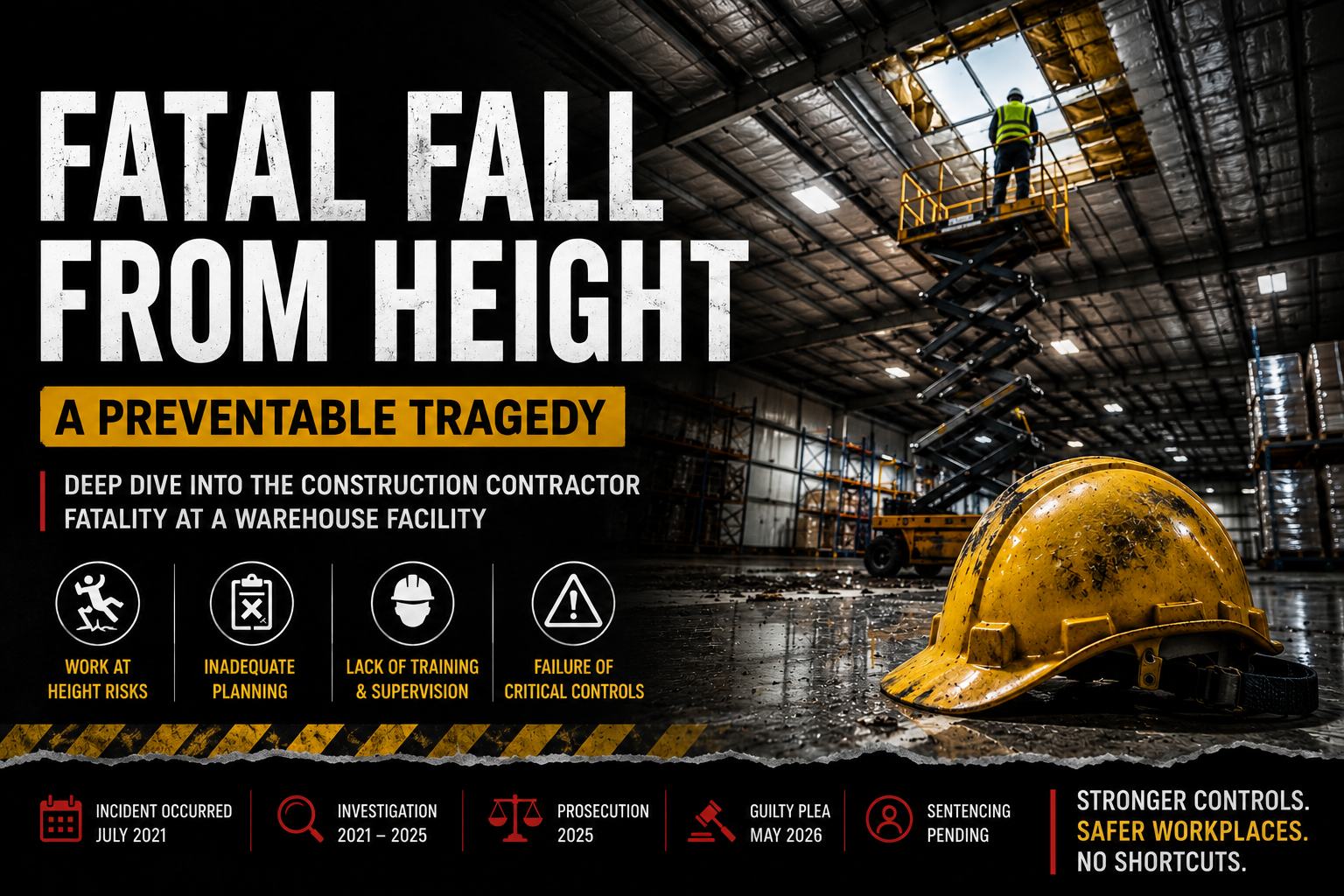
In May 2026, Risham Nominees Pty Ltd, trading as Centenary Bakehouse in Victoria, Australia, pleaded guilty to workplace manslaughter following the death of a contractor who fell approximately four metres while undertaking roof-related work at a warehouse facility. The prosecution represents one of the most significant workplace manslaughter cases to emerge under Victoria’s industrial safety laws and highlights how long serious workplace incidents can take to progress through investigation, enforcement, and court proceedings.
For safety professionals, the timeline alone is noteworthy.
The nearly five-year period between the fatality and guilty plea demonstrates the complexity of major workplace investigations, particularly where criminal liability is being considered. Investigators must examine physical evidence, organisational systems, supervision arrangements, planning documentation, witness testimony, and management decision-making before prosecutions can proceed.
Incident Overview
Court proceedings revealed that the company director had organised replacement works involving suspended insulation panels located approximately four metres above the warehouse floor. The task involved removing existing panels and replacing them with new sheeting materials.
The work reportedly required four workers, however one participant was unavailable. In an effort to complete the task, an additional worker was sourced informally through existing contacts and engaged to assist with the work despite having no formal qualifications for the task.
According to court evidence, the worker was provided with only general verbal instructions and was not given documented procedures, specific work-at-height guidance, or formal training relating to fall hazards. The worker subsequently fell approximately four metres and suffered fatal injuries.
Incident Analysis
Absent or Failed Defences
1. Failure to Eliminate the Work-at-Height Risk
The first failure appears to have occurred during planning.
Under the hierarchy of controls, organisations should first determine whether elevated work can be eliminated altogether. There is no indication alternative methods were explored before workers were exposed to fall hazards.
Potential alternative controls may have included:
Ground-level assembly methods
Elevated work platforms
Temporary engineered work platforms
Alternative installation sequencing
The work appears to have proceeded directly into a high-risk work environment without sufficient consideration of safer alternatives.
2. Absence of Effective Fall Protection
The most significant failed defence was the apparent absence of effective fall prevention systems.
Available information suggests:
No engineered fall prevention system was actively controlling the work area
No documented fall arrest arrangements were implemented
No evidence of a structured work-at-heights permit process
Available safety equipment was reportedly not being effectively utilised
In ICAM terminology, a critical risk control appears either absent, ineffective, or unenforced.
3. Inadequate Safe Work Method Planning
The work involved multiple recognised high-risk construction activities:
Elevated work
Material handling
Roof and ceiling modifications
Potential exposure to unprotected edges
Despite these hazards, evidence presented to the court suggests workers received only broad instructions to work safely and avoid falling.
A formal Safe Work Method Statement (SWMS) should have identified:
Fall hazards
Control measures
Rescue arrangements
Supervision requirements
Equipment requirements
Worker competency requirements
Individual and Team Actions
Worker Actions
There is no evidence that the deceased worker intentionally disregarded safety requirements.
Instead, available information suggests the worker was operating within the work environment established by management.
This distinction is important.
This incident analysis methodology focuses on understanding how systems shape worker behaviour rather than attributing incidents solely to frontline actions.
Supervisory Actions
Potential supervisory failures include:
Allowing work to commence without verifying controls
Failure to confirm worker competency
Failure to verify use of fall protection
Inadequate monitoring of work-at-height activities
The absence of structured supervision appears to have significantly increased exposure to risk.
Task and Environmental Conditions
Several workplace conditions likely increased vulnerability:
Informal Workforce Engagement
Court evidence revealed the worker was recruited informally after labour shortages emerged during planning.
Informal engagement often creates risks including:
Incomplete inductions
Unverified competencies
Limited understanding of site hazards
Reduced supervision
Production Pressure
A recurring factor in serious incidents is schedule pressure.
The decision to source an additional worker at short notice suggests maintaining progress on the task had become a priority.
While production pressure is rarely identified as the sole cause of an incident, it frequently influences decision-making that weakens critical controls.
Organisational Factors
Safety Leadership
The incident raises broader questions regarding safety leadership and governance.
Effective safety systems require leaders to ensure:
Hazards are systematically identified
Critical controls are verified
Workers are competent
High-risk work is supervised
The court proceedings suggest organisational systems were insufficiently mature to manage the risks associated with elevated work activities.
Contractor Management
One of the strongest lessons from this case relates to contractor management.
The worker was reportedly not a regular employee and had been brought into the task through informal arrangements.
Contractor management systems should ensure:
Competency verification
Formal onboarding
Role clarity
Supervision requirements
Safety accountability
Without these controls, organisations may inadvertently expose workers to hazards they are neither trained nor equipped to manage.
Latent Conditions
Several latent organisational weaknesses appear evident:
Latent Condition
Potential Outcome
Informal hiring practices
Unverified competency
Limited task planning
Inadequate hazard controls
Weak supervision
Unsafe work practices unchecked
Production priorities
Increased risk tolerance
Poor critical control verification
Fall hazards unmanaged
These conditions often exist long before an incident occurs and remain invisible until a serious event exposes them.
Root Cause Summary
Based on publicly available court information, the most likely root causes include:
Primary Causes
Failure to adequately control work-at-height risks
Absence of effective fall protection systems
Inadequate work planning
Failure to verify worker competency
Contributing Causes
Informal contractor engagement
Insufficient supervision
Weak safety governance
Potential production pressure influences
Recommendations for Industry
Organisations seeking to reduce the likelihood of similar incidents should consider the following controls:
No worker should be engaged for high-risk work through informal arrangements.
3. Introduce Critical Control Assurance Programs
Develop verification systems that actively confirm:
Guardrails remain installed
Harness systems are used correctly
Work platforms remain compliant
Controls remain effective throughout the task
4. Improve Safe Work Method Statement Quality
SWMS documentation should move beyond compliance paperwork and become practical task-planning tools.
Focus areas should include:
Critical risks
Control verification
Changing conditions
Escalation pathways
5. Reinforce Stop-Work Authority
Workers must be empowered to stop work immediately when:
Fall protection is absent
Conditions change
Hazards become uncontrolled
Instructions are unclear
6. Conduct Leadership Field Verification
Safety leaders should routinely verify critical controls in the field rather than relying solely on documentation.
Direct observation remains one of the strongest predictors of effective risk management.
Final Reflection
The Centenary Bakehouse case is not simply a story about a worker falling four metres.
It is a reminder that workplace fatalities are often the final outcome of decisions made days, weeks, or months before an incident occurs.
The most striking lesson may be the timeline itself.
A worker lost his life in July 2021.
The guilty plea occurred in May 2026.
Nearly five years separated the incident from the prosecution.
For organisations, that serves as a powerful reminder that safety decisions made today may be scrutinised years into the future. More importantly, it reinforces that critical risk controls must be treated as non-negotiable long before investigators, regulators, or courts become involved.
Disclaimer
This analysis is provided for educational and professional discussion purposes only. It is based on publicly available court reporting, regulatory information, and presumed industry-standard conditions. It does not represent official findings beyond those presented in court proceedings and should not be relied upon as a legal determination of liability, causation, or regulatory compliance.